Vestibular Issues and Balance
A scientific examination of vestibular function, balance, sensory processing differences and everyday experiences in autistic people.
Introduction
Balance is a complex neurological function that allows the body to remain upright, coordinate movement and maintain spatial orientation. The vestibular organs of the inner ear contribute information about head movement and gravity. The brain integrates these signals with vision and proprioception, the sense of limb and body position. Some autistic people experience movement sensitivity, balance difficulties or strong preferences for particular kinds of movement. These experiences vary widely, and a balance problem should not automatically be attributed to autism. Inner-ear disorders, neurological conditions, visual difficulties and medication effects can produce similar symptoms.
1. What Is the Vestibular System?
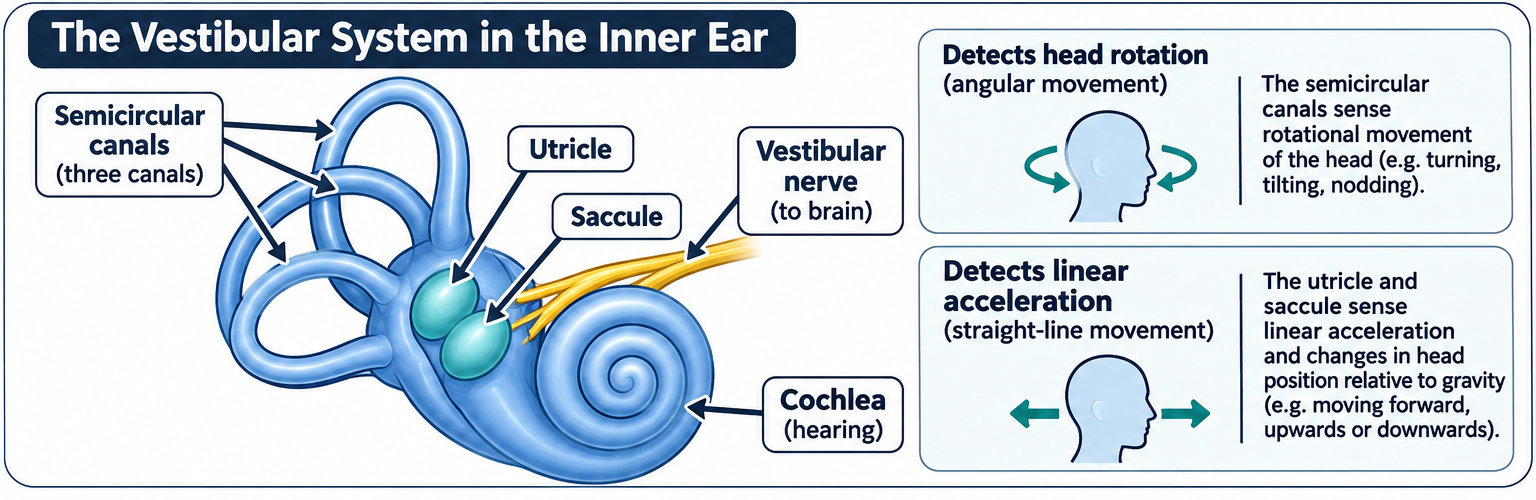
The vestibular system is a specialised sensory system located in the inner ear, close to the cochlea, which supports hearing. Each ear contains three semicircular canals and two otolith organs: the utricle and saccule. The semicircular canals detect angular acceleration, including head turning and nodding. Movement of fluid within the canals deflects sensory hair cells, which transmit signals through the vestibular nerve. The otolith organs detect linear acceleration and head orientation relative to gravity. Their sensory surfaces contain calcium carbonate crystals called otoconia. Together these organs provide complementary information about movement and orientation.
2. How the Brain Maintains Balance
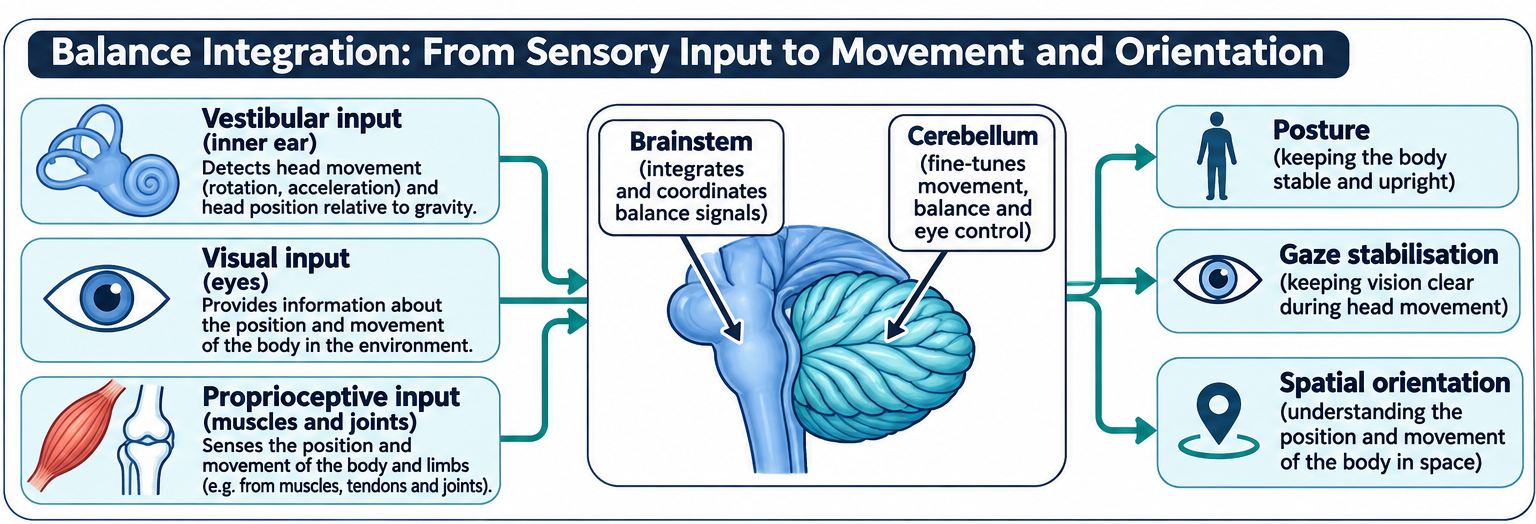
Balance depends on the integration of vestibular information, vision and proprioception. Vision provides information about the position and apparent movement of the surroundings. Proprioceptive receptors in muscles, tendons and joints indicate the position and movement of limbs and the body. The brainstem and cerebellum help combine these signals and coordinate postural responses, while other brain networks contribute to conscious spatial awareness. The nervous system adjusts the relative importance of different sensory signals as circumstances change, a process often termed sensory reweighting. In darkness, vision becomes less informative; on an unstable surface, signals from the feet and ankles may become less reliable.
3. Vestibular Processing Differences in Autism
Sensory differences are recognised features of autism, but vestibular experiences are not uniform. Some individuals find motion unusually uncomfortable or disorientating, while others enjoy rocking, swinging, spinning or bouncing. The terms vestibular hypersensitivity and hyposensitivity are sometimes used to describe these patterns, but preferences or behaviour alone do not establish that vestibular organs are overactive or underactive. Research has found differences in postural control, motor coordination and sensory integration in some autistic groups, although results vary. These findings do not demonstrate that every autistic person has a vestibular disorder. Motor planning, attention, proprioception, anxiety and co-occurring developmental coordination difficulties can also influence balance.
4. Vestibular Function and Proprioception
The vestibular system detects head movement, acceleration and orientation relative to gravity. Proprioception provides information about the position and movement of the limbs and body. When an individual bends to pick up an object, vestibular signals describe changes in head orientation while proprioceptive signals describe movements of the knees, hips, back and arms. The brain combines these with visual information to maintain stability. Some autistic people report bumping into furniture, misjudging distances or feeling uncertain about body position. Such experiences may involve proprioception, visual-spatial processing, motor planning or balance; they should not be assigned automatically to a single sensory system.
5. Vestibular Differences in Everyday Activities
Walking and uneven surfaces
Gravel, uneven pavements, slopes and slippery ground require frequent postural adjustments. An individual with balance difficulties may move cautiously, watch the ground closely or avoid unfamiliar terrain.
Stairs and escalators
Stairs require depth judgement and coordinated weight transfer. Moving escalator steps add timing and visual-motion demands that some individuals find unsettling.
Public transport
Acceleration, turning and vibration stimulate the vestibular system. Reading while travelling can aggravate motion sickness when the eyes focus on a relatively stationary page while the inner ear detects movement.
Supermarkets and shopping centres
Bright lighting, repeated visual patterns, moving crowds and reflective surfaces may cause sensory overload or visually induced dizziness. Similar symptoms can occur in vestibular migraine and persistent postural-perceptual dizziness.
Photography and outdoor activities
Looking upwards, bending, turning rapidly or standing on rocky ground can challenge balance. Stopping before using a smartphone camera, selecting stable footing and avoiding the edges of water are sensible precautions.
6. The Vestibulo-Ocular Reflex: Keeping Vision Stable
The vestibulo-ocular reflex (VOR) helps stabilise vision when the head moves. If the head turns left, the eyes make a compensatory movement towards the right, helping maintain fixation on an object. When gaze stabilisation is impaired, the environment may appear to bounce or move during walking or head movement. This symptom is called oscillopsia. It may indicate a vestibular disorder and should not be presumed to result from autism.
7. Balance, Anxiety and Fear of Falling
Repeated dizziness, uncertainty or falls can create anxiety about movement. Individuals may avoid escalators, public transport or unfamiliar paths because these settings feel unsafe. Anxiety can increase vigilance and bodily tension, potentially intensifying discomfort, but it must not be assumed to be the original cause. Genuine vestibular conditions can produce severe distress. Autistic people may also find it difficult to describe unfamiliar bodily sensations, so clinicians should investigate reported discomfort rather than dismissing it as behavioural.
8. Vestibular Difficulties During Childhood
Children use vestibular, visual and proprioceptive information when learning to sit, stand, run, jump and climb. Some autistic children show differences in coordination or postural stability. Avoiding swings or climbing frames may reflect discomfort or uncertainty, while seeking rocking and spinning may provide enjoyable and predictable sensory input. Neither pattern by itself diagnoses a vestibular abnormality. Persistent dizziness, frequent falls or significant movement difficulties may justify assessment by a GP, paediatrician, audiologist, physiotherapist or occupational therapist. Explanations, choice and gradual introduction are preferable to forcing distressing activities.
9. Vestibular Differences in Autistic Adults
Adults may develop compensatory habits such as holding handrails, avoiding moving stairways, choosing familiar routes or walking cautiously on uneven surfaces. These strategies may conceal difficulties from observers but require additional attention and effort. Balance demands can combine with social interaction, sensory overload and masking to increase fatigue. New or worsening symptoms should not be assumed to represent an inevitable feature of ageing or autism; other medical explanations must be considered.
10. Vestibular Disorders That Should Not Be Confused With Autism
Benign paroxysmal positional vertigo (BPPV)
Displaced otoconia within a semicircular canal can cause brief spinning vertigo when the head changes position, for example when rolling over in bed.
Vestibular migraine
This condition can cause episodes of vertigo, dizziness, visual sensitivity and motion intolerance, sometimes without a headache.
Vestibular neuritis
Dysfunction of the vestibular nerve may cause sudden prolonged vertigo, nausea and difficulty walking.
Persistent postural-perceptual dizziness (PPPD)
PPPD involves persistent dizziness or unsteadiness that is often aggravated by upright posture, movement and visually complex settings. These conditions require individual clinical assessment and should not be dismissed as autistic sensory preferences.
11. Assessment of Balance Difficulties
Assessment begins by establishing whether the sensation is spinning, light-headedness, unsteadiness, nausea or visual disturbance, and identifying triggers and duration. Examination may include gait, eye movements, hearing, balance and neurological function. Specialist vestibular tests may be appropriate. Autistic patients may benefit from clear explanations, predictable procedures, sensory adjustments and extra processing time. Sudden imbalance accompanied by weakness, facial drooping, speech disturbance, double vision, severe new headache or inability to walk requires urgent medical attention.
12. Support and Management
Vestibular rehabilitation
Specialist physiotherapy may help selected vestibular conditions through individually prescribed gaze-stabilisation and balance exercises. Assessment is important because treatment differs by diagnosis.
Occupational therapy
Occupational therapists may help identify sensory and environmental demands and support practical adjustments. Evidence for sensory-based interventions in autism varies; claims that particular exercises correct autism-related vestibular processing should be treated cautiously.
Environmental changes
Quieter shopping times, handrails, predictable routes, stable seating, reduced visual complexity and time to recover may improve participation.
Movement choice and pacing
Predictable movement under personal control is often more tolerable. Individuals should be able to pause or stop activities that cause discomfort. Support should promote autonomy, safety and confidence rather than compulsory tolerance of distress.
13. Understanding Individual Vestibular Experiences
Balance-related discomfort can be invisible. A person who avoids an escalator or walks slowly may be responding to genuine instability rather than unwillingness. Likewise, someone who enjoys rocking may be using movement for comfort or self-regulation. Respectful support begins by listening to the individual’s description, recognising differences between sensory preference and disease, and investigating persistent or unusual symptoms.
14. Conclusion: Understanding Balance Beyond the Inner Ear
Balance is not simply the ability to remain standing. It results from ongoing cooperation between vestibular organs, vision, proprioception and neural networks responsible for posture, gaze stability and spatial orientation. Some autistic people experience differences in movement sensitivity or postural control, but there is no single vestibular profile shared by all autistic individuals. Appropriate assessment, reasonable adjustments, predictable environments and respect for personal preferences can support independence and wellbeing.
Scientific References and Further Reading
Access to some publications may require a subscription or payment to the respective academic journal or publisher. Availability and charges should be checked directly with the publisher.
- National Institute on Deafness and Other Communication Disorders (NIDCD). Balance Disorders.
- NHS. Vertigo.
- Fournier, K. A., Hass, C. J., Naik, S. K., Lodha, N., & Cauraugh, J. H. (2010). Motor coordination in autism spectrum disorders: A synthesis and meta-analysis. Journal of Autism and Developmental Disorders.
- Minshew, N. J., Sung, K., Jones, B. L., & Furman, J. M. (2004). Underdevelopment of the postural control system in autism. Neurology.
This article provides educational information and does not replace professional medical advice, diagnosis or treatment.