Autistic Meltdowns: Causes, Experiences and Support Across the Lifespan
A comprehensive examination of autistic meltdowns across childhood, adolescence and adulthood, including internal experiences, stress physiology, communication difficulties, and practical support.
1. Introduction
An autistic meltdown is an intense, involuntary response to overwhelming emotional, sensory, cognitive or environmental demands. It can occur when an autistic person’s capacity to process and manage those demands has been exceeded, leaving them temporarily unable to maintain their usual level of emotional and behavioural regulation.
Meltdowns are frequently misunderstood, particularly when they involve shouting, crying, agitation, anger or behaviour that other people perceive as unreasonable. A meltdown is not simply a temper tantrum, deliberate misbehaviour or an attempt to manipulate another person. It is better understood as overwhelming distress during which emotional regulation and communication may be significantly impaired.
Meltdowns can occur throughout life. An observer may see anger or argument, while the person experiences fear, confusion, helplessness, frustration or an inability to communicate. For some individuals, thoughts, words and actions seem no longer to work together as they ordinarily would.
2. What Causes an Autistic Meltdown?
There is rarely one universal cause. Sensory overload, emotional demands, social expectations, communication difficulties, fatigue, uncertainty, unexpected changes, pain and perceived loss of control may interact and progressively reduce a person’s capacity to cope.
Sensory overload
Bright lights, competing conversations, movement, smells and background noise may be uncomfortable or overwhelming. A supermarket, for example, combines multiple demands that may be manageable individually but exhausting together.
Emotional and cognitive overload
Being required to answer immediately, resolve an argument, process several voices, make decisions without sufficient information or explain a concern while distressed may exceed the person’s available capacity. Understanding the problem is not the same as being able to communicate a response under pressure.
Fatigue and cumulative stress
Masking autistic characteristics, interpreting social expectations and tolerating sensory discomfort may require sustained mental effort. An apparently minor incident may become the final demand after many hours of accumulated stress. The immediate trigger is not necessarily the underlying cause.
3. The Importance of Control, Predictability and Autonomy
For some autistic people, feeling unable to influence a situation is especially distressing. This need not mean wanting to control other people; it can mean needing predictability, meaningful choice and a clear understanding of what is happening. Unexpected decisions, feeling trapped in an argument, having concerns dismissed or being unable to withdraw may heighten anxiety.
A possible escalating cycle is: perceived loss of control → increasing anxiety → difficulty organising thoughts and speech → frustration at being misunderstood → further escalation and possible meltdown. This is an illustrative description of some lived experiences, not a universal scientific sequence. Genuine choices, time to respond and permission to pause can reduce the feeling of being trapped.
4. What an Autistic Person May Experience Before a Meltdown
Some individuals recognise a build-up of tension, irritability, sensory sensitivity or difficulty concentrating. Others experience little or no identifiable warning. Stress may have accumulated without being consciously recognised.
Possible experiences include racing thoughts, heightened sensitivity, pressure to resolve a problem immediately, increased heart rate, muscle tension, shaking and increasing difficulty finding words. Differences in recognising internal bodily signals may make warning signs less apparent for some people. The absence of warning does not mean the person chose not to intervene.
5. Racing Thoughts, Communication Breakdown and Escalating Frustration
Some autistic adults describe an especially distressing discrepancy between what they intend to say and what they actually say. Several thoughts and emotional reactions may compete for attention. An intended explanation that a situation feels overwhelming or beyond the person’s control may emerge as an abrupt statement or accusation. The listener may respond defensively to the words spoken rather than the intended meaning.
The autistic person then becomes more frustrated because the original concern has not been understood. Further attempts to explain may produce additional misunderstandings, fuelling the meltdown. This does not necessarily mean the person lacks insight: they may recognise that their words are inaccurate but temporarily be unable to correct them.
Families can help by reducing questions, avoiding arguments about exact wording, acknowledging communication difficulty and agreeing to return to the issue later. A statement such as “There is no need to explain everything now. We can discuss it when things feel easier” can remove immediate pressure.
6. What Happens in the Brain Before, During and After a Meltdown?
Neurological and physiological research can help explain why communication, emotional regulation and decision-making become difficult under stress. There is not yet a single established brain-activity or chemical signature unique to autistic meltdowns. The following account draws on wider evidence about stress physiology, emotional regulation and sensory processing.
6.1 The Brain’s Response to Perceived Threat
The brain continuously evaluates information from the environment and body, helping assess whether circumstances are safe, predictable, demanding or potentially threatening. Several interconnected regions are relevant:
The amygdala contributes to detecting emotionally significant events, including potential threats. Its role is broader than fear alone.
The prefrontal cortex supports planning, decision-making, attention, impulse regulation and organising behaviour.
The anterior cingulate cortex contributes to attention, monitoring conflict and regulating responses when competing demands arise.
The insula helps integrate bodily sensations with emotional awareness, including changes in heartbeat, breathing and discomfort.
The hypothalamus helps coordinate physiological stress responses, including autonomic activity and hormonal pathways.
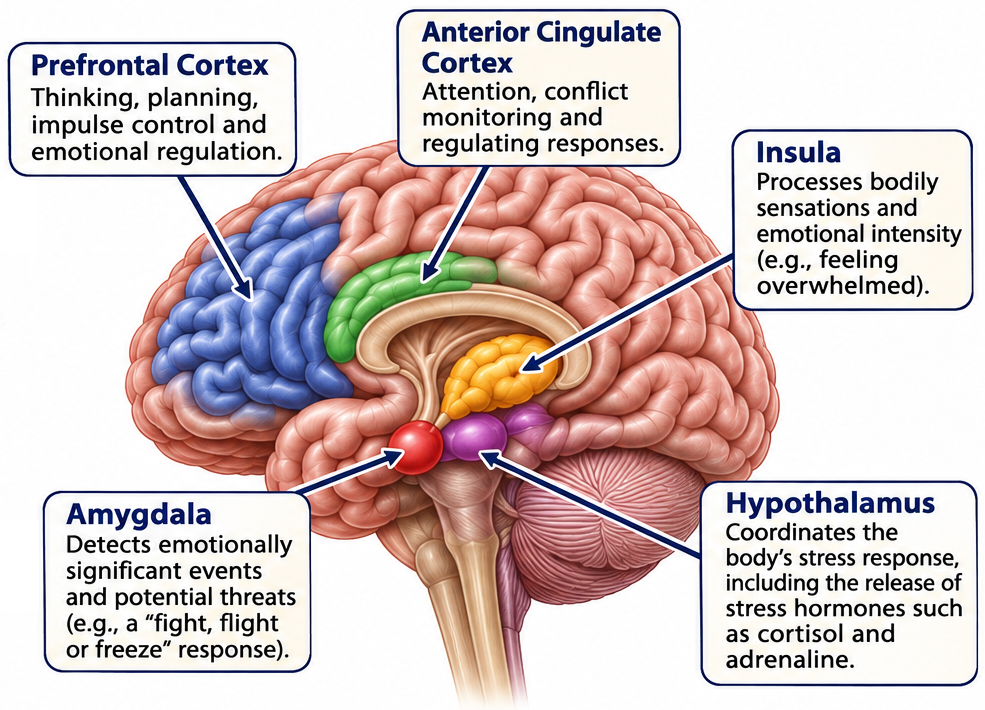
These regions operate as interconnected networks, not independent switches. Research suggests that differences in emotional reactivity and regulation may contribute to distress in some autistic people, but experiences vary substantially.
6.2 The Autonomic Nervous System
The autonomic nervous system regulates heartbeat, breathing, sweating and digestion. Its sympathetic branch prepares the body to respond to demanding situations. Stress may increase heart rate, breathing, muscle tension, sweating and alertness. Fight-or-flight is a useful shorthand, but responses may also include freezing and withdrawal.
6.3 Adrenaline and Noradrenaline
Adrenaline and noradrenaline contribute to alertness and rapid bodily responses to stress. Their effects may be associated with agitation, urgency and the sensation that the body is responding faster than thoughts can be organised. However, it has not been demonstrated that every autistic meltdown results from excessive adrenaline.
6.4 Cortisol and the Stress Response
Cortisol helps regulate metabolism, energy and stress responses. Its release is influenced by the hypothalamic-pituitary-adrenal (HPA) axis and generally develops more slowly than the immediate sympathetic response. Studies of cortisol in autism have produced mixed findings. There is no established pattern of too much or too little cortisol that explains all meltdowns.
6.5 Glutamate and GABA
Glutamate is a major excitatory neurotransmitter and GABA a major inhibitory neurotransmitter. Both are involved in the regulation of neural activity. Research has investigated excitation-inhibition differences in autism, but it would be inaccurate to claim that a meltdown is caused by a sudden excess of glutamate or lack of GABA. Their precise involvement in individual meltdowns remains uncertain.
6.6 Why Thinking and Speaking Can Become Difficult
Intense arousal can interfere with attention, working memory and executive functions. An individual may simultaneously be trying to remember the original disagreement, interpret another person’s response, regulate distress, choose words and predict how those words will be received. The result may be a substantial gap between the intended message and the spoken response. This should not automatically be mistaken for deliberate aggression or unwillingness to communicate.
6.7 What Happens After the Meltdown?
As immediate stress diminishes, physiological systems generally move towards recovery, but this can take time. Exhaustion, headaches, muscle tension, difficulty concentrating, sadness, embarrassment and a need for sleep may follow. The visible end of a meltdown does not necessarily mean full recovery. There is no scientifically established timetable for particular chemicals to return to baseline after an autistic meltdown.
7. Autistic Meltdowns in Children
Children are still developing the language, emotional awareness and cognitive skills needed to explain distress. Meltdowns may involve crying, screaming, agitation or attempts to escape, and should not automatically be interpreted as defiance. Noise, clothing, school transitions, changes in routine, hunger, tiredness and communication difficulties can contribute.
Why difficulties may appear after school
A child may appear settled at school yet experience a meltdown shortly after returning home. They may have spent hours managing sensory discomfort, suppressing self-regulating behaviours, following social expectations and masking distress. Home may be the first environment in which the accumulated strain becomes visible. Sometimes called after-school restraint collapse, this is a descriptive phrase rather than a medical diagnosis. Fatigue, physical needs and school stress may also contribute.
A predictable transition home, quiet time, food or drink, comfortable clothing and fewer immediate questions may help. Schools should work with families to reduce the demands causing distress rather than expecting the child simply to suppress it.
8. Autistic Meltdowns in Adolescents
Adolescents encounter puberty, changing relationships, examinations, identity concerns, greater independence and peer pressure. These demands may interact with sensory differences, anxiety, sleep disruption and masking. Restrictions imposed without explanation or unexpected changes may feel particularly threatening to personal autonomy.
Collaborative decision-making, genuine choices, agreed quiet spaces, written communication, predictable plans and suitable psychological support can help. The adolescent’s growing independence should be respected, and meltdowns should not automatically be treated as disciplinary incidents.
9. Autistic Meltdowns in Adults
Meltdowns do not necessarily disappear with age. Employment, relationships, travel, family responsibilities and continual social expectations can create cumulative stress. Adults may mask successfully in public and become overwhelmed at home, where they have fewer resources left for regulation.
For some, racing thoughts and unintended speech are especially difficult. The person may feel that what they say is not what they mean, while repeated attempts to correct misunderstandings intensify frustration. Others have almost no identifiable warning. Stress may have accumulated unnoticed, and recognising bodily signals may be difficult.
Close relationships may be strained when distressed speech is perceived as intentional hostility. The involuntary nature of meltdowns deserves understanding, while the safety and feelings of others also matter. Repairing misunderstandings is generally more productive after recovery, not during peak distress.
10. How Meltdowns May Differ Across the Lifespan
| Aspect | Children | Adolescents | Adults |
|---|---|---|---|
| Typical pressures | School, sensory demands, transitions | Peers, examinations, independence | Work, relationships, cumulative stress |
| Communication | May struggle to explain distress | May struggle with intense or conflicting emotions | May experience racing thoughts or unintended speech |
| Masking | May suppress distress at school | May mask to fit in socially | May mask in professional and social settings |
| Support | Predictability, sensory adjustments, co-regulation | Autonomy, collaborative planning, flexible communication | Reduced demands, respect for independence, recovery time |
These are broad patterns, not rules. Support must be based on individual needs rather than age-based assumptions.
11. What Families and Carers Can Do During a Meltdown
The immediate priorities are safety, reduced distress and recovery—not winning an argument or obtaining an explanation.
Remain calm and reduce demands
Use a quiet voice, brief statements and minimal questions. “You are safe”, “There is no need to answer now” or “We can discuss this later” may help when appropriate and truthful.
Do not argue about exact words
When intended speech and spoken words diverge, challenging the wording may worsen frustration. Pause the conversation and revisit it when communication becomes easier.
Reduce sensory stimulation
Where possible, reduce noise and glare, move other people away and provide access to a quiet space. Avoid unexpected touch; some people welcome it, while others find it distressing.
Restore meaningful choice
Offer one or two manageable options, such as whether the person wants space or a trusted person nearby. Avoid overwhelming them with numerous questions.
Allow recovery and protect safety
Some people prefer solitude; others prefer quiet companionship. Remove hazards if necessary. Physical restraint should never be used simply to enforce compliance and any emergency response must be lawful, necessary and proportionate.
12. Interventions to Reduce the Frequency and Severity of Meltdowns
Identify patterns: A simple record of preceding events, sensory conditions, sleep, pain, emotional demands and recovery may reveal modifiable contributors. The purpose is understanding, not blame.
Reduce cumulative stress: Plan quiet periods after demanding activities, avoid overloading schedules and recognise recovery time as a legitimate need.
Offer communication alternatives: Text messages, writing, communication cards or an agreed signal to stop talking may reduce the pressure to explain distress verbally.
Consider adapted psychological support: Individualised approaches, including adapted cognitive behavioural therapy and emotional-regulation strategies, may help some autistic people. Their aim should be wellbeing and autonomy, not simply concealing distress more effectively.
Assess other health factors: Pain, illness, poor sleep, medication effects, anxiety and depression can reduce coping capacity. Increasingly frequent or unusually severe meltdowns warrant appropriate assessment. Medication is not a routine treatment for meltdowns themselves.
13. Developing an Individual Meltdown Support Plan
A plan developed while the person is calm can identify known triggers, any early signs, preferred responses, communication methods, safety considerations, recovery needs and how later discussion should take place. It should explicitly acknowledge when the person has little warning.
For an adult who experiences racing thoughts and unintended speech, an especially useful agreement may be that a conversation can stop as soon as communication begins to deteriorate, without requiring the person to explain why they need a pause.
Downloadable Individual Meltdown Support Plan
To assist autistic individuals, their families, carers and those providing support, an editable Individual Meltdown Support Plan template is available. It provides a structured means of recording possible triggers, communication preferences, helpful responses, safety considerations, recovery needs and relevant contact information.
Important information: This template is provided for general guidance only and has not been clinically assessed or approved. It is not a formal clinical document and must not replace professional advice, existing care plans or emergency procedures. Use is entirely at the discretion of the individual or those supporting them.
Download the Individual Meltdown Support Plan (editable Microsoft Word document)
14. Recovery and the Importance of Understanding
After a meltdown, exhaustion, emotional sensitivity and regret may persist. Immediate questioning or demands for an apology may prolong distress. Allow recovery before discussing what happened. Later conversations should consider both the autistic person’s experience and the effects on family members, with a shared aim of reducing future harm and misunderstanding.
15. Conclusion
Autistic meltdowns involve complex emotional, sensory, cognitive and physiological processes. Their outward appearance may conceal profound internal distress. Perceived loss of control, accumulated fatigue, racing thoughts and difficulty expressing intended words may contribute to escalation.
Scientific research helps explain the broader roles of emotional regulation and stress physiology, but the precise chemical pattern of an individual meltdown remains uncertain. The most constructive response is not to demand greater self-control at the moment when control has become most difficult, but to provide safety, understanding, meaningful choice and the adjustments that support recovery.
References and Further Reading
The following are links to scientific literature, books and professional guidance. Some publications may require library access.
- Mazefsky (2014), Emotion Regulation: Concepts & Practice in Autism Spectrum Disorder.
- Mazefsky et al. (2013), The Role of Emotion Regulation in Autism Spectrum Disorder.
- Assessment and Treatment of Emotion Regulation Impairment in Autism Spectrum Disorder Across the Life Span (2020).
- Stress System Activation in Children and Adolescents With Autism Spectrum Disorder (2022).
- Interoception in Autism: A Narrative Review of Behavioral and Neurobiological Data (2024).
- Systematic Review: Emotion Dysregulation and Challenging Behavior Interventions for Children and Adolescents with Autism (2023).
- Hull et al. (2017), “Putting on My Best Normal”: Social Camouflaging in Adults with Autism Spectrum Conditions.
- Made to Feel Different: Families’ Perspectives on External Responses to Autism (2024).
- Attwood (2006), The Complete Guide to Asperger’s Syndrome, Jessica Kingsley Publishers (historical diagnostic terminology).
- Bogdashina (2016), Sensory Perceptual Issues in Autism and Asperger Syndrome.
- National Autistic Society: Meltdowns.
- NICE CG142: Autism Spectrum Disorder in Adults.
- NHS inform: Supporting an Autistic Person.
Important: This educational article is not a substitute for individual medical or psychological assessment. Stress-related chemical mechanisms are discussed as relevant background, not as proven causes of every meltdown. Seek professional advice where episodes are worsening, involve injury or cause significant difficulties.