Understanding Autism and Communication
1. Introduction
Communication enables people to share information, express needs and preferences, build relationships and participate in everyday life. It involves more than speech: people must also understand what others mean, decide how to respond and have an accessible way to express themselves.
Autistic people communicate in many different ways. Some use fluent speech or writing but find indirect language, rapid exchanges or unspoken social expectations difficult to navigate. Others use gestures, signs, pictures, symbols or communication technology. A person’s preferred method may also change with the setting or the demands of the moment.
Fluent speech does not guarantee that communication is easy, just as limited or absent speech does not imply limited understanding. The central question is whether information can be exchanged in a way that works for the individual.
2. Communication Across the Autism Spectrum
Autistic people have different communication abilities, preferences and support needs. Some communicate fluently through speech or writing but experience difficulties interpreting indirect language, recognising facial expressions or processing information during conversations. Others may communicate using gestures, pictures, symbols, signing or Augmentative and Alternative Communication (AAC). 1, 3
An individual’s ability to communicate may also change according to their environment, emotional state, sensory experiences and the demands placed upon them. Someone who communicates confidently in familiar surroundings may experience considerable difficulties in a busy, unfamiliar or stressful situation.
The UK Diagnostic Approach
In the United Kingdom, autism is generally diagnosed through a clinical assessment rather than by routinely assigning individuals to Levels 1, 2 or 3. Instead, emphasis is placed on identifying each person’s individual strengths, difficulties and support needs, including their communication requirements. 1
Communication Needs and Support in the UK
Communication support should reflect the individual’s abilities, preferences and circumstances rather than assumptions based on their diagnosis or apparent communication skills.
Communication needs may be identified through assessments involving speech and language therapists (SALT), healthcare professionals, educational services and other relevant specialists. Depending on the individual’s circumstances, support may include clear verbal instructions, additional processing time, Easy Read information, visual aids, communication boards, signing systems or AAC. 1, 6
In education, healthcare, employment and public services, reasonable adjustments may include providing information in alternative formats, allowing written responses instead of spoken answers, and adapting appointments or meetings to accommodate individual communication needs. 1, 2
The fundamental principle is that communication should be accessible to the individual, with responsibility shared between the autistic person and those communicating with them.
3. Understanding and Expressing Information
Communication has two connected aspects: understanding information (receptive communication) and expressing information (expressive communication). These abilities do not always develop or operate in the same way. Someone may understand a question but need time or a different method to answer; another person may speak readily yet struggle to follow a lengthy explanation. 1
Literal Interpretation
Some autistic people interpret words more literally or find vague instructions difficult to act upon. “We will sort that out later”, for example, gives little indication of what will happen or when. “We will discuss this at 2 pm” is more specific. Literal interpretation varies between individuals and should not be assumed in every autistic person. 3
Processing Time
A spoken question may require time to identify its meaning, consider the context and formulate a response. Rapidly repeating or rephrasing the question can make this harder. A pause, a clear written version or an opportunity to respond later may support more accurate communication. 1
Non-Verbal Communication
Eye contact, gestures, facial expressions, posture and tone of voice can convey meaning, but autistic and non-autistic people may use and interpret these signals differently. A person looking away may be concentrating rather than disengaged; a neutral expression or unusual tone should not automatically be taken as indifference or rudeness. Asking for clarification is more reliable than interpreting behaviour without checking. 3
4. Sensory and Information Overload
Communication becomes harder when several sources of information compete for attention. In a shopping centre, for example, conversations, public announcements, advertising screens and phone notifications may overlap, making it difficult to follow what one person is saying. 1
Information overload can also occur without noise. A lengthy report, several instructions delivered at once or a fast-moving meeting may make it difficult to identify key points and formulate a response. This is a problem of how information is presented and processed, not necessarily of understanding the subject itself. 1
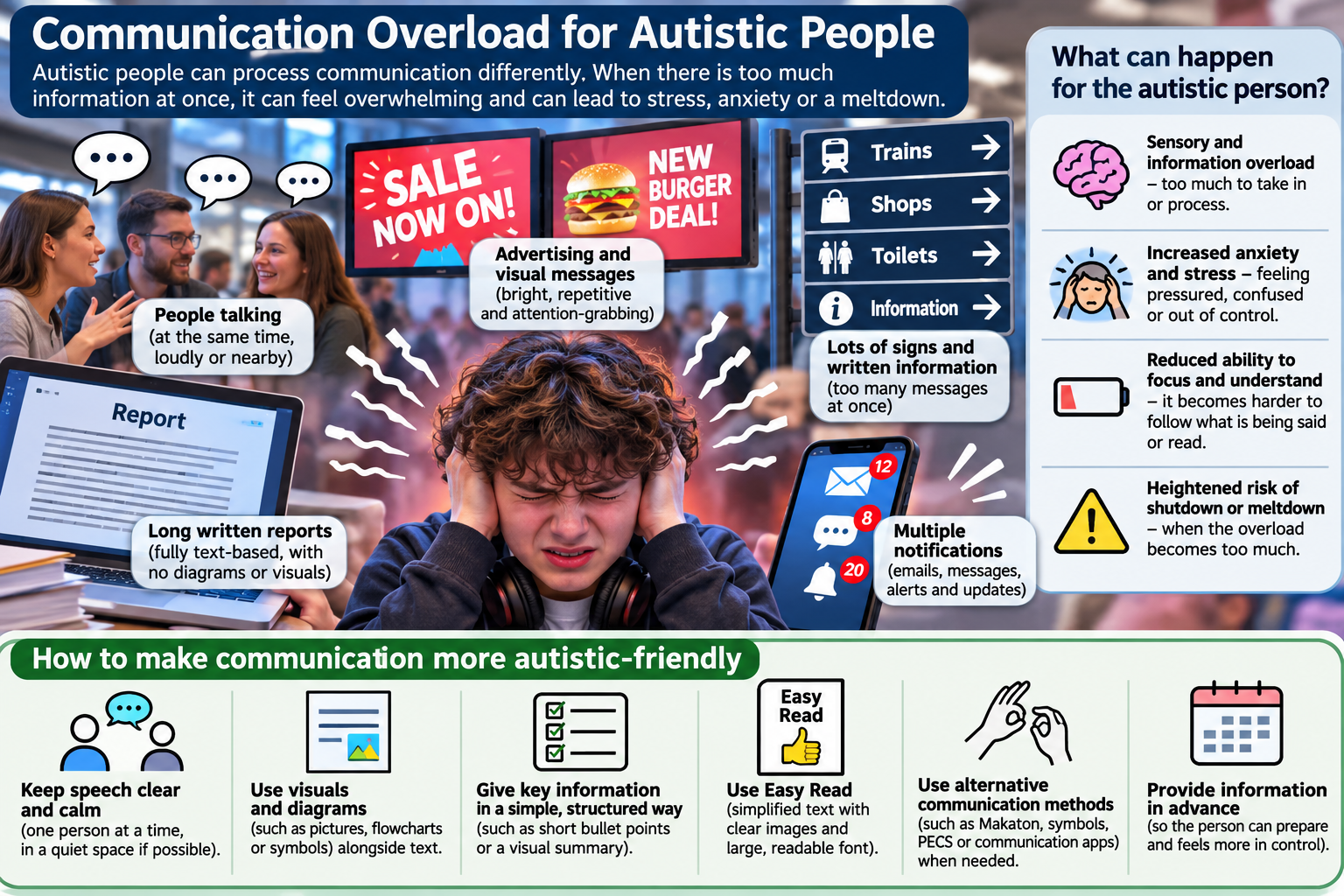
Select the image to open the full-size version in a new tab.
The Consequences of Overload
When demands exceed a person’s capacity to process them, they may lose track of a conversation, struggle to find words, respond more slowly or need to stop communicating for a time. In more overwhelming situations, a shutdown or meltdown may occur. These responses are not deliberate failures to cooperate. 1
Reducing Information Overload
Communication can be made easier by limiting competing demands, presenting one point at a time, providing concise written summaries and allowing the person to choose how and when to respond. Visual information helps some people; others prefer detailed text or speech. The useful adjustment is the one that works for that individual. 1
5. Masking and Communication Fatigue
Masking, or camouflaging, involves adapting communication to meet other people’s social expectations. An autistic person may rehearse replies, imitate conversational styles, monitor their tone or attempt eye contact even when these behaviours require conscious effort. 5
Some autistic people avoid looking directly at faces because eye contact feels uncomfortable or distracting. This may mean they do not see subtle changes in expression. Others see an expression but have difficulty interpreting the emotion it conveys, sometimes described as a difficulty with facial emotion recognition (FER). These experiences are different and neither applies to everyone. FER difficulties should also be distinguished from alexithymia, which concerns difficulty identifying and describing emotions, particularly one’s own. 3
A conversation may therefore involve several simultaneous tasks: following the words, interpreting their meaning, preparing a reply and monitoring how that reply is delivered. Sustaining this effort can make communication tiring even when the exchange appears successful. 5
An apparently confident conversation should not be taken as evidence that no support is needed. Accepting reduced eye contact, giving space for a reply and allowing different ways of participating can reduce the pressure to mask.
6. Communication Breakdowns and Mutual Understanding
Communication misunderstandings can work in both directions. An autistic person may find an indirect request confusing, while a non-autistic person may misinterpret a direct answer as impolite. The “double empathy problem”, associated with Damian Milton, highlights how people with different communication styles may misunderstand one another without either intending offence. 4
The Importance of Mutual Adaptation
The solution is not to expect autistic people alone to change how they communicate. Both parties can check meaning, state expectations clearly and avoid judging intentions from eye contact, tone or conversational style. 4
Shutdowns and Meltdowns
During overwhelming situations, an autistic person may become less responsive, temporarily unable to speak or unable to manage further questions. If communication is no longer possible in the usual way, reducing demands, offering a quieter space and allowing recovery are generally more helpful than pressing for an immediate explanation. A preferred written, visual or AAC method may still be useful, but should not be imposed. 3
7. Making Communication Accessible
Accessible communication means enabling someone both to receive information and to express their own views. The appropriate approach may involve plain language, Easy Read, written messages, pictures, signing, communication boards or AAC. These methods serve different purposes and are not interchangeable. 1, 7
The people and services involved in a conversation share responsibility for making it accessible. This includes checking the person’s preferred method, allowing meaningful choices and respecting the right to disagree or decline. Communication support should make participation possible, not simply encourage an appearance of compliance. 1, 2
The companion essay, “Communication Methods and Practical Support”, examines 26 approaches in greater detail, including when each may help and what limitations should be considered.
8. The Author’s Experience
Developing Language and Communication Skills
During adolescence, the author regularly read The Economist magazine to develop a better understanding of written English and broaden their vocabulary. Initially, the language and sentence structures were challenging. However, through sustained reading over approximately a year, the author noticed a considerable improvement in their vocabulary and ability to understand and use more complex language.
This experience illustrates how communication skills can develop through deliberate learning and practice. It also demonstrates that difficulties experienced during adolescence do not necessarily reflect an individual’s eventual communication abilities.
Communication in the Military
During military service, the author was frequently required to prepare and deliver presentations to audiences of up to 200 soldiers. These presentations demanded considerable preparation, including understanding the audience, organising information logically, preparing diagrams and visual materials, and ensuring that the presentation remained within the allotted time.
Although the author became accustomed to addressing large audiences, maintaining direct eye contact was uncomfortable. Instead, the author generally concentrated on the back of the room rather than looking directly at individual members of the audience. This allowed attention to remain focused on delivering the information without the additional demands associated with interpreting facial expressions and audience reactions.
Despite being able to deliver these presentations successfully, the concentration required was mentally exhausting. Afterwards, the author frequently needed a period of rest to recover.
One aspect of military communication that particularly suited the author was its emphasis on clarity, brevity and precision. Instructions were generally direct, structured and intended to minimise misunderstanding. The absence of unnecessary ambiguity made information easier to interpret and respond to.
Adapting Communication to Different Audiences
In civilian life, the author continued to be invited to deliver presentations and speeches. Over time, considerable attention was given to adapting the content and presentation style to suit the intended audience.
When addressing predominantly neurotypical audiences, presentations could contain more detailed written information. When communicating with neurodivergent audiences, the author generally preferred shorter passages of text supported by additional diagrams and visual explanations.
These adaptations reflected an understanding that people differ in how they receive and process information. They were not based on an assumption that all neurodivergent people require simplified material, but rather on the importance of making information accessible to the particular audience.
Preferences for Written Communication
For many years, the author has reviewed documents and articles presented in both Easy Read and conventional full-text formats. Although recognising the importance of Easy Read for people who benefit from simplified language and visual support, the author's personal preference has generally been for full-text documents.
Full-text material provides the author with greater detail, context and opportunities to examine information more thoroughly. Simplifying information can sometimes remove explanations or qualifications that the author considers important to understanding the subject.
This illustrates a fundamental principle of accessible communication: autistic people do not all have the same communication preferences or information-processing needs. Some benefit from Easy Read, while others prefer detailed written explanations. Providing a choice of formats is often more appropriate than assuming that one method will suit everyone.
Using a Communication Information Card
To help overcome communication difficulties in everyday situations, the author carries a small, credit-card-sized information card explaining their particular communication needs.
One side of the card asks anyone speaking to the author to communicate slowly, clearly and concisely, using direct language without ambiguity. When the author experiences difficulty understanding what someone is saying, the card can be handed to that person, allowing the author's communication requirements to be explained without the need for a lengthy verbal explanation.
The reverse side explains that the author may require additional time before responding to a question or statement. This is because the author often needs to mentally repeat and process what has been said before formulating an appropriate response. Consequently, a delay in replying should not be interpreted as a lack of understanding, interest or willingness to communicate.
The card encourages both participants to adapt how they communicate. Rather than expecting the author to continually adjust to another person's communication style, it invites others to make simple changes that can considerably improve mutual understanding.
Reflections on Communication
Throughout the author's life, effective communication has frequently depended upon preparation, clear language, appropriate presentation methods and an understanding of the intended audience.
The ability to deliver a speech confidently or understand complex written information does not necessarily mean that communication is effortless. The author has experienced the considerable concentration required to communicate effectively in demanding situations and the subsequent need for recovery.
These experiences reinforce the importance of recognising individual communication preferences, avoiding assumptions based on outward confidence and understanding that successful communication can involve considerable effort that remains invisible to others.
9. Conclusion
Autistic communication cannot be understood by considering speech alone. Understanding, expression, non-verbal signals, processing demands and the environment all affect whether a person can take part in an exchange.
Clearer language, appropriate response time, accessible formats and respect for different communication styles can remove avoidable barriers. Just as importantly, non-autistic communication partners must be willing to clarify meaning and adapt their own approach.
The aim is not to make every autistic person communicate in the same way, but to ensure that each person has a genuine opportunity to understand, express choices and be heard.
References and Further Reading
- NICE. Autism spectrum disorder in adults: diagnosis and management (CG142).
- NICE. Autism spectrum disorder in under 19s: support and management (CG170).
- National Autistic Society. Autism information and guidance.
- Milton, D. E. M. (2012). On the ontological status of autism: the double empathy problem. Disability & Society, 27(6), 883–887.
- Hull, L., Petrides, K. V., Allison, C., et al. (2017). Putting on My Best Normal: Social Camouflaging in Adults with Autism Spectrum Conditions.
- Royal College of Speech and Language Therapists. Professional resources.
- Communication Matters. AAC resources.