Proprioception and Body Awareness
A scientific examination of proprioception, body awareness, motor coordination and sensory differences in autistic people.
Introduction
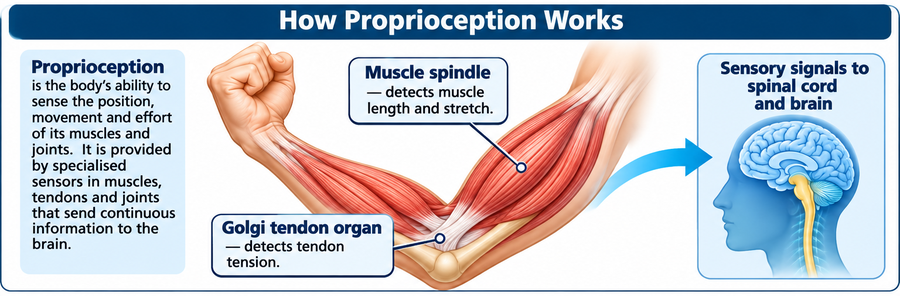
Proprioception is the body’s ability to sense the position, movement and effort of its limbs without continuous visual observation. It allows a person to walk without watching every footstep, reach towards an object and adjust posture automatically. For some autistic individuals, aspects of body awareness, movement coordination and force regulation may be different or particularly demanding. Such experiences vary considerably: autism does not imply a universal proprioceptive impairment, and difficulties with movement can have several causes.
1. What Is Proprioception?
Proprioception encompasses position sense, kinaesthesia (the perception of movement) and information about muscular force and effort. These processes contribute to posture, coordinated movement and safe interaction with objects. A person can usually close their eyes, raise an arm and estimate its position because sensory receptors continually report changes in muscles and surrounding tissues. Proprioception operates largely outside conscious awareness, although attention can be directed towards bodily position when necessary.
2. How the Proprioceptive System Works
Muscle spindles
Muscle spindles detect muscle length and changes in stretching. They provide signals about movement and contribute to rapid reflexive responses.
Golgi tendon organs
Golgi tendon organs detect tension in tendons, contributing information about the forces generated by muscle contraction.
Joint and skin receptors
Additional mechanoreceptors in joints and skin provide complementary information about position and movement. Signals travel through peripheral nerves to the spinal cord and brain, where they contribute to both automatic and conscious movement control.
3. How the Brain Processes Proprioceptive Information
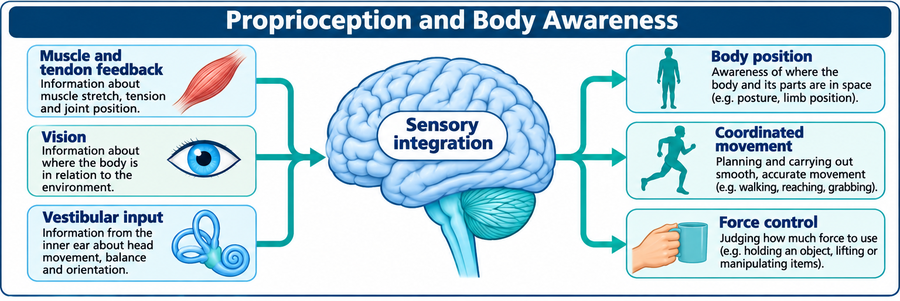
The spinal cord receives proprioceptive signals and supports rapid reflex circuits. The cerebellum helps compare intended movements with ongoing sensory feedback, allowing movement to be refined. The somatosensory cortex contributes to conscious awareness of limb position, while other networks integrate this information with vision and movement plans. The body schema is the continuously updated representation of the body’s dimensions and position used to guide action. It differs from body image, which includes conscious attitudes and perceptions about the body.
4. Proprioception and Autism
Some autistic people report uncertainty about limb position, frequent collisions with objects or difficulty regulating the force used in everyday tasks. Others enjoy pushing, stretching, squeezing cushions or applying pressure. Such observations do not, by themselves, establish an impaired proprioceptive system. Visual-spatial judgement, attention, motor planning, tactile processing, joint mobility and co-occurring developmental coordination disorder may also contribute. Research into autism and body representation is developing and does not identify a single proprioceptive profile shared by all autistic individuals.
5. Proprioception, Vestibular Function and Interoception
These three sensory systems perform distinct but interacting roles.
| Sensory system | Principal function | Example |
|---|---|---|
| Proprioception | Position and movement of limbs; muscular effort | Knowing where an arm is without looking |
| Vestibular | Head movement, acceleration and orientation relative to gravity | Maintaining stability when turning the head |
| Interoception | Internal physiological condition | Recognising hunger or a racing heartbeat |
Walking upstairs illustrates their cooperation: proprioception reports leg movement, vestibular signals contribute head orientation, vision identifies steps and interoception may register increased exertion.
6. Proprioception and Motor Coordination
Fine motor coordination
Writing, fastening buttons, handling cutlery and using tools require precise finger and hand movements. Some individuals grip a pen tightly or find small objects difficult to manipulate. Such difficulties may involve proprioception, dexterity or motor planning.
Gross motor coordination
Walking, jumping, climbing and running depend on the coordination of larger muscle groups. Difficulties with timing or balance can increase the effort involved.
Motor planning and dyspraxia
Praxis involves planning and organising purposeful movement. Developmental coordination disorder can co-occur with autism but is not synonymous with proprioceptive impairment.
7. Proprioception and Everyday Life
Crowded environments
Navigating a supermarket requires continual adjustments in position, distance and movement around others. Visual, auditory and social demands can increase the burden.
Sitting and posture
Changing position, leaning against furniture or seeking stable seating may be comfortable for some individuals, although pain, fatigue and ordinary preference can also explain these behaviours.
Writing and tools
Regulating grip and pressure depends on sensory feedback alongside vision and learned motor control.
Eating and drinking
Cutlery use and bringing a cup towards the mouth require accurate coordination. Difficulties can involve several sensory or motor processes.
Photography
Holding a smartphone steadily requires coordinated grip, arm position and small adjustments. Using both hands, supporting the elbows or placing the phone on a stable surface may improve comfort. On uneven ground, stability and safety should take priority.
8. Proprioception and Emotional Regulation
Some autistic people find predictable muscular resistance or firm pressure comforting. Activities may include stretching, pushing against a stable surface, carrying manageable objects or squeezing a cushion. These experiences may provide enjoyable sensory feedback or help focus attention. Evidence that particular proprioceptive exercises reliably treat emotional dysregulation is limited and variable. What helps one individual may be unpleasant for another. Consent, safety and personal choice are essential.
9. Proprioception During Childhood
Proprioception contributes to reaching, crawling, standing, walking and learning complex motor skills. Some autistic children experience difficulty catching a ball, fastening clothing, writing or riding a bicycle. A child who frequently knocks objects over may be struggling with coordination or force regulation rather than acting carelessly. Support should identify the particular difficulty, provide clear explanations and encourage enjoyable, appropriately supervised movement. Repeated criticism without practical guidance can reduce confidence.
10. Proprioception in Autistic Adults
Adults may compensate for body-awareness or coordination differences by relying more heavily on visual guidance, moving slowly, arranging objects consistently or rehearsing unfamiliar actions. These strategies may be effective but can require extra concentration. The combined demands of movement, sensory input and social interaction may contribute to fatigue. New falls, weakness or worsening coordination should not automatically be attributed to autism and may require medical assessment.
11. Proprioception, Masking and Fatigue
Some autistic people consciously control posture, gestures and movement to meet social expectations. If body awareness or coordination is already demanding, this additional self-monitoring may increase effort. An individual may manage hand movements, eye contact, conversation and sensory discomfort simultaneously during a social event. The relationship between proprioceptive differences and masking-related exhaustion is plausible but has not been established as a universal causal mechanism.
12. Assessing Body-Awareness Difficulties
Assessment may explore position sense, movement detection, force regulation, strength, reflexes, coordination and balance. Depending on symptoms, a GP, occupational therapist, physiotherapist or neurologist may be involved. Visual problems, peripheral neuropathy, vestibular conditions, joint hypermobility and developmental coordination disorder can also affect movement. Sudden weakness, significant numbness, acute loss of coordination or rapidly developing difficulty walking requires prompt medical attention.
13. Approaches to Support and Management
Occupational therapy
Practical assessment can identify adjustments to handwriting tools, seating, workspaces and daily tasks.
Physiotherapy
Where indicated, individualised programmes may address strength, posture, balance and coordination.
Muscular resistance activities
Some people enjoy manageable pushing, pulling or carrying activities. These should not be represented as universal treatments and must account for pain, joint instability and other health conditions.
Environmental adjustments
Clear walkways, stable seating, predictable object placement and handrails may improve safety and independence.
Respecting preferences
Firm pressure may be comforting for one individual and distressing for another. Physical pressure or restraint should never be imposed as a routine sensory intervention.
14. Understanding Rather Than Judgement
A person who appears awkward or frequently bumps into objects may experience genuine coordination or body-awareness difficulties. Similarly, stretching or leaning against furniture may provide comfort. Observers should avoid assuming carelessness or lack of motivation. Respectful support begins with listening to the individual’s account and investigating difficulties that are persistent, unusual or worsening.
15. Conclusion: Understanding the Body's Hidden Sense
Proprioception provides continuous information about limb position, movement and muscular effort. Together with vision, vestibular sensation and neural systems for movement control, it supports nearly every physical action. Some autistic individuals experience differences in body awareness or coordination, but there is no single proprioceptive abnormality shared by all autistic people. Individual assessment, practical adjustments and respect for sensory preferences can improve comfort and independence. Movements that appear effortless to one person may require considerable concentration and effort from another.
Scientific References and Further Reading
Access to some or all of the scientific publications listed below may require a journal subscription or payment to download the full article. Availability and any associated charges should be confirmed directly with the relevant publisher.
- Marasco, P. D., & de Nooij, J. C. Proprioception: A New Era Set in Motion by Emerging Genetic and Bionic Strategies? Annual Review of Physiology.
- Proprioception, the Regulator of Motor Function.
- Functional and Molecular Insights into Muscle Proprioceptors.
- Reframing Body Representations in Autistic Individuals: A Systematic Review.
- Physiology, Sensory System. StatPearls.
- The Making of a Proprioceptor: A Tale of Two Identities.
This article is intended for educational purposes and does not replace professional medical assessment, diagnosis or treatment.