Health and Fitness Inequalities Among Disabled and Neurodivergent People
Scotland and Northern England
Demographics, participation, accessibility, financial barriers and future service provision
Executive summary
Disabled people are less likely to meet physical activity guidelines than non-disabled people, despite substantial reported interest in becoming more active. Financial hardship, transport, inaccessible equipment, sensory demands and limited support can all restrict participation. The evidence supports investigation of affordable, inclusive provision, but does not establish the commercial viability of a new facility.
| Key indicator | Reported finding |
|---|---|
| Scotland: activity-limiting conditions | Approximately 1.31 million people |
| Northern England: census disability | Approximately 2.97 million people |
| Scottish adults meeting activity guidelines | 49% disabled; 71% non-disabled |
| Scottish disabled survey respondents wanting more activity | 73% |
| UK disability-related additional costs (Scope estimate) | £1,095 per month |
About the evidence
Population prevalence, reported physical activity, facility attendance and potential demand are distinct measures. Selected official Scottish statistics have been rechecked for this edition. Earlier survey findings and provider tariffs remain provisional until checked against their original sources.
Contents
2. Regional population and evidence gaps
3. Physical activity and facility use
4. Accessibility and neurodivergence
5. Poverty, benefits and the cost of living
6. The true cost of fitness participation
7. Concessionary prices and eligibility
8. Scottish local authority directory
9. Grants and equipment for home exercise
10. Inclusive service development
11. Recommendations and further research
12. Conclusion and limitations
References and further reading
1. Population demographics
Disability includes physical, sensory, cognitive and mental health-related impairments and long-term conditions. Neurodivergence encompasses autism, ADHD, dyslexia, dyspraxia and other neurological differences. These categories overlap; not every neurodivergent person identifies as disabled.
| Scottish census 2022 category [1] | Approximate number |
|---|---|
| Total population | 5,440,000 |
| Activities limited considerably | 587,000 |
| Activities limited to some extent | 726,000 |
| Total activity-limiting conditions | 1,313,000 |
Around 24% of Scotland’s population reported activity limitations. Age is important: the reported prevalence rises from 8% among children aged 0–15 to 50.2% among those aged 65 and over 2.
| Age group | Prevalence |
|---|---|
| 0–15 | 8.0% |
| 16–24 | 14.2% |
| 25–34 | 14.5% |
| 35–49 | 17.7% |
| 50–64 | 28.2% |
| 65+ | 50.2% |
Northern England
| Region [3] | Disabled population | Age-standardised rate |
|---|---|---|
| North East | 567,000 | 21.2% |
| North West | 1,400,000 | 19.8% |
| Yorkshire and Humber | 1,000,000 | 18.9% |
| Total | 2,967,000 | — |
| England overall | 9,800,000 | 17.7% |
The combined Scottish and northern English count is approximately 4.28 million, but the census definitions and years differ. It is an indication of scale, not a harmonised statistic.
2. Regional population and evidence gaps
Council-level disability prevalence varies substantially. The Scottish Government’s 2026 evidence review reports these age-standardised census figures for selected councils 27.
| Council | Activity-limiting disability (%) |
|---|---|
| Glasgow City | 29.0 |
| Inverclyde | 27.5 |
| West Dunbartonshire | 27.1 |
| East Dunbartonshire | 19.6 |
| Aberdeenshire | 19.3 |
| East Renfrewshire | 18.9 |
The Scottish Borders needs assessment reported approximately 1,150 autistic residents as an estimate, not a count of diagnoses or gym users 4. No reliable comprehensive count of neurodivergent gym users is available for the Central Belt, Borders, Highlands or Islands.
Planning without attendance data
Population counts cannot establish demand for a gym. For example, 10% of 1.3 million is 130,000, but this arithmetic is not an attendance forecast. Adult preferences must not be extrapolated to all-age populations without evidence.
3. Physical activity and facility use
Scottish Government and Sport England survey evidence indicates persistent participation inequalities 5,6,7. Physical activity includes walking, home exercise and other activities outside gyms.
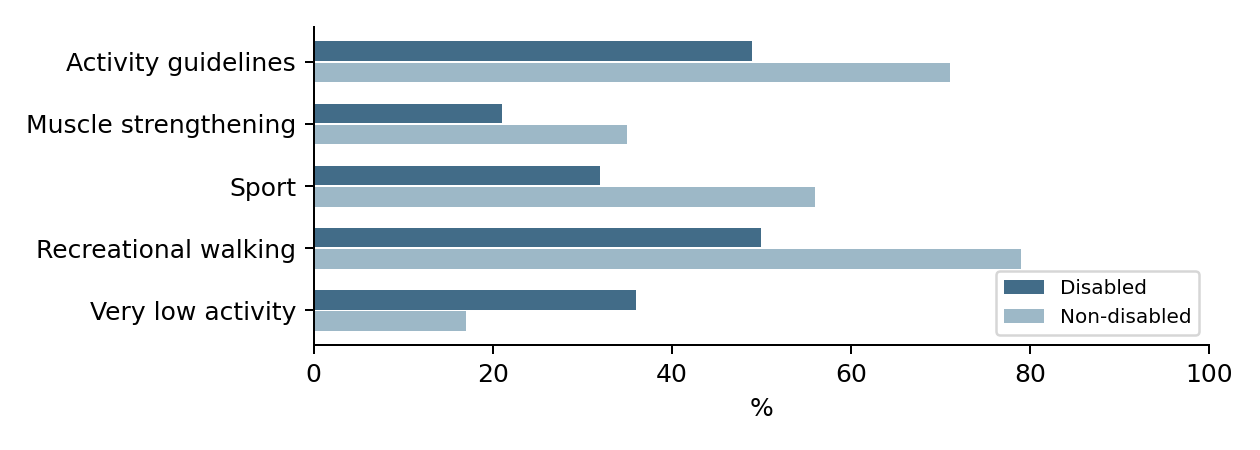
Click the figure to view it at full size in a new tab.
| Indicator | Disabled | Non-disabled |
|---|---|---|
| England activity guidelines 2015–16 | 43.7% | 66.7% |
| England activity guidelines 2024–25 | 49.1% | 69.8% |
| Scottish leisure user satisfaction | 79% | 85% |
Scottish disabled adults’ sport participation reportedly rose from 25% in 2014 to 32% in 2023, and recreational walking from 41% to 50%. Satisfaction among existing users does not capture people excluded from facilities.
Unmet demand
A Scottish Disability Sport survey of 335 respondents reported that 73% wanted to be more active, 95% recognised wellbeing benefits, 67% would struggle without family or friends, and 18% undertook no activity in a typical week 8. These are respondent findings, not population estimates. Activity Alliance regional research reported that 82% of disabled North West respondents wanted more activity 9.
Reported preferred environments included green spaces (39%), home online activities (31%), leisure centres (28%), blue spaces (28%) and home offline activities (25%) 10. Preferences may overlap.
4. Accessibility and neurodivergence
A physically accessible building can still be inaccessible to someone experiencing sensory overload, communication difficulties or anxiety. Accessibility should include physical, sensory, cognitive, social and financial dimensions.
| Barrier | Potential response |
|---|---|
| Loud music, bright lighting, crowds | Quiet sessions, adjustable lighting, occupancy limits |
| Unpredictable routines or equipment | Advance information, bookings, familiarisation visits |
| Verbal instructions and communication | Visual demonstrations, plain language, written guidance |
| Interoception, balance and coordination | Individual assessment, paced instruction, adapted equipment |
| Masking and fatigue | Flexible attendance, rest areas, no pressure to socialise |
| Mobility and personal care | Accessible equipment, hoists, changing rooms, companion access |
| Executive functioning differences | Reminders, flexible booking, short structured sessions |
Different support requirements
Autistic people may experience cumulative sensory and social demands, making the effort of attending greater than the exercise itself. ADHD may affect planning, time management and consistency, while physical activity may also be enjoyable and helpful for some individuals. Dyspraxia can affect coordination and movement sequencing. People with learning disabilities may benefit from Easy Read information and familiar support.
Research identifies barriers associated with sensory demands, social expectations and inadequate adaptations. The precise regional number of autistic or ADHD gym users remains unknown.
Transport and geography
The Scottish Disability Sport survey reported that over 70% of respondents considered public transport unsuitable for supporting participation. Rural travel, weather, limited timetables, accessible parking and travelling fatigue can make a nominal catchment area misleading. Around 40% expressed concerns about losing disability benefits through participation 8. Such concerns should be addressed through qualified welfare advice rather than assumptions about eligibility.
5. Poverty, benefits and the cost of living
Many disabled and neurodivergent people rely partly or wholly on benefits because employment opportunities, hours or sustained work may be restricted. Others work and receive disability benefits to meet additional costs. Diagnosis alone does not establish eligibility.
| Reported financial indicator | Finding |
|---|---|
| Scope additional monthly disability costs [12] | £1,095 |
| Annual equivalent | £13,140 |
| UK disabled working-age adults in poverty [13] | 33% |
| Scottish families receiving disability benefits: poverty excluding those benefits [14] | 23% |
| Scottish families not receiving disability benefits [14] | 17% |
| Scottish ADP recipients, April 2026 (reported) [15] | 504,710 |
A UK Government survey of 1,438 disabled respondents reported rising utility costs affecting 87%, reduced independence and isolation each affecting 78%, rising food costs affecting 68%, and reduced or stopped transport use affecting 62% 16. These findings are not representative estimates for every disabled household.
Transport Scotland reports that 28% of disabled adults were in work in its combined 2022–24 data, while 40% were retired. These figures do not measure benefit receipt, but illustrate the importance of employment and pension income when assessing affordability 28.
Relevant benefits
Scotland: Adult Disability Payment, Child Disability Payment, Scottish Adult Disability Living Allowance, Pension Age Disability Payment and Carer Support Payment. England: Personal Independence Payment, Disability Living Allowance, Attendance Allowance and Carer’s Allowance. Universal Credit, Employment and Support Allowance and Council Tax Reduction are also relevant across Great Britain, subject to eligibility.
Disability payments help cover extra costs and should not be treated as spare income. Food, heating, housing, transport and personal care take priority. A gym membership can therefore become unaffordable even when exercise is beneficial. Reduced participation may contribute to isolation and poorer wellbeing, although the scale of resulting healthcare costs is not established.
Deprivation and activity
The Scottish Health Survey reported 73% meeting activity guidelines in the least deprived areas compared with 50% in the most deprived areas 6. Activity Alliance reported 46% of disabled respondents reducing activity because of rising costs and 59% saying costs influenced their choices 10.
6. The true cost of fitness participation
| Monthly expense | Independent user | User requiring support |
|---|---|---|
| Membership | £30 | £30 |
| Transport | £20 | £80 |
| Companion admission | £0 | £30 |
| Supervised instruction | £0 | £60 |
| Equipment/clothing | £5 | £15 |
| Total monthly | £55 | £215 |
| Total annual | £660 | £2,580 |
Illustrative costs only. The second example is almost four times the first. A small membership discount may be insufficient when travel and support dominate the total cost.
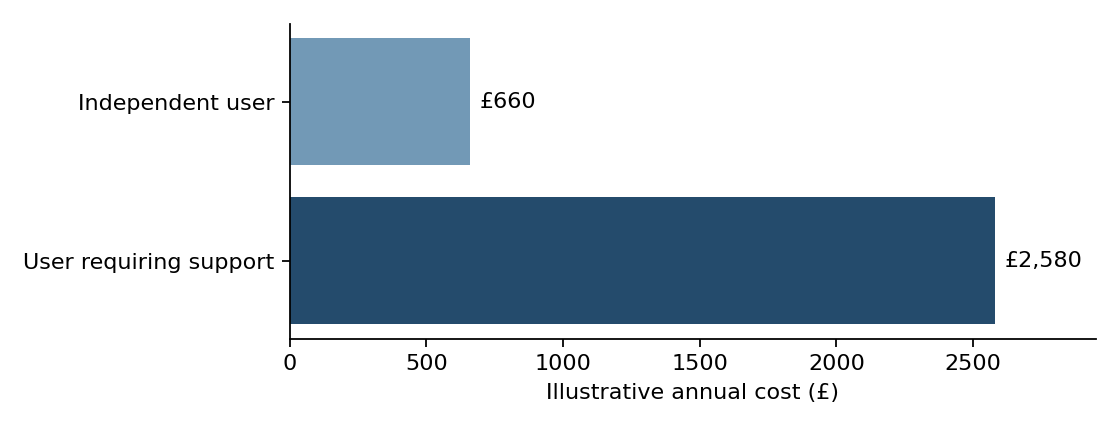
Click the figure to view it at full size in a new tab.
Home exercise versus membership
| Option | Year 1 | Two years |
|---|---|---|
| Home equipment | £300 | £300 |
| Gym at £30/month | £360 | £720 |
| Gym and travel at £90/month | £1,080 | £2,160 |
The model excludes maintenance, electricity, supervision and replacement. Home exercise can reduce travel and sensory demands, but should remain a choice rather than a substitute for accessible community services.
Exercise referral and continuity
GPs, physiotherapists, occupational therapists and community link workers may refer or signpost individuals to supported activity. Live Borders, Glasgow Life and Better have been identified as potential providers. A referral does not automatically provide free membership. Time-limited programmes can establish confidence and routine, but withdrawal of subsidy may make continued attendance impossible. Longer-term concessions and transition planning are therefore important.
7. Concessionary prices and eligibility
The following prices were reported in the earlier assessment. They have not been independently checked for this combined edition; confirm current prices, eligibility, opening hours and included activities with providers.
| Provider / scheme | Standard | Concession | Eligibility / note |
|---|---|---|---|
| Edinburgh Get Active | Varies | £10/month | Qualifying low income; off-peak |
| Live Borders gym | £33.50/month | £30.50/month | Disability membership |
| Live Borders visit | £7.50 | £6.50 | Eligible concession |
| Glasgow entry level | From £21/month | From £13/month | Qualifying benefits; PIP alone not sufficient |
| Fife Club | £32/month | £23.50/month | Qualifying criteria |
| High Life Highland gym | £10.40 | £6.20 | Concession |
| Highland Active gym | £10.40 | £3.10 | Full Council Tax Reduction |
| Highland Active swim | £9.10 | £2.70 | Scheme eligibility |
| Orkney ActiveLife | Varies | £1/activity | Budget scheme |
| Shetland Access2Leisure | Varies | £1/activity | Qualifying criteria |
| Newcastle East End Pool gym | £10 | £6 | Concession |
| Newcastle East End swim | £7 | £3.50 | Peak comparison |
| Newcastle City Baths Flex | Varies | £5/month | Setup fee; activity restrictions |
Sources: provider links in references 17,18,19,20,21,22,23,24,25. Annual savings based on monthly prices are £36 at Live Borders, £96 at Glasgow entry level and £102 at Fife Club. Products are not directly equivalent. Better Inclusive membership may allow an essential companion free entry when assisting. Cumberland Everyone Active offers concessions subject to local rules. Yorkshire and Humber pricing remains unaudited.
8. Scottish local authority directory
All 32 councils are included below. A dash means pricing was not established in the earlier research, not that concessions are unavailable. Argyll and Bute is listed with Highlands and Islands for service planning, unlike the illustrative population model in section 2.
| Council | Provider | Reported concession |
|---|---|---|
| Edinburgh | Edinburgh Leisure | £10/month |
| Glasgow | Glasgow Life | From £13/month |
| East Lothian | Enjoy Leisure | — |
| Midlothian | Council | — |
| West Lothian | West Lothian Leisure | — |
| North Lanarkshire | Active NL | — |
| South Lanarkshire | SLLC | — |
| East Renfrewshire | ER Culture and Leisure | — |
| Renfrewshire | OneRen | — |
| Inverclyde | Inverclyde Leisure | — |
| East Dunbartonshire | EDLC | — |
| West Dunbartonshire | Council | — |
| Falkirk | Council | — |
| Stirling | Active Stirling | — |
| Clackmannanshire | Council | — |
| Fife | Fife Sports and Leisure Trust | £23.50/month |
| Scottish Borders | Live Borders | £30.50/month |
| Highland | High Life Highland | Active £3.10 gym |
| Argyll and Bute | LiveArgyll | — |
| Orkney | Council | £1/activity |
| Shetland | SRT | £1/activity |
| Na h-Eileanan Siar | Council | — |
8. Scottish directory (continued)
| Council | Provider | Reported concession |
|---|---|---|
| Aberdeen City | Sport Aberdeen | — |
| Aberdeenshire | Live Life Aberdeenshire | — |
| Moray | Council | — |
| Dundee | Leisure and Culture Dundee | — |
| Angus | ANGUSalive | — |
| Perth and Kinross | Live Active Leisure | — |
| Dumfries and Galloway | Council | — |
| East Ayrshire | East Ayrshire Leisure | — |
| North Ayrshire | KA Leisure | — |
| South Ayrshire | Council | — |
Regional delivery considerations
| Region | Potential approach |
|---|---|
| Central Belt | Larger inclusive hubs, satellite sites, quiet sessions and transport links |
| Scottish Borders | Distributed town-based provision, outreach and equipment loans |
| Highlands and Islands | Community facilities, mobile services, remote support and subsidised travel |
| North East and Tayside | Urban specialist provision combined with rural outreach |
| South West | Affordable community facilities and transport support |
| North East England | Community fitness and rehabilitation partnerships |
| North West England | Urban hubs and rural outreach in Cumbria |
| Yorkshire and Humber | Urban hubs and distributed rural provision |
The Borders strategy reported around 60% of the general population meeting activity guidelines 26. Live Borders was reported to offer nine gyms and six pools through its One Club membership. Facility counts do not demonstrate disability accessibility or actual use. Highland and island low-cost schemes provide useful case studies, but their impact on participation needs evaluation.
9. Grants and equipment for home exercise
There is no universal entitlement to a home gym grant on the basis of disability or neurodivergence. Funding may be available where equipment addresses an assessed disability-related, rehabilitation or independent living need. Apply before purchasing and obtain professional support where required. Before buying equipment, obtain a written quotation, describe the disability-related need, explain the financial barrier and ask the funder whether a professional recommendation is required. Wait for a decision before purchasing.
| Organisation / route | Potential support and limitations |
|---|---|
| Independence at Home | Independent living equipment; professional referral and financial need |
| Family Fund | Eligible families with disabled or seriously ill children; recreational and specialist equipment |
| Caudwell Children | Selected specialist equipment; programme criteria apply |
| Hospital Saturday Fund | Medical or therapeutic equipment; medical need |
| Barchester’s Charitable Foundation | Mobility and independence support; not general gym funding |
| Turn2us | Searchable grants directory; individual criteria vary |
| Disability Information Scotland / Scope / Sense | Funding information and signposting |
| NHS / council occupational therapy | Assessed rehabilitation or independent living equipment |
| Local trusts and Rotary clubs | Discretionary local assistance |
Illustrative equipment budgets
| Equipment | Planning range |
|---|---|
| Seated pedal exerciser | £30–£150 |
| Recumbent exercise bicycle | £150–£600 |
| Upper-body exerciser | £50–£300 |
| Resistance bands | £10–£40 |
| Adapted treadmill | £300–£1,500+ |
| Adapted bicycle/tricycle | £500–£3,000+ |
These are not retail quotations or confirmed eligible grant items. Seek appropriate clinical advice for significant mobility, balance, cardiovascular or chronic health conditions. Some conditions require careful pacing rather than increasing exertion.
10. Inclusive service development
Community equipment loan scheme
A community equipment library could allow people to trial suitable equipment without committing to purchase. Equipment would be assessed, allocated, delivered where necessary, inspected and cleaned before reallocation.
| Item | Quantity | Illustrative cost |
|---|---|---|
| Pedal exercisers | 20 | £1,500 |
| Exercise bicycles | 10 | £3,000 |
| Resistance bands | 50 | £1,000 |
| Upper-body exercisers | 10 | £1,500 |
| Adapted benches | 5 | £1,250 |
| Mats and accessories | 30 | £750 |
| Initial storage and administration | — | £2,000 |
| Total | — | £11,000 |
Excludes ongoing staffing, insurance, maintenance and delivery.
Funding for organisations
Potential routes include sportscotland, Sport England, National Lottery Community Fund, Foundation Scotland, Robertson Trust, local authority community funds, Benefact Trust and Cash for Kids. Scottish Disability Sport can provide guidance. These are potential routes, not confirmed open awards; commercial businesses may be ineligible.
Illustrative annual membership income
| Members | £10/month | £15/month | £20/month | £30/month |
|---|---|---|---|---|
| 100 | £12,000 | £18,000 | £24,000 | £36,000 |
| 250 | £30,000 | £45,000 | £60,000 | £90,000 |
| 500 | £60,000 | £90,000 | £120,000 | £180,000 |
| 750 | £90,000 | £135,000 | £180,000 | £270,000 |
| 1000 | £120,000 | £180,000 | £240,000 | £360,000 |
For example, 500 members at £15/month yield £90,000 annually. With £30,000 subsidy and £150,000 operating costs, the deficit is £30,000; approximately 667 paying members would be needed to break even. Capital costs, tax and financing are excluded. This is not a feasibility forecast.
11. Recommendations and further research
Proposed concessionary framework
| Category | Illustrative price |
|---|---|
| Standard adult | £30/month |
| Disabled or neurodivergent concession | £20/month |
| Qualifying disability benefits | £15/month |
| Financial hardship | £10/month |
| Severe hardship | £5/month |
| Essential companion | Free |
| Subsidised single admission | £1–£3 |
| Funded rehabilitation | Free or subsidised |
These are policy options, not existing charges. Eligibility should avoid excluding people with substantial needs who do not receive benefits. The Equality Act 2010 provides the framework for reasonable adjustments in Great Britain.
Priority actions
Develop consistent concession eligibility, free essential companion access, rural transport support, home equipment grants and loans, sensory-friendly sessions, staff training, flexible membership suspension and longer-term referral support. Consult disabled and neurodivergent people directly and offer mainstream as well as specialist options.
Data required from providers
Request anonymised annual counts from 2019–20 onwards: unique members and visitors, disabled and neurodivergent participants where voluntarily recorded, age and catchment, concession use, gym/swim/class attendance, referral participation, companion access, retention and cancellations, adapted equipment, quiet sessions and waiting lists. Public authorities may be approached through Freedom of Information; commercial providers may participate voluntarily. Avoid requiring unnecessary diagnostic disclosure.
Potential research partners include sportscotland, Scottish Disability Sport, Public Health Scotland, Sport England, Activity Alliance, ukactive, National Records of Scotland, ONS, Scottish Learning Disabilities Observatory, National Autistic Society and local leisure trusts.
12. Conclusion and limitations
The combined evidence identifies a substantial population that could benefit from accessible physical activity, alongside a persistent inequality in participation. The desire to be more active reported by disabled survey respondents suggests that lower participation should not automatically be interpreted as lack of interest.
Financial barriers are especially important. Benefits are intended to meet essential living and disability-related costs, and modest gym concessions may not make participation affordable. Transport and support costs can exceed membership charges. Low-cost admission schemes, free essential companion access and equipment loans may offer more meaningful assistance.
Regional delivery should reflect geography. Larger urban centres may support specialist facilities, whereas rural Borders, Highland, island and northern English communities may require distributed provision, outreach and home-based options. Accessibility must include sensory and communication needs as well as physical access.
The principal evidence gap remains actual disability- and neurodivergence-specific gym, pool and leisure centre attendance. Neither population estimates nor activity guidelines can substitute for these counts. A full council-level demographic aggregation, comprehensive concession audit and local feasibility study remain outstanding.
Disclaimer
This article is for information and strategic planning, not medical, benefits or investment advice. Selected official statistics have been checked, but not every original report, tariff or grant condition has been independently verified. Confirm eligibility and prices directly. The author cannot guarantee grant awards, health outcomes or commercial viability.
References and further reading
1. Scotland Census 2022: Health, disability and unpaid care
2. Scottish Government: inequalities and challenges experienced by disabled people
3. ONS: Disability, England and Wales, Census 2021
4. Scottish Borders joint strategic needs assessment
5. Scottish Government: Sport and physical activity, state of the nation
6. Scottish Health Survey 2024
7. Sport England: Active Lives surveys
8. Scottish Disability Sport survey: 73% want to be more active
9. Activity Alliance regional secondary analysis
10. Activity Alliance annual survey
11. Autistic adults physical activity scoping review (reported reference)
12. Scope: Disability Price Tag
13. Joseph Rowntree Foundation: Disability and poverty
14. Joseph Rowntree Foundation: Poverty in Scotland 2026
15. Social Security Scotland: ADP statistics to April 2026
16. UK Government: impact of rising cost of living on disabled people
17. Edinburgh Leisure Get Active
18. Live Borders fitness price list
19. Glasgow Life physical activity information
21. High Life Highland Active Scheme
24. Better inclusive membership
25. Newcastle East End Pool prices
26. Scottish Borders sport and physical activity strategy
27. Scottish Government: disability demographics by council
28. Transport Scotland: Disability and transport 2024
Grant and funding directories
Barchester’s Charitable Foundation
Disability Information Scotland
Scope: disability sport funding