Autism and the Need for Control
Why predictability, autonomy and self-regulation matter in everyday life.
Introduction
For many autistic people, maintaining a degree of control over their daily lives is not simply a matter of preference. It can be a practical way of remaining emotionally regulated, managing sensory stimulation, conserving mental energy and feeling safe. A familiar routine, an agreed plan or the freedom to leave an overwhelming situation can make the difference between participating comfortably and becoming distressed.
The word “control” is easily misunderstood. It can suggest a wish to dominate other people, but the concern addressed in this essay is primarily personal control: being able to influence one’s own surroundings, time, body, decisions and exposure to demands. Autistic people are not all alike. Some enjoy spontaneity, while others depend heavily on predictability; many need different levels of structure in different circumstances.
This essay explains why control can matter, how a loss of predictability can contribute to overload, and how families, colleagues and professionals can support autonomy without encouraging harmful rigidity.
1. Why control is so important
The central reason control can matter is that it reduces the number of demands a person must manage at once. If an autistic person knows where they are going, who will be there, what is expected and when they can leave, fewer resources are spent anticipating unknown outcomes. Their attention can instead be directed towards the activity itself. 1, 5
Control may serve six related functions: reducing uncertainty; limiting unwanted sensory input; conserving attention and decision-making capacity; supporting emotional regulation; preventing cumulative overload; and protecting dignity and self-determination. These are interconnected, not six separate explanations for identical behaviour.
Consider a supermarket visit. A familiar route, a written shopping list and a quiet time of day may enable someone to shop independently. A rearranged aisle, loud announcement and unexpected queue may force rapid replanning while noise, lighting and movement continue. The difficulty is not merely that the plan has changed: the change removes a coping structure at the same time as new demands are arriving. 1, 2
The ability to say “I need a break” or “I need to leave” can also provide psychological safety. Knowing that withdrawal is possible may make it easier to remain engaged. Personal control is therefore often an enabling condition for participation rather than a barrier to it.
Figure 1. How an environment can overwhelm an autistic person
The illustration shows a busy city environment and the cumulative effects of noise, crowds, sensory input, social pressure, multiple tasks and unexpected changes. It is a conceptual example, not a universal sequence or a clinical measurement. 1, 2
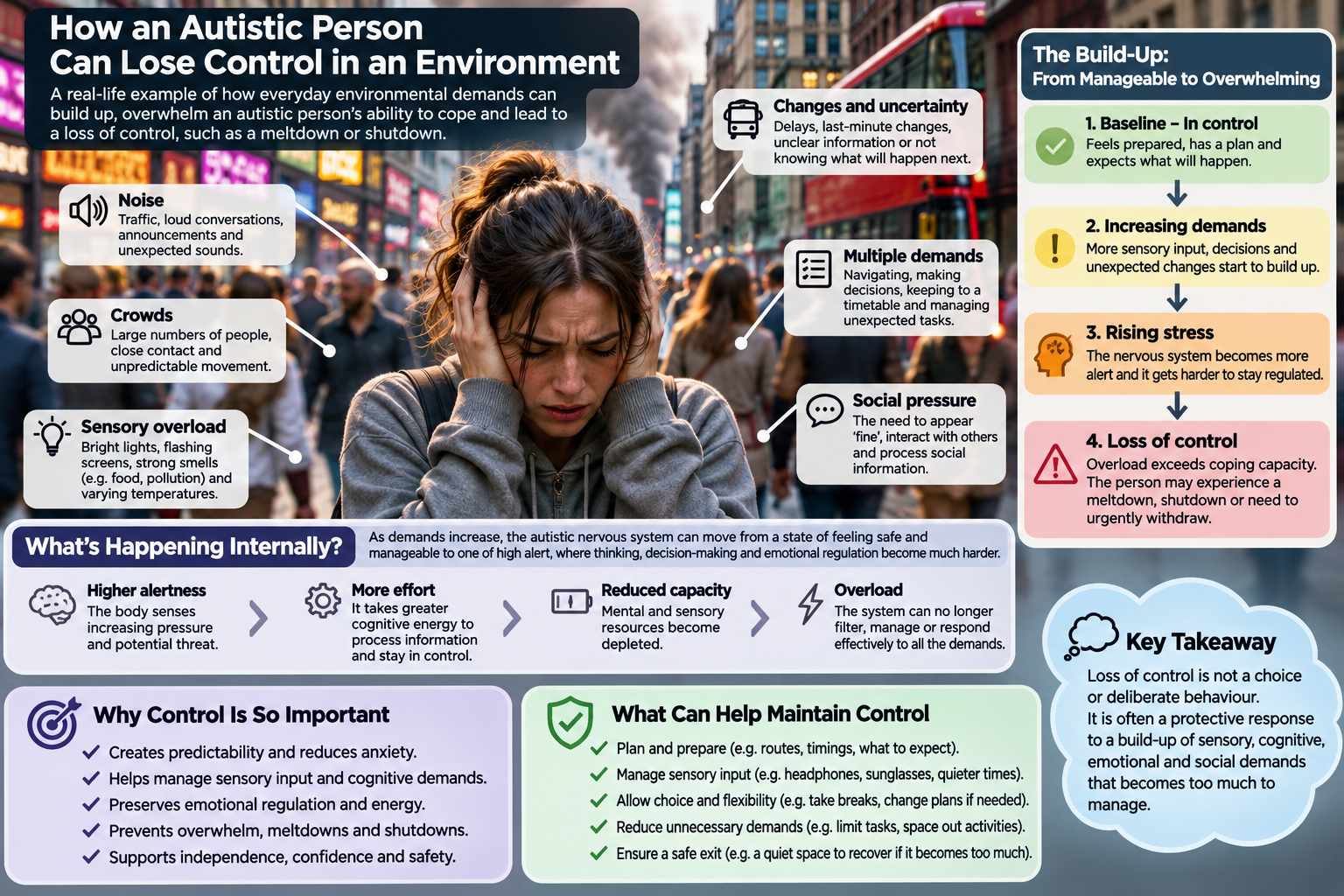
Original conceptual illustration, not a clinical measurement. Select the image to open a larger version in a new tab.
How control can be lost gradually
An autistic person may begin an outing feeling prepared. They have planned the journey, know the destination and expect to follow a familiar timetable. When a bus is delayed, the environment becomes crowded and someone asks an unexpected question, the person may need to process several new problems simultaneously.
They may initially compensate by concentrating harder, masking discomfort and suppressing signs of stress. These efforts can preserve outward composure while consuming energy. Further noise, uncertainty or demands may then reduce the capacity to think clearly, communicate, make decisions and regulate emotions. A meltdown, shutdown or urgent need to withdraw may follow, although none is inevitable.
The apparent “last straw” may be a minor incident, but the response can reflect the whole accumulation of demands. The loss of control should not automatically be interpreted as a deliberate attempt to manipulate others. It may reflect an involuntary response to overload. Early adjustments—quieter surroundings, fewer demands, clear information, a break or a safe exit—can sometimes prevent escalation.
2. Predictability, uncertainty and psychological safety
Uncertainty increases the need to anticipate possible outcomes. Some autistic people experience uncertainty as particularly distressing, especially when it affects travel, appointments, social expectations or access to familiar support. Research has associated intolerance of uncertainty with anxiety in autistic populations, although the relationship varies and does not explain every individual experience. 1, 5
A routine can act as an external structure. It allows the person to know what happens next without repeatedly reconstructing the day. Unexpected change may affect more than one event: a late appointment can alter transport, meals, childcare, medication timing or planned rest. The emotional impact may therefore exceed what an observer expects from the initial change.
Advance notice, accurate explanations and realistic contingency plans can help. The aim is not to remove every surprise from life, but to provide sufficient certainty and choice for unavoidable changes to become manageable.
3. Sensory control and bodily boundaries
Autistic sensory experiences vary widely. Noise, fluorescent lighting, crowds, smells, textures and unexpected touch may be unusually intense for some people, while others seek particular forms of stimulation. The opportunity to adjust these conditions can be essential to comfort and independence. 2
Headphones, quieter shopping times, preferred clothing, controlled lighting and a seat near an exit are examples of personal sensory regulation. Such strategies should not be dismissed as avoidance if they enable the person to participate in work, education or community life.
Bodily autonomy is part of the same principle. A person should be asked before being touched, given explanations before physical examinations and supported to communicate discomfort. Physical boundaries matter even when the individual cannot provide a detailed explanation of why a sensation is distressing.
4. Emotional regulation, meltdowns and shutdowns
A meltdown may involve an intense outward expression of distress; a shutdown may involve withdrawal, reduced communication or difficulty initiating action. Experiences differ, and neither should be assumed to be wilful misconduct. The build-up may involve sensory, social, cognitive and emotional demands over hours or days. 2, 4
Early signs of overload may include increased irritability, repetitive questions, restlessness, difficulty finding words, unusual quietness or an urgent wish to be alone. The most useful response is often to reduce demands and offer space, rather than insist on an immediate explanation.
Recovery may require quiet, familiar activities, reduced sensory input or sleep. Discussing what happened later, when the person is ready, is usually more constructive than questioning them during acute distress. The purpose is to identify preventable triggers and strengthen support, not simply to suppress visible reactions.
5. Masking, energy conservation and burnout
Some autistic people consciously monitor eye contact, facial expression, speech, posture and emotional reactions to meet social expectations. This masking or camouflaging can create an appearance of confidence while requiring sustained mental effort. A person may seem to be coping well yet have very little energy remaining afterwards. 4
Control over the duration and timing of social activity can protect limited resources. Choosing a smaller gathering, declining an additional commitment or arranging rest after a meeting may help prevent cumulative exhaustion. Autistic burnout, described in emerging research and lived-experience accounts, can involve prolonged exhaustion, reduced functioning and increased sensitivity to demands.
A crucial distinction is that successful outward control is not proof of internal wellbeing. When an individual's ability to mask begins to weaken, simply asking them to try harder may increase the problem. A more useful response is to examine workload, recovery time, sensory demands and available choice.
6. Executive functioning and decisions
Executive functions include planning, initiating tasks, organising information, switching attention and monitoring progress. Autistic people have varied profiles: an individual may be highly skilled in one area and struggle in another. 1
Familiar routines can reduce the number of decisions required during the day. Written instructions, step-by-step plans, clear start points and advance information about changes may help when task initiation or switching is difficult. These tools support control by making demands more visible and manageable.
Offering a small number of clearly explained options can be helpful, but simplifying choices should not mean taking decisions away from the person. The objective is supported decision-making, not substituted decision-making.
7. Demand avoidance and perceived pressure
Some autistic people report intense distress when faced with demands, including activities they might otherwise enjoy. This is sometimes discussed using the term PDA, or Pathological Demand Avoidance. The term and its proposed status as a distinct profile are debated; PDA is not a separate diagnosis in major diagnostic manuals. 3
A task may feel manageable when self-directed but overwhelming when imposed without warning. Possible reasons include anxiety, uncertainty, executive functioning difficulties, loss of autonomy and earlier experiences of coercion. No single explanation applies to everyone, and pain, fatigue, misunderstanding or legitimate disagreement should also be considered.
Collaborative requests, meaningful choices, flexible timing and clear reasons for necessary tasks may reduce pressure. Safety needs still matter, but escalating confrontation is often less useful than understanding why the demand has become difficult.
8. Past invalidation and the need to feel heard
Some autistic people have repeatedly been told that their sensory discomfort is exaggerated, that their routines are unreasonable or that they must tolerate distress without accommodation. Such experiences may make them more cautious about handing decisions to others. 5, 6
A strong preference to know what will happen may partly reflect an attempt to avoid a repetition of earlier distress. This does not mean every need for control is caused by trauma or invalidation; preferences for order and predictability may be longstanding aspects of an individual's autistic experience.
Trust grows when others give reliable information, honour boundaries and explain changes rather than imposing them. Support should make the person more able to exercise autonomy, not less.
9. Control in relationships and shared environments
Personal autonomy does not remove the needs and rights of partners, relatives, colleagues or friends. An autistic person may need notice before visitors arrive; another household member may value spontaneity. Neither need is automatically unreasonable.
The most constructive approach is to explain why an arrangement matters, identify which elements are essential and negotiate the rest. For example, visitors might be agreed in advance, while some flexibility is retained about timing. Written agreements can help where conversations are difficult under pressure.
The key distinction is between setting boundaries over one's own participation and controlling other people's choices. Respectful compromise protects both.
10. Helpful control and harmful rigidity
Control is helpful when it increases independence, participation and wellbeing. It can become burdensome when maintaining perfect predictability takes so much time and effort that the person cannot do activities they value. Repeated checking, intense fear of minor changes or severe avoidance may warrant additional support. 1, 7
The response should not be to remove useful routines indiscriminately. Instead, flexibility can be developed gradually and collaboratively, with realistic alternatives and opportunities for recovery. Where anxiety, compulsive behaviour or distress substantially restricts life, an appropriately informed professional assessment may help identify co-occurring difficulties and suitable support.
11. Practical ways to preserve autonomy
Practical support should preserve the individual’s ability to make choices while reducing demands that are avoidable or unnecessarily distressing. The appropriate adjustment depends on the person and should be agreed with them wherever possible. The purpose is not to remove all uncertainty, but to provide sufficient information, flexibility and support for everyday participation.
| Area of daily life | Why personal control can help | Practical approach |
|---|---|---|
| Daily routines | Reduces uncertainty and repeated planning. | Share schedules in advance; explain changes and offer alternatives. |
| Sensory environments | Allows the person to regulate noise, light, touch and other input. | Offer quieter spaces, headphones, lighting adjustments and breaks. |
| Travel and appointments | Helps manage delays, timing and unfamiliar arrangements. | Provide clear directions, realistic travel time and a way to report lateness. |
| Social activities | Protects energy and supports informed participation. | Agree the purpose and duration; make leaving or taking a break acceptable. |
| Decisions and executive functioning | Reduces competing demands without removing autonomy. | Offer clear options, written information and manageable steps. |
| Emotional overload | Enables earlier recognition of distress and timely adjustment. | Respect warning signs, reduce demands and avoid confrontational responses. |
| Recovery and burnout prevention | Protects limited energy and prevents demands from accumulating unchecked. | Plan rest periods, review commitments and allow recovery after demanding events. |
| Personal and bodily boundaries | Promotes safety, trust and self-determination. | Ask permission before touch; respect requests for space and communication preferences. |
Supporters should ask what an existing routine achieves before trying to change it. If it enables independence and does not cause harm, there may be no reason to remove it. Where a routine becomes restrictive, adjustments should be developed collaboratively and at a manageable pace. 1, 7
12. The author’s experience
For the author, maintaining a sense of control provides clarity about forthcoming activities and reduces the effort involved in preparing for everyday life. The following experiences show how this need for predictability can be helpful, and what happens when plans are disrupted.
Everyday routines
After the evening meal, the author frequently asks their partner, “What is for dinner tomorrow?” Their partner prefers to decide nearer the time and sometimes finds the question frustrating. For the author, however, knowing the answer settles one small uncertainty about the following day. This difference illustrates how a seemingly ordinary domestic decision can carry different significance for two people.
Travelling and unexpected delays
Before setting out by car, the author usually has the route and expected arrival time planned mentally. Becoming caught in a traffic jam without knowing its cause or duration can provoke rapid frustration, especially when travelling to a timed appointment. The author describes the escalation as going from “zero to thirty thousand feet” in a very short time.
The author is learning to allow extra time, anticipate possible delays and telephone ahead when an appointment may be missed. Their partner sometimes puts the situation into perspective by saying, “No one has died.” These practical responses do not remove the uncertainty, but they offer ways to respond to it without allowing the frustration to escalate further.
Military life and the value of structure
The author’s military service provides a contrasting example. The daily routine was generally regimented, with orders displayed on a noticeboard the previous evening. Parade times, breakfast, duties and NAAFI breaks were clearly scheduled. Knowing what was expected and when suited the author and made the environment easier to navigate.
This was an individual experience, not a claim that military service is suitable for every autistic person. Military life can also involve sudden operational changes, intense sensory demands and limited personal choice, which may be particularly difficult for others.
Masking, energy and recovery
For the author, activities such as visiting supermarkets, attending meetings and socialising can involve substantial sensory and cognitive demands. Appearing confident during these activities may require sustained masking and conscious self-regulation. Afterwards, the author frequently needs to rest or sleep for several hours.
More recently, increasing tiredness and greater difficulty maintaining emotional regulation have reinforced the need to recognise personal limits, allow recovery time and reduce avoidable demands.
Taken together, these experiences show that control is not about insisting that every event follows a fixed plan. For the author, it means having enough information, preparation and freedom to respond to daily demands, while gradually learning to manage the situations that cannot be controlled.
13. Conclusion
For many autistic people, personal control is a practical means of reducing uncertainty, managing sensory and cognitive demands, supporting emotional regulation and protecting dignity. It may allow someone to engage in daily activities that would otherwise be exhausting or overwhelming. 1, 7
The goal is not total predictability, nor should one person's needs automatically override those of others. The most sustainable approach combines helpful routines, meaningful choice, respected boundaries, manageable flexibility and adequate recovery.
Understanding the purpose of control changes the question from “Why must this person have things their own way?” to “What demands are they trying to manage, and how can we make participation safer and more sustainable?”
14. References and further reading
- National Autistic Society — Preference for order, predictability or routine. Read source
- National Autistic Society — Sensory processing. Read source
- National Autistic Society — Demand avoidance. Read source
- National Autistic Society — Autistic fatigue and burnout. Read source
- Dwyer — Self-Determination, Control, and Mental Health. Read source
- The Unmasked Autistic — Autism and the Relentless Need for Control. Read source
- NICE — Autism spectrum disorder in adults (CG142). Read source
Sources include professional guidance and lived-experience perspectives. Individual experiences should not be treated as universal.