Employment – Researching and Finding
These essays provide general information, not individual legal advice. Autism is experienced differently by different people. Employment legislation and services differ across the UK nations.
Autism and Employment: Understanding the Barriers
Finding suitable employment can be particularly challenging for autistic people. UK figures for 2024/25 show a substantial difference in employment rates between disabled people reporting autism, disabled people overall and non-disabled people. These figures describe working-age people aged 16–64 and do not mean that everyone outside employment is unemployed or actively seeking a job. 1
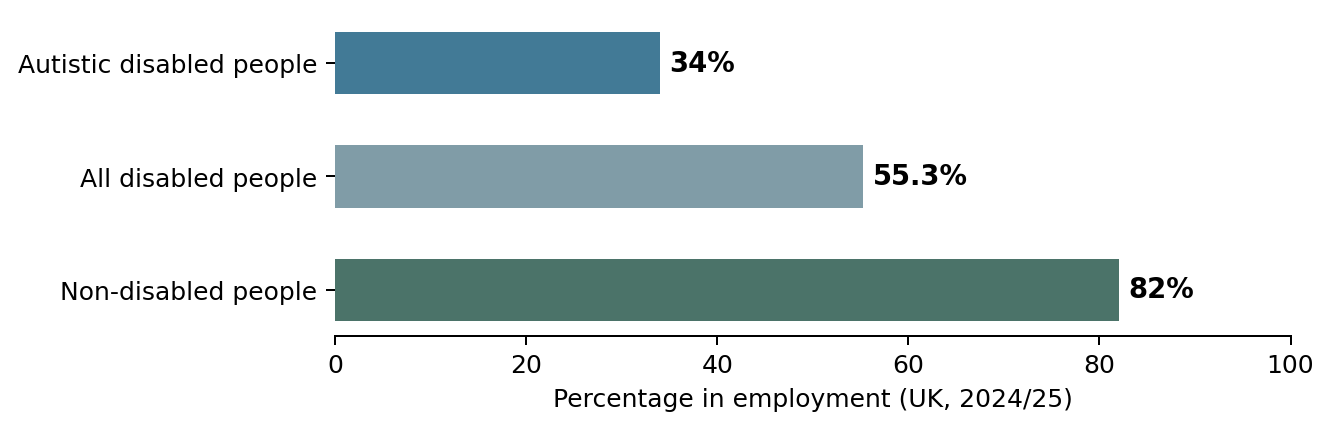
Click the diagram above to view it at full size in a new tab.
Several barriers may contribute to this gap. Recruitment processes can place heavy emphasis on interviews, rapid verbal responses and social presentation rather than practical ability. Unclear instructions, sensory demands, inflexible working arrangements, inaccessible travel and limited understanding of autism can also make obtaining or sustaining employment difficult. These barriers differ between individuals and workplaces. 2
The figures should not be interpreted as evidence that autistic people lack ability or motivation. The purpose of these four essays is to consider practical ways of identifying suitable work, preparing applications, approaching interviews and securing appropriate support in employment.
Essay 1 — Finding Employment: Research, Opportunities and Support
Finding suitable work can be a demanding process for anyone. For some autistic people, the difficulty lies not in performing a job but in identifying vacancies, interpreting vague advertisements, managing repeated applications and navigating recruitment systems. Searching for employment can become a full-time activity without the structure, support or predictable rewards of paid work.
Understanding employment statistics
It is important to distinguish between unemployment and not being in employment. Not all autistic people who are outside paid employment are actively seeking work. Some may be studying, caring for family members, experiencing ill health or unable to work because of their individual circumstances. Others may wish to work but face significant barriers to obtaining suitable employment. Employment statistics therefore demonstrate the extent of the employment gap but do not explain why each individual is outside paid employment.
1. Identifying suitable work
A useful starting point is to consider both what a person can do and the conditions in which they can do it sustainably. Qualifications and interests matter, but so do noise, lighting, working hours, travel, communication demands, interruptions and the availability of clear instructions. A job that looks suitable on paper may be exhausting in practice; conversely, an unfamiliar occupation may prove a good match if the environment is supportive.
Applicants can prepare two short lists: essential requirements, such as a manageable journey or particular hours, and preferences that are negotiable. This helps narrow a search without assuming that every workplace in an industry is identical.
Personal strengths, interests and working preferences
Before searching for vacancies, applicants may find it helpful to identify their core strengths, interests, qualifications and preferred working conditions. Strengths may include specialist knowledge, careful attention to detail, creativity, practical skills, research, analytical thinking or reliability; these should be considered individually rather than assumed to apply to every autistic person. Enjoyment matters as well as ability: work that draws on a genuine interest may be more rewarding and sustainable.
The pattern of working hours is equally important. A predictable nine-to-five routine may be reassuring for one person, while another may prefer part-time employment, flexible start and finish times, compressed hours, hybrid arrangements or working from home. Flexible working does not automatically mean unpredictable hours: an applicant may need both flexibility and a consistent agreed schedule. Consider whether shifts, overtime, weekends and changes to rotas are manageable, and whether sufficient time remains for rest and recovery.
An applicant can separate essential requirements from preferences. For example, a quiet workspace and reliable hours may be essential, whereas a particular industry or location may be negotiable. The aim is to find employment that fits the person’s abilities and circumstances, not simply to accept the first available vacancy.
Practical and logistical factors
A suitable job must also be realistic to reach, affordable to undertake and sustainable over time. Before applying, consider the actual door-to-door commute in both directions, including walking, waiting, changes of transport and the return journey after a tiring day. A trial journey at the expected start or finish time can reveal difficulties that are not obvious from a route planner.
Public transport may involve crowded vehicles, noise, delays, unfamiliar changes and uncertainty. Driving can involve traffic congestion and parking costs. Some autistic people find unexpected disruptions particularly stressful; others may be more affected by sensory demands or exhaustion. Where appropriate, ask whether flexible start times, home working or agreed arrangements for disrupted travel are possible.
Winter travel deserves specific attention. Snow, ice, untreated pavements, freezing temperatures, cancelled buses or trains and early darkness can make an otherwise straightforward journey difficult or unsafe. Consider whether the route remains accessible in poor weather, whether an alternative exists and how to contact the employer if travel becomes unsafe. A clear contingency plan may reduce uncertainty and anxiety.
Compare advertised salary with estimated take-home pay after relevant deductions, rather than relying on the headline figure alone. Budget for travel, parking, meals, work clothing and any additional support or equipment. Examine contractual hours, annual leave, occupational sick pay, pension arrangements, training opportunities and any other employer benefits. A higher salary does not necessarily make a job better if the commute and working conditions are difficult to sustain.
For applicants receiving benefits, the financial effect of starting work depends on the particular benefit and personal circumstances. Means-tested support may change with earnings, whereas disability benefits such as Personal Independence Payment or Adult Disability Payment are not means-tested, although their own eligibility rules still apply. Seek an individual benefits calculation or welfare-rights advice before making decisions; do not assume that all benefits automatically stop when work begins. 5, 6, 7
Researching employers with inclusive recruitment practices
As well as searching by occupation, applicants can research organisations that have publicly committed to disability inclusion. The UK Government’s Disability Confident scheme maintains a register of participating employers (gov.uk/government/publications/disability-confident-employers-that-have-signed-up). Specialist disability employment services and websites, including Evenbreak (evenbreak.co.uk), may also provide useful starting points. Local authorities, public bodies, charities and private employers may advertise their recruitment adjustments and inclusion policies on their careers pages. 3, 4
A Disability Confident badge or equality statement is a useful starting point, not a guarantee that every team understands autism. Look for concrete information: whether interview questions can be supplied in advance, whether alternative assessments are offered, whether reasonable adjustments are clearly explained and whether support is available after recruitment. If necessary, ask a recruitment contact for clarification before applying.
Checklist: is this vacancy suitable?
| Factor | Questions to consider |
|---|---|
| Strengths and interests | Does the work use my abilities and reflect what I enjoy? |
| Working pattern | Do I want fixed nine-to-five, part-time, flexible, hybrid or home working? |
| Routine and recovery | Are hours predictable, and will I have sufficient recovery time? |
| Commute | Can I manage the journey both ways, including sensory and travel demands? |
| Winter conditions | Will snow, ice, darkness or cancellations make travel unsafe or unreliable? |
| Pay and costs | What is my likely take-home pay after deductions and work-related expenses? |
| Employment benefits | What annual leave, sick pay, pension and training arrangements apply? |
| Existing benefits | Do I need independent advice on how earnings may affect support? |
| Employer inclusion | Is there evidence of accessible recruitment and reasonable adjustments? |
Worked example: comparing two possible jobs
Consider two hypothetical vacancies. Job A pays £28,000 a year for fixed office hours, but requires a 75-minute journey each way on crowded public transport. Job B pays £25,000 a year, offers two days working from home and is a 20-minute journey away on office days. Although Job A has the higher advertised salary, its additional fares, travel time and possible sensory fatigue may make Job B more sustainable for some applicants. Another person may prefer the structure, salary or opportunities offered by Job A. The better choice depends on individual needs and actual take-home pay, not salary alone.
Before deciding, compare net earnings after tax, National Insurance and any pension contributions; weekly fares or fuel; hours spent travelling; sensory demands; predictability; opportunities for progression; and the amount of time available for rest. Check how employment might affect any means-tested benefits with a qualified adviser rather than assuming that all disability benefits stop when work begins.
2. Where to look for vacancies
| Source | How it can help |
|---|---|
| Local newspapers and community notices | Useful for local employers, smaller businesses and vacancies not widely advertised. |
| Online job boards | Search by location, salary, hours and occupation; set alerts to reduce repeated searching. |
| Employer websites | Look for careers pages at councils, universities, charities, retailers and the NHS. |
| Jobcentre Plus / Jobs & Benefits | Ask about vacancies, employment programmes and practical job-search support. |
| Recruitment agencies | Can match candidates with temporary or permanent roles, although the recruitment process varies. |
| Direct approaches | Send a speculative CV and short letter to organisations of particular interest. |
Indeed (uk.indeed.com), Reed (reed.co.uk), Find a Job (gov.uk/find-a-job) and sector-specific recruitment websites are examples. Vacancies should always be checked against the employer’s official website where possible. Be cautious of advertisements requesting upfront payments or unnecessary personal information. 22
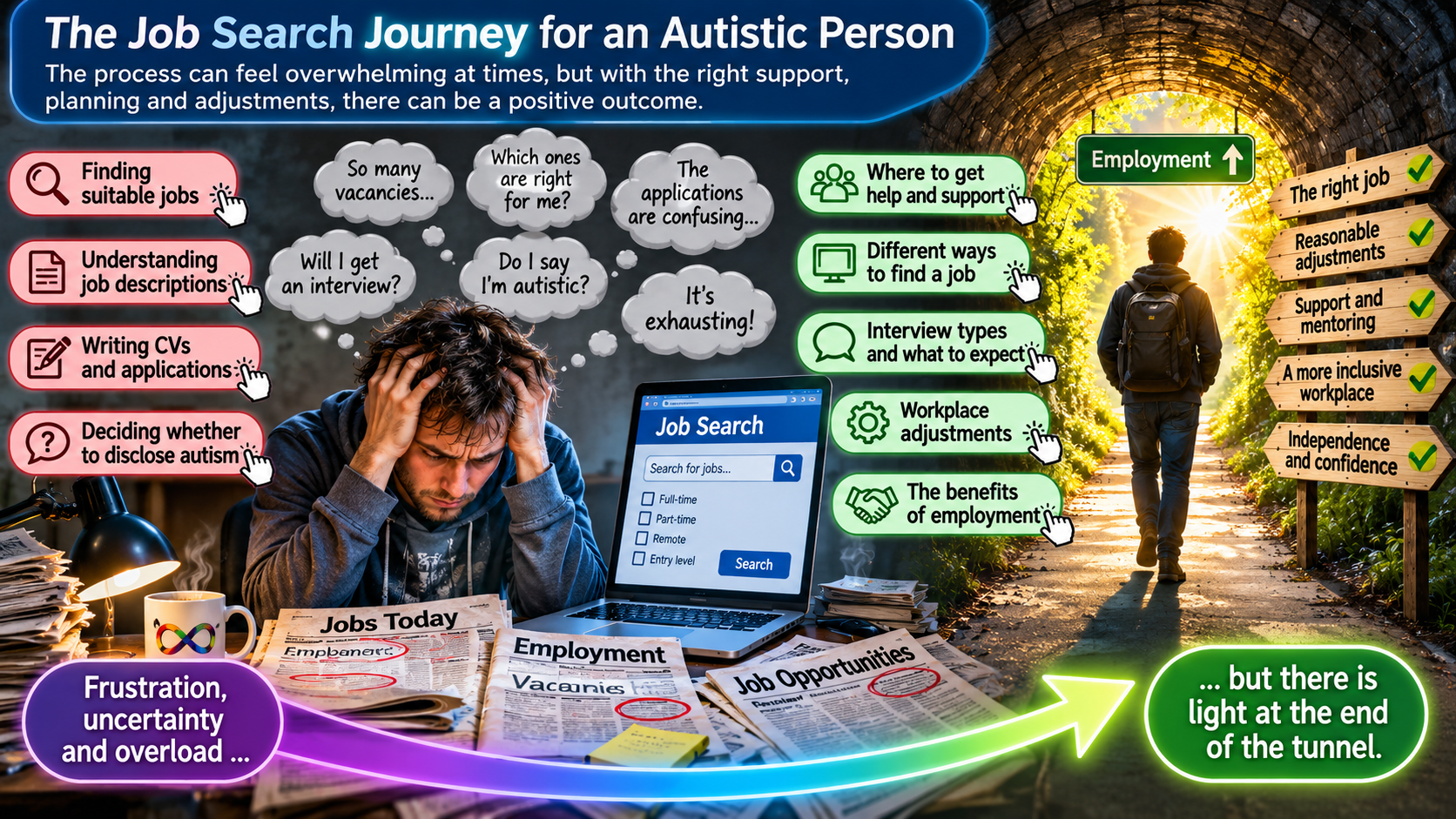
Click the diagram above to view it at full size in a new tab.
3. Contacting employers directly
A speculative application is a short enquiry to an organisation that has not advertised a vacancy. It can explain the applicant’s relevant skills, why the organisation interests them and the kind of opportunity they seek. A CV may be attached. This does not guarantee an interview, but it can introduce the applicant to an employer and occasionally reveal forthcoming opportunities.
A practical approach is to identify a small number of organisations, find the appropriate contact, send a concise enquiry and record the date. If no response arrives, one polite follow-up may be appropriate. Repeated contact is rarely useful.
4. Managing the research without becoming overwhelmed
Vacancy websites can present hundreds of listings, each with different requirements. Some autistic applicants may spend a great deal of time checking wording, comparing conditions or trying to decide whether they meet every criterion. A structured routine can make the process more manageable: set a time limit, save promising vacancies, keep a simple tracking sheet and take breaks. Applicants do not necessarily need to satisfy every desirable criterion, but must consider genuinely essential qualifications or legal requirements.
- Record the employer, role, closing date, application stage and next action.
- Save a copy of the vacancy description; it may disappear after the closing date.
- Ask someone trusted to help interpret unclear wording or prioritise applications.
- Schedule recovery time after particularly demanding research or correspondence.
5. Where to obtain help in the four UK nations
| Nation | Starting points |
|---|---|
| England | National Careers Service — nationalcareers.service.gov.uk; Jobcentre Plus and local supported employment services. |
| Scotland | Skills Development Scotland / My World of Work — myworldofwork.co.uk; local employability partnerships. |
| Wales | Careers Wales — careerswales.gov.wales; local employability services. |
| Northern Ireland | Careers Service — nidirect.gov.uk/campaigns/careers; Jobs & Benefits offices. |
Support differs across the four UK nations. The following public services and specialist organisations provide starting points. Availability and eligibility vary, and a service may provide general careers guidance rather than autism-specific assistance.
England
The National Careers Service provides careers information and guidance. Jobcentre Plus work coaches can discuss employment support and referrals. Access to Work may help eligible applicants and employees with additional disability-related costs, such as workplace support or some travel needs. 13, 14
Further information: National Careers Service | Access to Work
Scotland
Skills Development Scotland and My World of Work offer careers advice, planning resources and information about training. Fair Start Scotland has ended for new referrals; ask a local employability service or Jobcentre Plus about current provision. Access to Work is available in Scotland for eligible people. 13, 15
Further information: My World of Work | Access to Work
Wales
Careers Wales provides careers guidance and job-search resources. Working Wales can help people explore employment and training options. Access to Work is available in Wales for eligible applicants and employees. 16, 20
Further information: Careers Wales | Working Wales
Northern Ireland
The Careers Service provides guidance through nidirect. Jobs and Benefits offices and the Department for Communities can advise on local employment programmes. Northern Ireland has different disability-employment support arrangements from Great Britain; check locally rather than assuming that the GB Access to Work scheme applies. 17, 21
Further information: NI Careers Service | nidirect employment support
Across the UK, the National Autistic Society and specialist organisations such as Employment Autism may provide useful information about autism, recruitment and workplace needs. Applicants should check whether local support is available and whether an organisation offers individual assistance or general guidance. 18, 19
6. A hopeful but realistic journey
Job searching can bring frustration, uncertainty and rejection. Rejection is not necessarily evidence of an applicant’s inability to work; it may reflect competition, an unsuitable recruitment method or a mismatch with a particular role. Appropriate advice, adjustments and manageable search strategies can improve access to opportunities. There may be light at the end of the tunnel, although the journey is not always straightforward.
7. The Author’s Experience – Finding Work
The author never looked forward to searching for new employment, finding the process particularly stressful and emotionally demanding. This was especially evident following the completion of higher education, when considerable time and effort were invested in identifying suitable employment opportunities.
During the final year of a general engineering course at college, students were required to undertake a work placement. A lecturer was assigned to assist students in securing suitable placements, including providing guidance on preparing covering letters and CVs.
Having already qualified as an electrician and electrical engineer during military service, the author was keen to secure a placement that would build upon existing qualifications, technical knowledge and practical experience. However, the lecturer appeared to concentrate primarily on organisations with which the college had established relationships.
With only one month remaining before the placements were due to commence, none of the students had secured a position. The author therefore decided to take the initiative and independently research companies that were likely to employ electrical engineers. Speculative letters were sent to several organisations, including one specialising in naval engineering work for the Ministry of Defence.
The company responded promptly and invited the author to attend an interview, which subsequently resulted in a six-month work placement. Although the lecturer was apparently less than pleased that the author had pursued an independent approach, the author was the only student in the class to secure a placement at that stage.
Following the completion of a Master of Business Administration (MBA), the author experienced a considerably more challenging period of unemployment. Several months were spent searching for suitable positions, reading newspapers, visiting job centres in larger towns and cities, and registering with employment agencies.
The author regularly spent almost twelve hours a day researching vacancies and pursuing employment opportunities. Despite this considerable commitment, very few responses were received from prospective employers. The experience became increasingly demoralising, emotionally exhausting and, at times, soul-destroying.
Financial pressures added to these difficulties. Although the author did not qualify for unemployment benefit, fortnightly visits to the unemployment office were still required to maintain National Insurance contribution credits. The local library became an important resource, providing access to daily newspapers without the additional expense of purchasing them.
Eventually, through registering with a local employment agency, the author secured an opportunity with one of Scotland’s largest companies, where employment continued for seventeen years.
Looking back, the author recognises how uncertainty, the absence of responses from prospective employers and the lack of a predictable outcome contributed significantly to stress and anxiety. The determination to research opportunities thoroughly and independently was a considerable strength, although the intensity with which employment was pursued also resulted in emotional exhaustion.
The author’s experiences demonstrate the importance of perseverance, independent research and exploring alternative routes into employment. However, they also highlight the considerable psychological burden that searching for employment can place upon autistic individuals, particularly when their efforts appear to go unrecognised and there is little feedback or reassurance from prospective employers.
8. Conclusion
A successful search begins with finding work that suits the individual rather than forcing the individual to fit every vacancy. Clear criteria, practical assistance and a sustainable pace can make the process more accessible. The next stage is presenting relevant experience in a CV and application.
9. References and further reading
1. House of Commons Library: Autism policy and services — Employment — Read source
2. Buckland Review of Autism Employment — Read source
3. Disability Confident employers — Read source
4. Evenbreak — Read source
5. Benefits calculators — Read source
6. Personal Independence Payment — Read source
7. Adult Disability Payment — Read source
8. Equality Act 2010 — Read source
9. Disability Discrimination Act 1995 — Read source
10. Acas: Disability discrimination and reasonable adjustments — Read source
11. Equality and Human Rights Commission — Read source
12. Equality Commission for Northern Ireland — Read source
13. Access to Work — Read source
14. National Careers Service — Read source
15. Skills Development Scotland / My World of Work — Read source
16. Careers Wales — Read source
17. Northern Ireland Careers Service — Read source
18. National Autistic Society — Read source
19. Employment Autism — Read source
20. Working Wales — Read source
21. Northern Ireland employment support — Read source
22. Find a Job — Read source