Tiredness, Fatigue and Burnout
Understanding the causes and consequences of autistic exhaustion, recognising warning signs and identifying interventions that may support recovery.
1. Introduction
Tiredness and fatigue are common experiences for many autistic people. However, the severity and persistence of autistic fatigue can extend considerably beyond everyday tiredness. Functioning in a predominantly neurotypical world can demand sustained physical, cognitive, emotional and sensory effort.
When demands repeatedly exceed the capacity to cope and opportunities for recovery are insufficient, exhaustion may accumulate and contribute to autistic burnout.1,2
Some autistic people struggle to recognise early signs of tiredness. Others feel compelled to demonstrate exceptional competence, continuing to meet responsibilities despite considerable internal distress. Sustained camouflaging has been associated with exhaustion.3 Understanding these possible pathways is essential to prevention and support.
2. Everyday Tiredness vs. Autistic Fatigue
Everyday tiredness is a natural response to exertion or insufficient sleep and often improves with rest. Autistic fatigue may arise from a combination of sensory processing, social communication, masking and other demands. A supermarket visit, for example, can involve noise, crowds, decisions and anxiety, leaving an individual exhausted despite limited physical exertion.
| Everyday tiredness | Autistic fatigue |
|---|---|
| Often follows exertion or poor sleep | May follow sensory, social or cognitive demands |
| Usually improves with rest | May persist despite sleep |
| Often identifiable and temporary | May accumulate over days or longer |
| Usually recognisable | May go unnoticed until severe |
| Rest may restore functioning | Environmental adjustments may also be necessary |
These are illustrative distinctions, not diagnostic criteria. Persistent fatigue warrants consideration of other health conditions.
3. The Different Forms of Autistic Fatigue
Physical fatigue: bodily heaviness, reduced stamina and a need to sit or lie down. Cognitive fatigue: difficulties with memory, concentration, planning and decisions.
Emotional fatigue: exhaustion from managing stress and distress. Social fatigue: the effort of interaction, even when enjoyable. Sensory fatigue: reduced capacity to tolerate environmental stimulation.
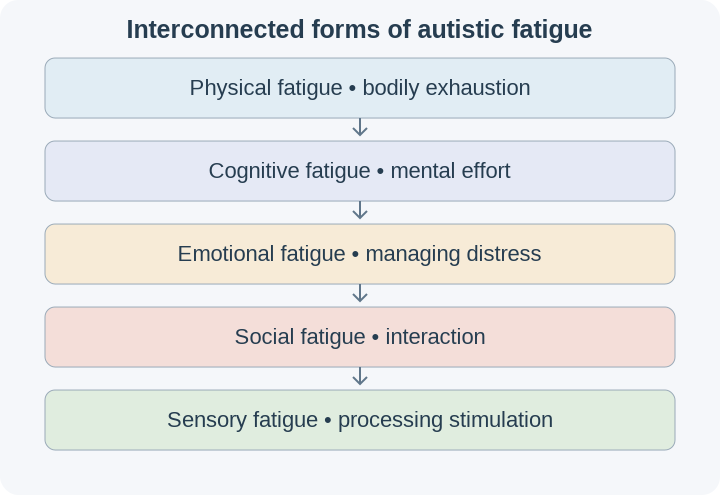
Conceptual illustration, not clinical data.
4. What Is Autistic Burnout?
Autistic burnout describes a prolonged state of exhaustion and reduced functioning associated with cumulative demands and inadequate support. Raymaker and colleagues described three principal features:
“chronic exhaustion, loss of skills, and reduced tolerance to stimulus.”1
Tasks such as preparing meals, personal hygiene, answering emails and communicating may become difficult. Burnout can persist for months, although experiences and duration vary. It is not yet a standalone clinical diagnosis with universally agreed criteria.2
5. Autistic Burnout vs. Occupational Burnout and Depression
Occupational burnout concerns chronic workplace stress. Depression may involve persistent low mood or loss of pleasure. A person experiencing autistic burnout may still wish to pursue interests but lack the capacity to do so. These conditions can overlap and require appropriate assessment.2,4
| Characteristic | Autistic burnout | Occupational burnout | Depression |
|---|---|---|---|
| Context | Across life settings | Workplace | Across life settings |
| Exhaustion | Common | Common | Common |
| Sensory tolerance | Often reduced | Not defining | May change |
| Functional skills | May become inaccessible | Work efficacy reduced | Function may decline |
| Low mood | May coexist | May occur | Core symptom or loss of pleasure |
6. Why Are Autistic People Susceptible to Burnout?
Repeated demands, insufficient accommodations, stigma and camouflaging may contribute to burnout. A 2025 systematic review synthesised 48 studies involving approximately 4,000 autistic people; its sample was predominantly adults with relatively strong verbal or intellectual abilities, limiting generalisation.2
The perceived need to perform better than others. Some autistic people, following years of criticism or being underestimated, may feel they must demonstrate higher standards of competence than their peers. They may work longer hours, volunteer for additional duties, refuse assistance and feel guilty about resting. Praise may reinforce excessive commitment, whilst others come to expect exceptional performance as normal. This is a possible pathway, not an established universal autistic trait.
An ability to perform a task does not mean that it can be sustained without adverse consequences.

Conceptual illustration, not clinical data.
7. Difficulties Recognising Tiredness and Exhaustion
Interoception concerns the perception and interpretation of internal bodily signals. Some autistic people may have difficulty identifying fatigue, hunger or thirst, or distinguishing these from anxiety and overload. Differences vary between individuals.
Intense concentration, sometimes explained through the theory of monotropism, may make it difficult to redirect attention to physical needs. Someone engrossed in research or voluntary work may overlook meals, hydration and breaks. This is a plausible explanation rather than proof of an individual cause.
Persistent exhaustion may also become familiar and be regarded as normal. Warning signs may only become apparent when functioning has already deteriorated.

Conceptual illustration, not clinical data.
8. Primary Causes and Energy Drainers
Masking and camouflaging: monitoring speech, eye contact and behaviour or suppressing natural responses can demand sustained effort.3
Sensory overload: noise, lighting, smells and crowds may increase exhaustion. Social expectations: interpreting unwritten rules and managing misunderstandings may require considerable effort.
Stress and anxiety: uncertainty and replaying interactions may limit recovery. Perfectionism: difficulty delegating or accepting satisfactory work can prolong activity. Executive functioning: planning, switching tasks and decisions may become harder as fatigue increases.
Life changes and discrimination: employment, caring, bereavement, bullying and exclusion may add demands. Insufficient sleep: disrupted rest can reduce capacity. Coexisting conditions: pain, sleep disorders, depression and ME/CFS may compound fatigue.
9. The Accumulation of Fatigue and Development of Burnout
Energy reserves can be compared with a bank account: repeated withdrawals without sufficient deposits may leave little capacity for further demands. Ordinary rest may become insufficient, and a minor additional demand can appear to precipitate a crisis. The underlying pressures may have accumulated for months. Not every episode of fatigue progresses to burnout.

Conceptual illustration, not clinical data.
10. Signs and Symptoms
Physical: persistent tiredness, daytime sleep, reduced stamina, headaches and changes in sleep. Cognitive: forgetfulness, slower processing, word-finding difficulties and impaired planning.
Emotional: irritability, anxiety, frustration and feeling overwhelmed. Sensory: increased sensitivity to light, sounds and textures. Social: withdrawal, reduced communication, increased meltdowns or shutdowns.
A particularly distressing feature is difficulty accessing previously acquired skills, including personal care, preparing meals and managing responsibilities. These changes are not necessarily permanent.2
11. Reduced Ability to Mask
An individual who has concealed discomfort for years may find that maintaining an outward appearance of confidence is increasingly difficult. Families and colleagues may misunderstand the change because previous functioning seemed effortless. Reduced masking capacity may reflect exhaustion rather than a change in autism itself.
12. Recognising Different Stages of Exhaustion
A personalised warning system can help identify when demands should be reduced. It is not a validated clinical assessment.
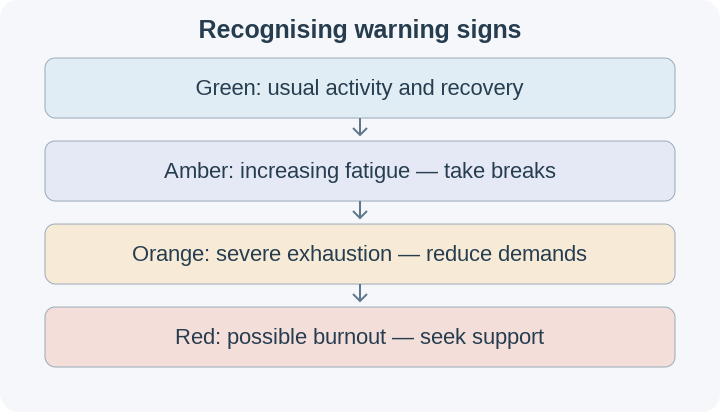
Conceptual illustration, not clinical data.
13. Impact on Everyday Life
| Area | Potential consequences |
|---|---|
| Employment and education | Absence, difficulty completing work |
| Relationships | Withdrawal, misunderstandings, irritability |
| Independent living | Difficulty with meals, hygiene and finances |
| Voluntary work | Reduced ability to maintain commitments |
| Health | Disrupted sleep, reduced self-care and distress |
Loss of income, purpose or independence can create further pressures, making recovery more difficult.
14. Children and Young People
A child may appear academically successful or well behaved at school while expending considerable effort to cope. At home, exhaustion may become apparent through withdrawal, meltdowns, reduced ability to complete homework or reluctance to return to school. Academic achievement is not proof of wellbeing.
Support may include quiet spaces, flexible homework, predictable routines and sensory accommodations. Significant changes should be assessed professionally. General autism guidance supports individualised adjustments.5,6 NICE provides general guidance for under-19s.7
15. Interventions to Prevent and Mitigate Burnout
There is no universally established treatment programme. Practical approaches include energy management, planned breaks, reducing demands, self-understanding and suitable support.
Pacing: avoid scheduling several demanding activities together; allow recovery before and after outings. Early warning signs: use reminders to eat, drink and rest, and monitor changes in concentration or sensory tolerance.
Realistic expectations: decline additional tasks, delegate and accept assistance. Masking: reduce pressure to conceal autistic characteristics where safe; disclosure remains the individual’s choice. Sensory adjustments: quieter surroundings, comfortable clothing and suitable lighting.
Sleep and rest: address disrupted sleep and allow restorative downtime. Professional support: an autism-informed psychologist or occupational therapist may help with boundaries, anxiety and practical adjustments. NICE and SIGN offer general autism guidance, not dedicated burnout treatment protocols.5,6 The National Autistic Society also offers practical information.
16. Energy Drainers and Replenishers
Activities that restore energy differ between individuals. Even enjoyable activities can be demanding; photography, reading or gardening should remain optional and manageable.
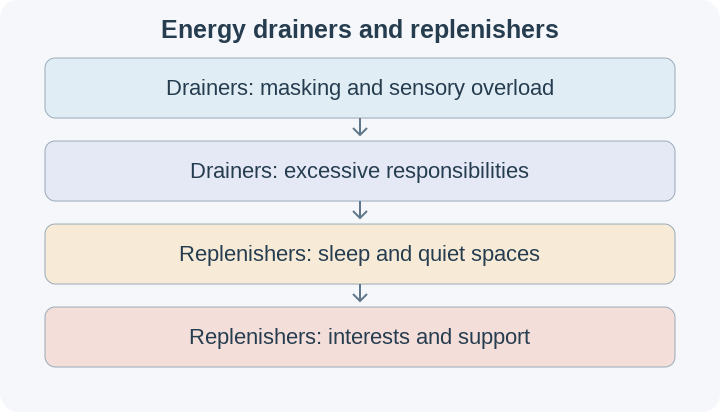
Conceptual illustration, not clinical data.
17. Recovering from Autistic Burnout
Recovery may require substantial time and lifestyle changes. Reduce immediate pressures, provide practical assistance, allow rest and reintroduce activities according to individual capacity. Returning to an unsustainable lifestyle may increase recurrence risk. The aim is sustainable wellbeing, not simply previous performance.
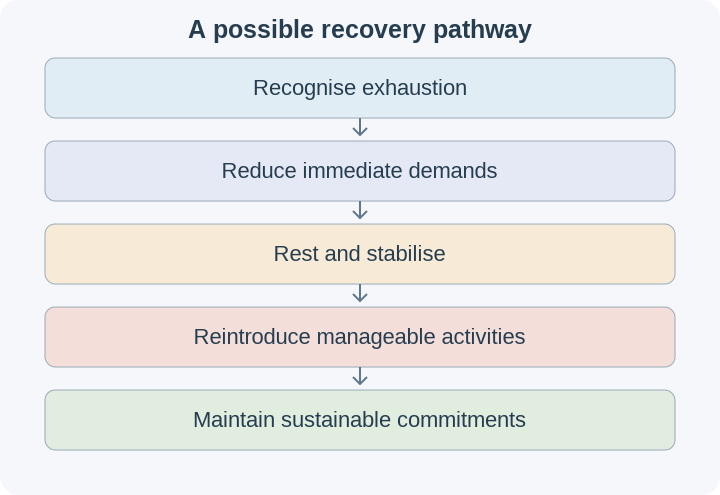
Conceptual illustration, not clinical data.
18. Partners, Families, Carers and Friends
Close contacts may recognise irritability, withdrawal or excessive sleeping before the person notices these changes. Agree respectful signals for breaks, share responsibilities, offer assistance without pressure and recognise fluctuating abilities. Families and carers also need appropriate support.
19. Coexisting Conditions and Medical Assessment
Persistent fatigue should not automatically be attributed to autism. Sleep apnoea, anaemia, thyroid disorders, diabetes, chronic pain, medication effects and depression can contribute. Sleep apnoea interrupts breathing and restorative sleep.
ME/CFS is distinct from burnout and may involve post-exertional malaise: delayed worsening after activity. Fixed increases in activity regardless of symptoms should not be used for ME/CFS.8
Seek medical advice for persistent or worsening fatigue, significant functional changes or unexplained symptoms.9 In Scotland, NHS 24 (111) provides urgent advice; call 999 if there is immediate danger to life.
Further practical information is available from the National Autistic Society.10
20. The Author’s Lived Experiences and Observations of Autistic Fatigue and Burnout
Through extensive discussions with autistic children, adolescents and adults of all ages, the author has identified tiredness and fatigue as recurring experiences. The author is no exception, having continually striven to achieve and perform to a higher standard than others, often at considerable expense to their physical, mental and emotional wellbeing.
Several autistic women with whom the author has spoken have described the overwhelming exhaustion associated with prolonged masking. Having reached a point where maintaining this outward appearance was no longer sustainable, they made a conscious decision to embrace their autistic identity and no longer conceal their natural characteristics. They recognised that their own health and wellbeing were of greater importance than conforming to the social expectations of friends, acquaintances and wider society.
The author has also encountered autistic individuals who have experienced severe autistic burnout, requiring several months to recover. In some instances, the severity of their exhaustion has resulted in them relinquishing their employment to concentrate upon their recovery. Following an improvement in their health, they have returned to employment, only to experience further episodes of burnout several years later. This creates a vicious cycle of achievement, exhaustion, burnout and recovery.
The author’s own experiences of tiredness and fatigue are further compounded by several coexisting medical conditions, including diabetes, ME/CFS and obstructive sleep apnoea. Additionally, the side effects of prescribed medication contribute to the author’s overall levels of exhaustion.
Throughout the author’s professional career, an inherent desire to excel resulted in the development of considerable expertise across numerous fields. In their capacity as a project manager, the author was frequently called upon to assume responsibility for complex projects that others had experienced considerable difficulty managing.
Although this determination resulted in significant professional accomplishments, the personal cost of maintaining such high standards was considerable.
Following retirement, these behavioural patterns continued within the author’s voluntary activities. The same determination to excel, demonstrate competence and make a meaningful contribution to society has repeatedly resulted in excessive commitments, prolonged exhaustion and episodes of burnout.
Despite experiencing these difficulties, the author frequently continues to undertake responsibilities beyond sustainable levels. Intense concentration, a strong sense of responsibility and difficulty recognising or responding to the early warning signs of exhaustion may all contribute to this behaviour.
The author’s partner has frequently expressed concerns regarding the potential consequences of excessive workloads and the continual pressure the author places upon themselves. Despite these warnings, the author often continues regardless, prioritising the completion of responsibilities over their personal health and wellbeing.
These lived experiences illustrate the considerable disparity that may exist between an autistic person’s intellectual and professional capabilities and their physical, mental and emotional capacity to sustain such levels of performance.
They also demonstrate that recognising the existence of fatigue does not necessarily mean that an individual is able to modify the behavioural patterns contributing to it.
The ability to achieve should not be confused with the ability to sustain achievement without detriment to one’s health and wellbeing.
21. Conclusion
Autistic fatigue and burnout may reflect the accumulated cost of navigating environments that do not adequately accommodate autistic needs. Some people also struggle to recognise exhaustion or feel compelled to demonstrate exceptional capability. Early recognition, realistic boundaries, rest and environmental adjustments may reduce unnecessary demands.
An individual should not have to sacrifice health and wellbeing to demonstrate competence or value. Achievements must be considered alongside the physical, cognitive and emotional cost of sustaining them.
22. Scientific Articles and References
1. Raymaker DM et al. (2020).
Defining Autistic Burnout: “Having All of Your Internal Resources Exhausted Beyond Measure and Being Left with No Clean-Up Crew”.
Autism in Adulthood, 2(2), 132–143. Participatory research describing burnout, its causes and recovery.
2. Ali D et al. (2025).
Burnout as experienced by autistic people: A systematic review.
Clinical Psychology Review, 122, 102669. Synthesises 48 studies involving approximately 4,000 autistic people.
3. Hull L et al. (2017).
“Putting on My Best Normal”: Social Camouflaging in Adults with Autism Spectrum Conditions.
Journal of Autism and Developmental Disorders, 47, 2519–2534. Explores motivations and costs of camouflaging.
23. Further Reading, Clinical Guidelines and Support Strategies
4. World Health Organization.
Burn-out an occupational phenomenon.
Explains the occupational scope of burnout in ICD-11.
5. NICE.
CG142: Autism spectrum disorder in adults: diagnosis and management.
General guidance on individualised support and adjustments.
6. SIGN (2016).
SIGN 145: Assessment, diagnosis and interventions for autism spectrum disorders.
Archived copy of general autism guidance; current status on SIGN’s website has not been confirmed.
7. NICE.
CG170: Autism spectrum disorder in under 19s: support and management.
General support guidance for children and young people.
8. NICE.
NG206: ME/CFS: diagnosis and management.
Guidance on ME/CFS, including energy management and post-exertional malaise.
9. NHS.
Tiredness and fatigue.
Explains possible medical causes of persistent fatigue and when to seek help.
10. National Autistic Society.
Autistic fatigue and burnout.
Practical information on autistic exhaustion and support.
Disclaimer
This educational essay is not a substitute for medical advice. Diagrams are original conceptual illustrations, not validated assessment tools. Experiences vary. Scientific research remains developing.