The Importance of Comfort Rooms and Safe Spaces for Autistic People
1. Introduction
For some autistic individuals, everyday life involves a continual process of adapting to environments that do not necessarily accommodate their neurological, psychological or sensory requirements. Attending meetings, travelling on public transport, visiting supermarkets and participating in social activities can result in considerable physical and mental exhaustion.
Having access to a familiar environment in which these demands are temporarily removed can play an important role in maintaining health and wellbeing. Such an environment may be referred to as a comfort room or personal safe space.
2. What is a comfort room?
A comfort room is a personal space in which an autistic individual feels physically, emotionally and psychologically secure. It does not necessarily require specialist sensory equipment or expensive alterations. It may simply be a bedroom, study, spare room, garden room or designated area within the home.
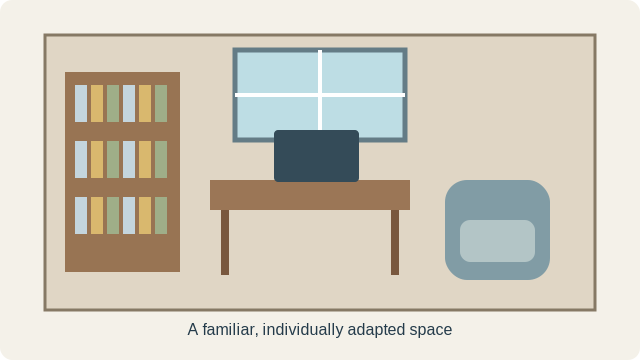
Original schematic illustration.
The defining characteristic is not its appearance but the security, familiarity and personal control it provides. It is somewhere to withdraw temporarily from external demands without being expected to communicate, socialise or modify natural behaviour. 1
3. The psychological importance of a safe space
Continually adapting to the requirements of the neurotypical world can create considerable emotional pressure. A familiar environment provides an opportunity for that pressure to be reduced. 1,2
| Psychological requirement | Potential benefit |
|---|---|
| Security | Reduced vulnerability |
| Predictability | Reduced anxiety about unexpected events |
| Personal control | Greater independence |
| Privacy | Freedom from judgement |
| Emotional regulation | Processing difficult experiences |
| Sensory regulation | Relief from uncomfortable stimulation |
| Personal identity | Freedom to behave naturally |
| Recovery | Restoring energy |
| Familiarity | Reassurance through known surroundings |
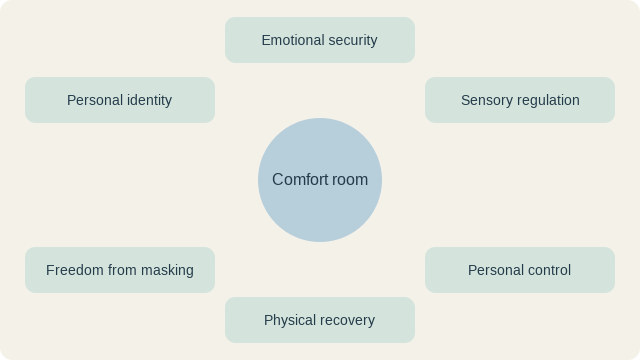
Knowing that they can return to a place of safety may provide reassurance to participate in activities outside the home.
4. Regaining control over one’s environment
Outside the home, others often determine noise, lighting, temperature, physical proximity and social interaction. Within a comfort room the individual may regain control over these experiences. 2,3
| External environment | Personal comfort room |
|---|---|
| Unpredictable noise | Controlled sound levels |
| Uncomfortable lighting | Preferred lighting |
| Unfamiliar smells | Familiar surroundings |
| Unexpected physical contact | Personal space |
| Social expectations | Freedom from social demands |
| Unexpected interruptions | Greater predictability |
| Limited privacy | Personal privacy |
The need for control should not be confused with a desire to control other people. It represents a need to regulate one’s own experiences.
5. Freedom from autistic masking
Many autistic individuals consciously or unconsciously suppress their natural characteristics. Masking can require considerable mental effort. 1,6
- Maintain eye contact
- Monitor facial expressions and body language
- Rehearse conversations
- Suppress stimming
- Conceal sensory discomfort
- Appear confident and socially comfortable
- Hide anxiety and distress
Within a comfort room these expectations may be removed, allowing the individual to behave naturally without continually monitoring how others perceive them.
6. The importance of personal identity
A comfort room may express an individual’s personality and identity through books, photographs, computers, musical equipment, models, collections or other hobbies. Familiar possessions and enjoyable activities can provide reassurance and help redirect attention away from distressing experiences. 1
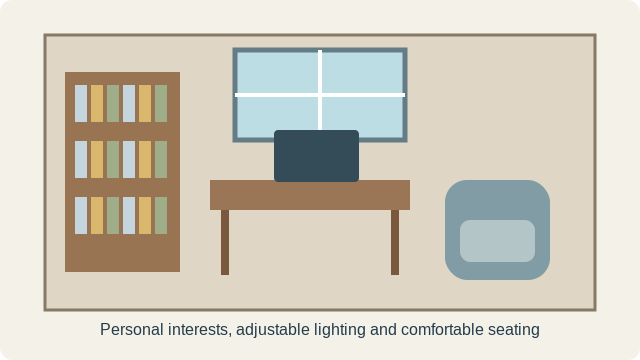
Original schematic illustration.
The room becomes an extension of the individual’s identity rather than an environment governed by the expectations of others.
7. Designing a comfort room
There is no standard design. Its appearance and contents should reflect the requirements and sensory preferences of the individual. 2,5
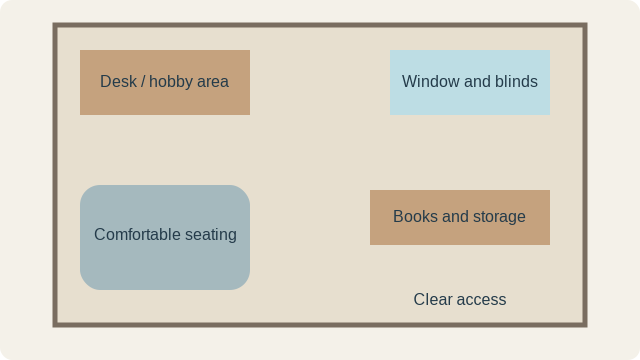
| Feature | Purpose |
|---|---|
| Adjustable lighting | Reduce visual discomfort |
| Curtains or blinds | Control natural light and privacy |
| Comfortable seating | Physical relaxation |
| Noise reduction | Limit unwanted sounds |
| Familiar possessions | Emotional reassurance |
| Blankets and cushions | Preferred tactile experiences |
| Personal hobbies | Enjoyment and regulation |
| Headphones | Manage unwanted noise |
| Adjustable temperature | Physical comfort |
| Drinking water | Hydration |
| Unobstructed access | Independence and safety |
Not everyone requires a quiet, dimly lit environment. Some prefer brighter colours, music, movement or stimulation. The environment should accommodate the individual.
8. Returning home and the need to decompress
After returning from a demanding environment, an autistic individual may need to disengage from the outside world. Although physically removed from the environment, their brain may still be processing conversations and sensory information. They may wish to sleep, listen to music, engage in a hobby or sit without being required to communicate. Even ordinary conversations may temporarily represent an additional demand. 1
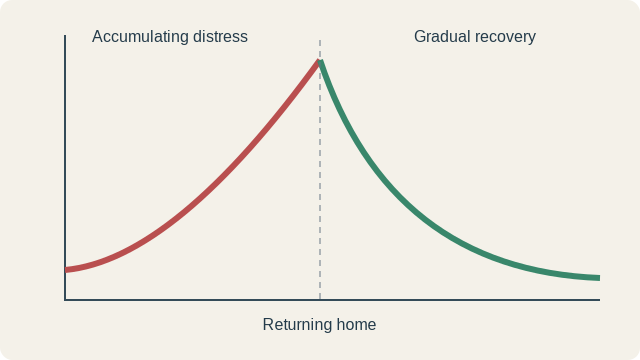
Illustrative model, not measured data.
Recovery may take minutes, hours or considerably longer. The desire to be alone should not automatically be interpreted as rejection.
9. Restoring physical and mental energy
Sensory processing, interpreting conversations, monitoring behaviour, decision-making and emotional regulation can consume considerable energy. Exhaustion may be physical and psychological. A comfort room offers an opportunity to recover without additional demands. Repeated demands without adequate recovery may contribute to autistic burnout. 1,4
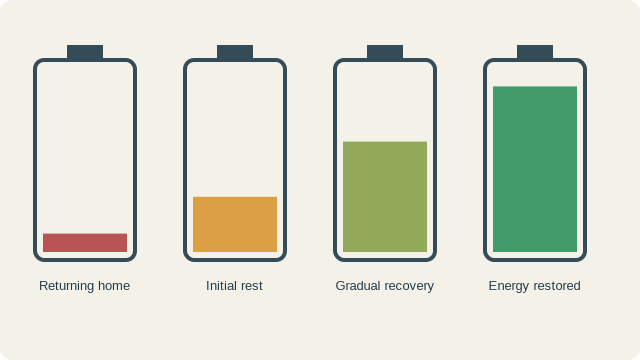
Conceptual representation rather than measured scientific data.
Regular recovery periods may help reduce overload rather than being reserved only for after a meltdown or shutdown.
10. The importance of comfort rooms throughout an autistic individual’s life
Childhood
School noise, social interaction and changes can be demanding. Access to a familiar space after school may help children regulate before homework, meals or conversations.
Adolescence
Friendships, examinations and increasing independence can add pressures. Personal space may support identity and processing of difficult experiences.
Adulthood
Employment, relationships, shopping, appointments and voluntary work can consume considerable energy. A comfort room may provide separation between responsibilities and personal wellbeing.
Older age
Health difficulties, reduced mobility, bereavement and changes to routines may make familiar environments particularly important, including in residential care.
Individuals with substantial support requirements
Some individuals cannot readily communicate distress. Families and carers may need to recognise signs and facilitate access to a safe space tailored to communication, mobility and safety needs.
11. The consequences of not having a place of safety
Individuals in shared or overcrowded accommodation, residential establishments or financially restricted circumstances may have little control over their surroundings. Without recovery opportunities, difficulties may increase. 1,4
| Area affected | Potential consequences |
|---|---|
| Mental health | Anxiety, low mood and distress |
| Physical wellbeing | Fatigue, tension and disrupted sleep |
| Emotional regulation | Greater vulnerability to meltdowns and shutdowns |
| Sensory processing | Reduced tolerance |
| Relationships | Irritability and withdrawal |
| Employment and education | Reduced concentration and participation |
| Independent living | Difficulty managing responsibilities |
| Long-term wellbeing | Vulnerability to burnout |
Access to a suitable environment should be considered in housing, education, employment, health and social care.
12. The difference between solitude and social isolation
There is an important distinction between choosing to spend time alone and experiencing unwanted social isolation. Solitude can be restorative, whereas loneliness may harm wellbeing. An individual may enjoy companionship whilst needing extended periods alone.
| Positive solitude | Unwanted social isolation |
|---|---|
| Personal choice | Feeling excluded |
| Emotional recovery | Emotional distress |
| Enjoyment of interests | Lack of meaningful engagement |
| Security | Feelings of abandonment |
| Freedom from demands | Lack of support |
| Preparation for activities | Difficulty engaging with society |
A qualitative study involving 16 autistic UK adults found that time alone helped participants manage overwhelm, recover and prepare for further social interaction. The small sample does not represent every autistic individual. 1
The objective is to preserve opportunities to participate when the individual wishes to do so.
13. Respecting personal boundaries
Entering without permission, moving possessions, introducing unexpected noise or repeatedly interrupting the individual may undermine security. Household members should knock, respect requests for privacy and allow recovery time while maintaining necessary care and safety. A comfort room must never be a punishment, a place of enforced isolation or somewhere an individual is prevented from leaving.
14. The role of families, partners, carers and friends
A partner may feel neglected, a parent may worry about social isolation or friends may misunderstand the need for solitude. Understanding the purpose of a comfort room can help prevent these misunderstandings.
| Potentially unhelpful comment | More supportive alternative |
|---|---|
| You spend too much time in that room. | Do you need more time to recover? |
| You have only been out for an hour. | Was your time outside demanding? |
| Why are you ignoring me? | Would you prefer to talk later? |
| Stop shutting yourself away. | Is there anything I can do to help? |
| You cannot be that tired. | Take the time you need to rest. |
| You need to socialise more. | Is there an activity we could enjoy together? |
The emotional and social needs of partners and family members should also be acknowledged. Mutual understanding and communication are important.
15. The Author’s Personal Experience
Throughout their time in primary and secondary education, and subsequently in further education, the author found recreational breaks and lunchtimes particularly uncomfortable. These were occasions when neurotypical individuals would typically socialise and participate in group activities and team games. The playground was often an environment filled with children shouting with excitement, running around and inadvertently making physical contact with one another. For the author, this combination of noise, unpredictable movement and social expectations created an uncomfortable and overwhelming sensory environment.
The author eventually obtained permission to spend these periods in the school library, quietly reading books. Initially, teachers and librarians were reluctant to encourage this arrangement, believing that the author would benefit from socialising and learning from their peers. However, having repeatedly observed the author walking alone or sitting in a quiet corner of the playground, members of staff eventually recognised that the library provided a more suitable environment.
At home, the author had the benefit of having their own bedroom. The author recalls their parents commenting that being sent to their bedroom for misbehaving never appeared to constitute a punishment. In reality, the bedroom had become the author’s comfort room, providing a quiet and familiar environment in which they could escape external demands and enjoy reading without interruption.
During their military career, the nature of military life and communal living arrangements made it particularly difficult to obtain personal space and privacy. Fortunately, the author gained promotion relatively quickly, enabling them to have their own accommodation. Once the door was closed, the author was able to withdraw from the demands of military life and enter an environment in which they felt safe and comfortable. The availability of this personal space proved invaluable in maintaining their psychological and emotional wellbeing.
Following their departure from the military, and as a married adult, the author designed and partly constructed the family home. Incorporated into its design was a study that would subsequently become their permanent comfort room.
Even in later life, the author estimates that approximately 95 per cent of their time spent at home is spent within this room. It contains adjustable lighting and heating, computers, printers, a hi-fi system and an extensive collection of books relating to their specialist interests. The environment has evolved over many years to accommodate the author’s sensory, intellectual and emotional requirements, providing everything they need to feel secure, comfortable and relaxed.
One particularly important aspect of the comfort room is the respect afforded to the author’s personal space. Their partner, family members and visitors are requested to knock on the door and await a response before entering.
During their professional career as a software designer, the author frequently became deeply absorbed in complex tasks requiring prolonged periods of concentration. An unexpected interruption could instantly disrupt their entire train of thought, resulting in considerable frustration and difficulty returning to the previous level of concentration.
The importance of knocking before entering was therefore not simply a matter of courtesy or privacy, but a means of maintaining concentration, predictability and emotional stability.
Looking back over their life, the author recognises that the need for a place of safety has remained remarkably consistent. Although the physical environment has changed, from the school library to the childhood bedroom, military accommodation and ultimately the study within the family home, its fundamental purpose has remained the same.
For the author, having access to a comfort room has never been about rejecting the company of others. Rather, it has been an essential means of maintaining personal wellbeing, preserving independence and managing the demands of living within a predominantly neurotypical world.
16. Conclusion
For some autistic individuals, a comfort room represents considerably more than a physical space. It provides a sanctuary from sensory, emotional, psychological and social demands, offering an opportunity to regain control, remove the necessity for masking, process experiences, restore energy and reconnect with personal identity. Having access to such a room may enable continued participation in society.
A comfort room is not necessarily a place where an autistic individual hides from the world, but a place where they recover from the demands of living within it.
17. Scientific articles and references
2. MacLennan et al. (2022). In Our Own Words: The Complex Sensory Experiences of Autistic Adults.
4. Raymaker et al. (2020). Defining Autistic Burnout.
18. Further reading and guidance
5. NICE. Autism spectrum disorder in adults: diagnosis and management.
6. NHS. Signs of autism in adults.
7. National Autistic Society. Advice and guidance.