Autism and Differences in Self-Awareness
Understanding the difficulties autistic individuals may experience in recognising their own emotions, behaviour, physical requirements and the impact they have upon others.
1. Understanding self-awareness and its prevalence in autism
Self-awareness is the ability of an individual to recognise, understand and reflect upon their own emotions, thoughts, physical sensations, behaviour, abilities and limitations. It also involves recognising how their actions, responses and behaviour may affect other people.
For some autistic individuals, aspects of self-awareness may be less developed, delayed or inconsistent. This can have significant implications for their physical and psychological wellbeing, personal relationships, employment and ability to live independently.
1.1 How prevalent is reduced self-awareness in autism?
Research undertaken by Huggins et al. (2021), involving a review of 47 scientific papers and 2,820 participants, identified greater difficulties with emotional self-awareness amongst autistic individuals, particularly adults. 1
Research undertaken by Kinnaird et al. (2019) also identified a considerably higher prevalence of alexithymia amongst autistic individuals. Alexithymia is associated with difficulties recognising, understanding and describing one's own emotions. 2
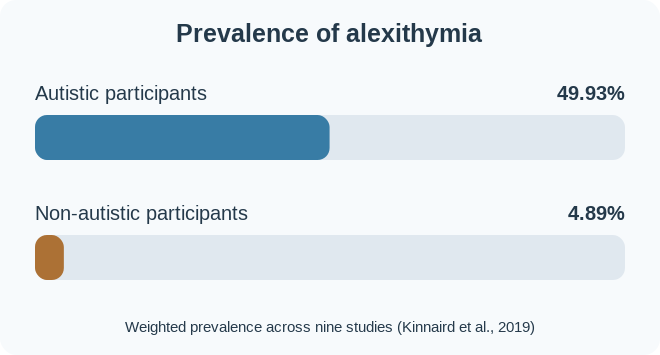
Although there is no reliable equivalent statistic for reduced self-awareness as a whole, the potential consequences should not be underestimated.
1.2 The different aspects of self-awareness
Self-awareness encompasses several interconnected abilities.
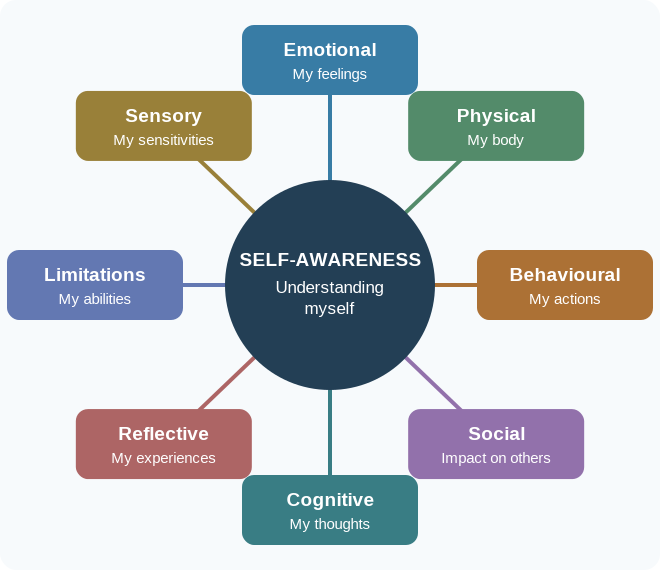
An autistic individual may possess considerable self-awareness in one area whilst experiencing significant difficulties in another.
2. Why might autistic individuals experience reduced self-awareness?
Reduced self-awareness does not necessarily indicate a lack of intelligence, empathy, compassion or consideration for others.
An autistic individual may understand a particular concept intellectually but experience difficulty applying that understanding to themselves in real time. Research on self-assessment suggests that accuracy can differ between general cognitive and social cognitive tasks. 3
Several factors may contribute to this.
| Contributing factor | Potential effect on self-awareness |
|---|---|
| Alexithymia | Difficulty recognising and identifying emotions. |
| Interoceptive differences | Difficulty recognising internal bodily signals. |
| Executive functioning differences | Difficulty monitoring and modifying behaviour. |
| Delayed emotional processing | Recognising emotions or the significance of events sometime afterwards. |
| Autistic masking | Suppressing or overlooking genuine feelings and personal requirements. |
| Intense concentration | Becoming less aware of physical, emotional or environmental changes. |
| Sensory overload | Reduced capacity to recognise and interpret personal responses. |
An individual may therefore be aware of what constitutes appropriate behaviour, emotional distress or excessive tiredness without recognising when they themselves are experiencing these difficulties.
3. Recognising emotions and physical requirements
3.1 Emotional self-awareness
Alexithymia can make it difficult for an autistic individual to distinguish between different emotional experiences or recognise what is causing their discomfort.
| Actual emotional experience | Possible personal interpretation |
|---|---|
| Anxiety | Something does not feel right. |
| Sadness | I feel tired and want to be alone. |
| Anger | Everything is irritating me. |
| Fear | I need to get away from here. |
| Emotional exhaustion | I do not want to do anything. |
| Loneliness | I feel uncomfortable but do not know why. |
The individual may experience powerful emotions without being able to identify, understand or explain them.
Consequently, they may be unable to take appropriate action before those emotions become overwhelming.
3.2 Physical self-awareness and interoception
Interoception is the process through which the nervous system detects and interprets signals originating from within the body. 7, 8
Differences in interoception may prevent some autistic individuals from recognising important physical requirements until they become particularly pronounced.
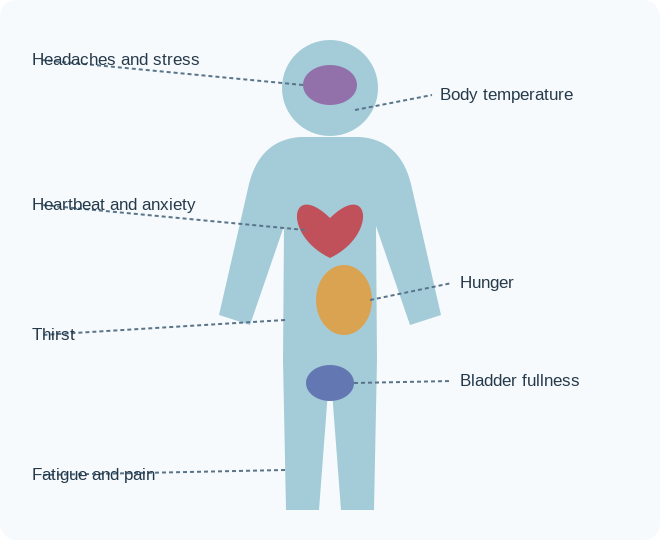
An individual may continue working despite considerable exhaustion, fail to drink sufficient fluids or overlook symptoms of an illness.
The difficulty may not be a conscious decision to ignore these requirements, but rather a genuine inability to recognise them at an appropriate time.
4. Recognising personal behaviour and its impact upon others
Some autistic individuals may experience difficulty recognising changes in their own behaviour, particularly during periods of increased stress, anxiety or exhaustion.
They may become more irritable, argumentative, withdrawn or impatient without recognising that their behaviour has changed.
There may also be a considerable difference between the intention behind an action and how that action is perceived by another person.
| The individual's intention | How others may perceive the behaviour |
|---|---|
| Correcting inaccurate information | Being argumentative. |
| Providing factual information | Being insensitive. |
| Offering practical solutions | Dismissing someone's emotions. |
| Requesting further clarification | Challenging authority. |
| Concentrating intensely | Ignoring other people. |
| Seeking time alone | Rejecting companionship. |
| Communicating directly | Being rude or inconsiderate. |
An individual may genuinely believe that their behaviour has remained unchanged whilst those around them recognise a considerable difference.
Understanding this discrepancy is particularly important within personal and professional relationships.
However, misunderstandings are not necessarily one-sided. The Double Empathy Problem, proposed by Damian Milton (2012), recognises that autistic and non-autistic individuals may experience mutual difficulties understanding one another. 4
5. Delayed recognition of stress and personal limitations
One of the more concerning aspects of reduced self-awareness is the inability to recognise accumulating stress and exhaustion.
An autistic individual may continue undertaking activities and responsibilities without recognising that their ability to cope is gradually diminishing.
Early indications may include increased irritability, reduced concentration, heightened sensory sensitivity and difficulty tolerating unexpected changes.
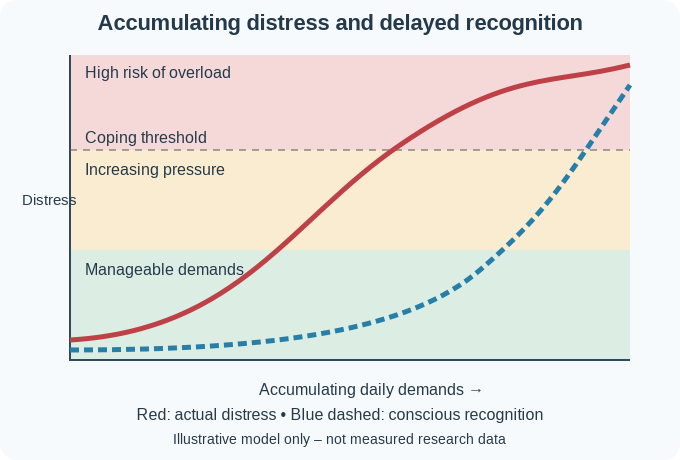
As illustrated in Figure 4, an individual may exceed their ability to cope before becoming consciously aware of the severity of their distress.
This may increase their vulnerability to meltdowns, shutdowns and autistic burnout. 6
Reduced self-awareness can also make it difficult to recognise when voluntary activities, employment, social commitments or everyday responsibilities should be reduced.
6. The influence of masking upon self-awareness
Autistic masking involves consciously or unconsciously suppressing natural autistic responses in an attempt to meet the expectations of others. 5
Over prolonged periods, an individual may become so accustomed to suppressing their discomfort that they find it increasingly difficult to distinguish between their genuine feelings and the behaviour they have learned to demonstrate.
| Genuine experience | Masked response |
|---|---|
| Sensory discomfort | Appearing comfortable. |
| Physical exhaustion | Continuing with activities. |
| Emotional distress | Appearing cheerful. |
| Anxiety | Presenting a relaxed appearance. |
| Needing solitude | Continuing to socialise. |
| Feeling overwhelmed | Pretending to be coping. |
The repeated suppression of personal requirements may contribute to a diminished awareness of individual limitations, preferences and emotional wellbeing.
For some individuals, prolonged masking may also make it difficult to establish a clear understanding of their own identity.
7. The impact upon families, partners, carers and friends
Reduced self-awareness can place considerable strain upon personal relationships.
Family members and partners may recognise changes in an autistic individual's behaviour before the individual becomes aware of them.
Attempts to highlight these changes may inadvertently result in disagreements, particularly if the autistic individual genuinely does not recognise the behaviour being described.
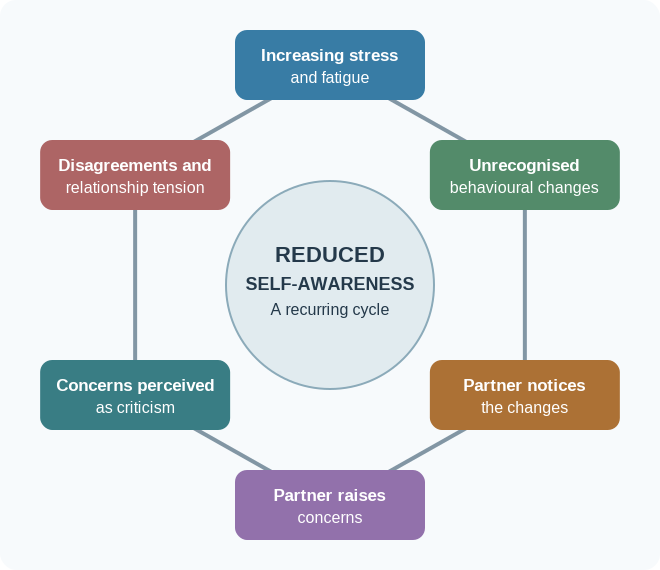
Within a marriage or long-term relationship, repeated incidents of this nature may lead to emotional exhaustion, frustration and resentment.
Both individuals may have entirely different perceptions of the same situation.
| Autistic individual's perspective | Partner's perspective |
|---|---|
| I am simply explaining the facts. | My feelings are being dismissed. |
| I am not being argumentative. | Every discussion seems to become an argument. |
| I am trying to resolve the problem. | I need emotional reassurance. |
| I need some time alone. | I feel emotionally rejected. |
| I did not intend to upset anyone. | Nevertheless, I feel hurt. |
Understanding reduced self-awareness may help explain certain behaviours, but it should not be used to justify behaviour that causes harm or distress to others.
8. Self-awareness throughout an individual's life
8.1 Childhood and education
Autistic children may experience difficulty recognising when they are becoming tired, anxious, hungry or overwhelmed.
A child may continue attempting to cope throughout the school day without recognising their increasing level of distress. Consequently, parents may witness behavioural changes or meltdowns shortly after the child returns home.
Children may also struggle to recognise their own abilities and limitations, making it difficult to identify when assistance is required.
8.2 Adulthood and employment
Within employment, reduced self-awareness may result in an individual undertaking excessive responsibilities, overlooking personal limitations or failing to recognise deteriorating relationships with colleagues.
The individual may require assistance recognising when reasonable adjustments, additional support or periods of rest are necessary.
8.3 Self-awareness and ageing
There is insufficient evidence to suggest that autistic individuals inevitably experience a decline in self-awareness as they grow older.
However, increasing physical health difficulties, prolonged masking, accumulated stress and reduced energy may affect an individual's ability to monitor their own emotional and behavioural responses.
Conversely, greater knowledge and understanding of autism acquired throughout life may enable some individuals to develop improved self-awareness.
8.4 Excessive self-awareness
Not all autistic individuals experience reduced self-awareness. Some may excessively analyse their behaviour, conversations and interactions with others.
An individual may spend considerable time examining previous conversations, questioning whether they behaved appropriately or worrying about how they were perceived.
It is possible to experience excessive self-monitoring in one area whilst having reduced self-awareness in another.
9. The potential dangers associated with reduced self-awareness
The consequences of reduced self-awareness can extend considerably beyond social misunderstandings.
| Area of concern | Potential consequences |
|---|---|
| Physical health | Failure to recognise illness, injury or pain. |
| Mental health | Delayed recognition of anxiety, depression or psychological distress. |
| Nutrition and hydration | Failure to recognise hunger and thirst. |
| Personal safety | Continuing activities despite exhaustion or discomfort. |
| Medical treatment | Difficulty identifying and describing symptoms. |
| Relationships | Failure to recognise harmful behavioural patterns or exploitation. |
| Independent living | Overlooking personal care and everyday requirements. |
| Emotional regulation | Increased vulnerability to meltdowns and shutdowns. |
| Long-term wellbeing | Chronic stress, exhaustion and autistic burnout. |
Healthcare professionals, families and carers should recognise that the absence of a complaint does not necessarily indicate the absence of a problem.
10. Interventions to support self-awareness
Interventions should concentrate upon developing emotional, sensory, physical and behavioural understanding rather than encouraging autistic individuals to mask their difficulties or conform to non-autistic expectations.
They should not place excessive demands upon an individual or contribute to additional stress, anxiety and exhaustion.
10.1 Developing emotional, sensory and behavioural awareness
Simple discussions about everyday experiences, gentle prompting and constructive feedback may help an autistic individual recognise changes in their emotional state and behaviour.
Understanding how sensory experiences affect personal wellbeing may also assist individuals in recognising why particular environments or activities cause discomfort, anxiety or exhaustion.
10.2 Adapted psychological interventions
Where appropriate, professional psychological support may assist individuals in developing a greater understanding of themselves. 10, 11
| Intervention | Potential benefit |
|---|---|
| Cognitive Behavioural Therapy (CBT) | Understanding the relationship between thoughts, emotions and behaviour. |
| Acceptance and Commitment Therapy (ACT) | Developing self-understanding and self-acceptance. |
| Psychological counselling | Exploring personal emotional and behavioural responses. |
| Psychoeducation | Understanding how autism affects the individual personally. |
| Occupational therapy | Recognising sensory differences, physical requirements and personal limitations. |
These interventions should be adapted to the individual's abilities and support requirements. Evidence for their effectiveness specifically in developing self-awareness varies.
10.3 Developing interoceptive awareness
Simple activities involving breathing, relaxation and recognising muscular tension may help individuals become more familiar with their internal bodily responses.
Where difficulties remain, external reminders and support from others may help prevent important physical requirements from being overlooked. 7
10.4 Personal reflection
Occasional reflection upon everyday experiences may assist an individual in recognising connections between their activities, emotions and behaviour.
This should not require extensive diary keeping, complicated monitoring exercises or constant self-analysis.
10.5 The SPELL framework
The National Autistic Society's SPELL framework provides a person-centred approach to understanding and supporting autistic individuals. 9
| Principle | Relevance to self-awareness |
|---|---|
| S – Structure | Providing predictable environments that may make changes easier to recognise. |
| P – Positive approaches and expectations | Helping individuals recognise their strengths and abilities. |
| E – Empathy | Understanding the individual's experiences and perspectives. |
| L – Low arousal | Reducing demands that may interfere with self-awareness. |
| L – Links | Developing supportive relationships and consistent assistance. |
Although SPELL has not been specifically developed to address reduced self-awareness, its principles may provide a supportive environment in which self-understanding can develop.
10.6 Individuals with substantial support requirements
It is important to recognise that not every autistic individual will be able to develop or maintain self-awareness independently.
Individuals classified as requiring substantial or very substantial support (Levels 2 and 3) may require ongoing assistance from family members, carers and healthcare professionals.
For some individuals, recognising their physical, emotional and behavioural requirements may remain a lifelong difficulty.
11. The role of families, partners, carers and friends
Those closest to an autistic individual may be particularly well placed to recognise changes in behaviour and wellbeing that the individual has not yet recognised themselves.
However, the manner in which these observations are communicated can significantly influence how they are received.
| Confrontational approach | Constructive approach |
|---|---|
| You are being argumentative again. | I have noticed that we are disagreeing more frequently. |
| You are always grumpy. | You seem more tired and frustrated recently. |
| You never listen to me. | I would appreciate some time to explain how I am feeling. |
| You are overreacting. | Something appears to be causing you distress. |
| You need to stop doing so much. | Would reducing some of your commitments help? |
In some circumstances, agreeing upon a particular word or phrase to highlight unrecognised behavioural changes may prove beneficial.
Nevertheless, families and partners should not be expected to assume complete responsibility for monitoring another individual's emotional and behavioural wellbeing.
12. The author's personal experiences of reduced self-awareness
12.1 Recognising and accepting other people's perspectives
During the early years of their marriage, the author was frequently convinced that their opinions and conclusions were correct and that those of their partner and friends were wrong. At this stage in their life, they had not received a diagnosis of autism.
They would frequently engage in prolonged arguments with their partner, sometimes lasting several hours, resulting in considerable emotional exhaustion for both of them. However, at the time, the author was largely unaware of the extent to which their behaviour was affecting the relationship.
The author often justified their position on the basis that they had examined the situation logically, much like one of their favourite fictional characters, Mr Spock from Star Trek. What they failed to recognise was that their logical reasoning could be influenced by their own understanding, assumptions and interpretation of a situation.
It was only after receiving an autism diagnosis and undertaking considerable research into the condition that the author began to recognise these shortcomings in their own self-awareness.
They gradually developed a greater appreciation of other people's perspectives and recognised that others were entitled to hold opinions that differed from their own. Importantly, they began to accept that their interpretation of a situation was not necessarily the correct one.
12.2 Intense concentration and reduced physical self-awareness
Many years ago, when running their own company from home, the author had a tendency to become so intensely absorbed in their work that they completely lost track of time.
Their partner would regularly leave for work at approximately 7 am, by which time the author would already be working. Upon returning home at around 7 pm, their partner would frequently find the author still sitting at their desk or working at their workbench.
When asked whether they had eaten during the day, the author would frequently realise that they had not.
This was particularly concerning because, as a Type 1 diabetic, the author needed to manage their carbohydrate intake in relation to their insulin requirements. Failure to do so could have had serious medical consequences.
Interestingly, the author would periodically take small amounts of Lucozade from a bottle kept nearby, seemingly without consciously considering why they were doing so.
This experience illustrates how intense concentration, sometimes referred to as hyperfocus, can reduce an individual's awareness of the passage of time, internal bodily signals and essential physical requirements, potentially placing their health at risk.
12.3 Recognising exhaustion and personal limitations
A further example of the author's reduced self-awareness became apparent following their diagnosis of Myalgic Encephalomyelitis/Chronic Fatigue Syndrome (ME/CFS).
Their consultant expressed surprise that the author could spend such prolonged periods concentrating and working on projects without becoming completely exhausted.
The author was advised to take regular breaks and to set an alarm to sound every hour, reminding them to rest for five minutes. However, they would invariably continue working despite hearing the alarm.
During one consultation, the author happened to mention that one of their cats regularly approached them seeking attention and affection. Upon reflection, they realised that this appeared to occur approximately every hour.
The simple act of stopping work to stroke and interact with their cat provided a natural interruption and an opportunity for respite, something that a conventional alarm had failed to achieve.
This experience demonstrates that being intellectually aware of the need to rest does not necessarily translate into recognising and responding to that requirement whilst engaged in an activity.
It also illustrates the potential value of personalised interventions that complement an autistic individual's natural behaviour and interests.
12.4 Observations of reduced self-awareness in other autistic individuals
Over the years, the author has attended numerous meetings involving other autistic individuals, during which they have observed several examples of reduced self-awareness, particularly in relation to time management, communication and the impact of personal behaviour upon others.
On numerous occasions, the author has observed individuals continuing to speak for 10 to 15 minutes despite having only five minutes remaining before the meeting was due to conclude or having been allocated five minutes to raise a question. They appeared unaware that they were exceeding their allotted time, reducing opportunities for others to contribute and potentially inconveniencing those with subsequent commitments.
The author has also witnessed individuals defending a particular viewpoint with considerable determination, without recognising that their position was based upon a misunderstanding or misinterpretation of the subject under discussion. In some instances, they appeared unaware of the increasing stress, anxiety and frustration their continued arguments were causing other participants.
These observations illustrate several aspects of reduced self-awareness:
- Difficulty recognising the passage of time.
- Difficulty monitoring and regulating one's own behaviour.
- Difficulty recognising when one's understanding of a situation may be incorrect.
- Reduced awareness of the needs and requirements of others.
- Difficulty recognising the emotional and practical consequences of one's behaviour.
Reflecting upon these experiences, the author recognised similarities with aspects of their own behaviour.
Such behaviour should not necessarily be interpreted as selfishness, inconsideration or a lack of empathy. Rather, it may reflect a genuine difficulty in recognising and evaluating one's own behaviour and its impact upon others at the time it occurs.
12.5 Reflections on personal self-awareness
The author's personal experiences have demonstrated how reduced self-awareness can have significant consequences for physical health, psychological wellbeing and interpersonal relationships.
Receiving an autism diagnosis and subsequently developing a greater understanding of their autistic characteristics enabled the author to recognise aspects of their own behaviour and limitations of which they had previously been unaware.
Nevertheless, understanding these difficulties does not necessarily eliminate them.
There is a considerable difference between being aware that one has difficulties with self-awareness and being able to recognise those difficulties at the moment they occur.
This distinction is fundamental to understanding reduced self-awareness in autistic individuals and the importance of appropriate, personalised support.
13. Conclusion
Reduced self-awareness is a potentially significant but frequently overlooked difficulty experienced by some autistic individuals.
The inability to recognise changes in personal behaviour, emotions, physical health or individual limitations may have considerable consequences for both the autistic individual and those around them.
Developing self-awareness should involve increasing personal understanding, recognising individual strengths and limitations, and identifying when assistance may be required.
The objective should not be to change who an autistic individual is, but to enable them to understand who they are.
14. Scientific articles and references
1. Huggins et al. (2021). Emotional self-awareness in autism: A meta-analysis of group differences and developmental effects. (Alternative access)
2. Kinnaird et al. (2019). Investigating alexithymia in autism: A systematic review and meta-analysis. (Alternative access)
4. Milton (2012). On the ontological status of autism: The double empathy problem.
5. Hull et al. (2017). “Putting on My Best Normal”: Social Camouflaging in Adults with Autism Spectrum Conditions – UCL Discovery. (UCL open-access full text (PDF))
6. Raymaker et al. (2020). Defining autistic burnout. (Alternative access)
15. Further reading and guidance
7. National Autistic Society – Interoception and mental wellbeing.
8. National Autistic Society – Sensory processing.
9. National Autistic Society – The SPELL framework.
10. NICE – Autism in adults (CG142).
11. NICE – Autism in under 19s (CG170). (Related NHS guidance)
12. Scottish Autism.
13. NHS – Autism.