Sensory Overload in Autistic People
Although sensory overload has already been discussed in other essays on this website, particularly in relation to sensory differences, masking, autistic fatigue and meltdowns, this essay examines the subject in greater depth. It explores how sensory overload develops, the neurological and physiological processes involved, and the ways in which different sensory demands can accumulate and become overwhelming. Particular attention is given to recognising early warning signs, understanding the immediate and longer-term consequences, and identifying practical approaches to prevention, management and recovery. The essay also considers the responsibilities of families, carers, educational establishments, employers and wider society in creating environments that are more understanding, accessible and supportive of autistic people's sensory needs.
1. Introduction
Sensory overload occurs when the amount, intensity, complexity or duration of sensory information exceeds an individual's ability to process and respond to it comfortably. For many autistic people, this can be an intensely distressing experience that affects their ability to think clearly, communicate, regulate emotions and participate in everyday activities.
Sensory overload is not simply a dislike of loud noises, bright lights or crowded environments. It involves a complex interaction between sensory processing, neurological responses, environmental demands, emotional wellbeing and the individual's capacity to manage competing information.
An environment that appears perfectly ordinary to a non-autistic person may be overwhelming to an autistic individual. A supermarket, classroom, shopping centre, restaurant or family gathering can expose someone to numerous simultaneous sensory demands. Each individual stimulus may be manageable, but their combined effects can become intolerable.
Sensory overload can occur at any age. It may be particularly difficult to recognise in individuals who have learned to conceal their distress, those who experience difficulties communicating their needs, and people who have spent many years adapting to environments that do not accommodate their sensory differences.
Importantly, sensory overload is not evidence of weakness, poor behaviour or an inability to cope with ordinary life. It represents a genuine experience of distress arising from the interaction between an individual's sensory processing characteristics and the demands placed upon them.
Understanding these processes is essential to developing environments, relationships and support arrangements that reduce unnecessary distress and allow autistic people to participate in everyday life without continually exceeding their limits.
2. Understanding Sensory Overload
The brain continuously receives information from the environment and the body. It must determine which information requires attention, which can be ignored and how competing signals should be interpreted. This process is essential to everyday functioning.
For example, when two people are having a conversation in a café, they may need to distinguish each other's voices from background music, conversations at neighbouring tables, the sound of coffee machines and people moving around them.
Some autistic people experience greater difficulty filtering or prioritising competing sensory information. Background sounds, movement, lighting and other sensations may remain unusually noticeable, requiring considerable conscious effort to manage.
However, sensory processing differs greatly between autistic individuals. Some experience particularly intense responses to sound, while others are more affected by lighting, touch, movement or combinations of sensory input. Research has identified differences in sensory responsiveness among autistic people, but there is no single neurological explanation that accounts for every individual's experience. 1,2
2.1 The accumulation of sensory demands
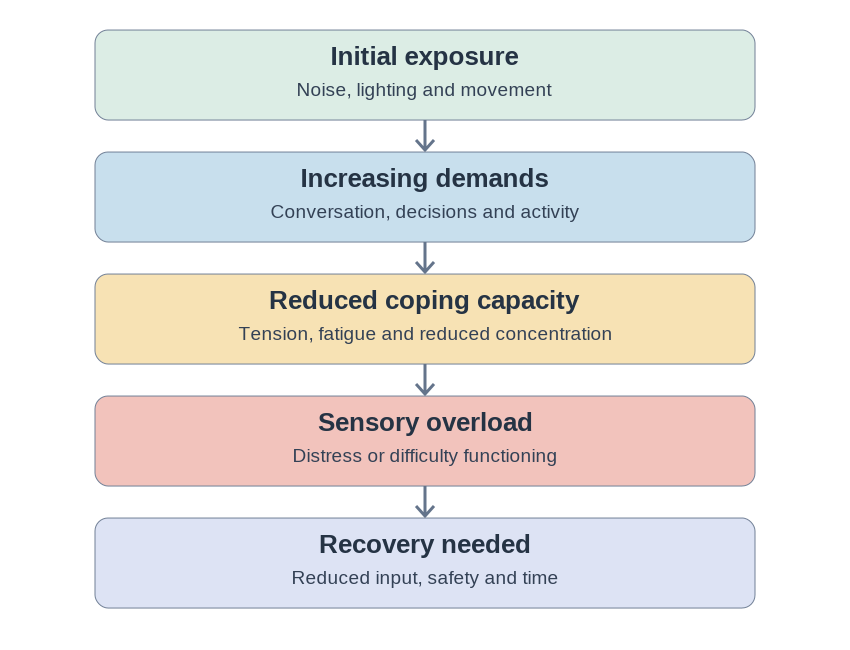
Sensory overload may develop gradually. A person might tolerate a noisy environment for several minutes without obvious difficulty. However, continuing exposure, combined with the demands of conversation, decision-making and movement, may progressively increase their distress.
As the situation continues, their ability to manage additional stimulation may decrease. Eventually, an apparently minor event, such as a telephone ringing or somebody unexpectedly touching their shoulder, may become the final stimulus that exceeds their capacity to cope.
This does not necessarily mean that the final event was particularly severe. Instead, it may represent the culmination of demands that have been accumulating over time. The possible progression is illustrated in Figure 1.
2.2 Sensory thresholds and changing tolerance
Every individual has a different pattern of sensory responsiveness. Furthermore, the amount of stimulation that can be tolerated may vary depending on circumstances.
The concept of a sensory threshold provides a useful way of understanding these differences. In this context, the threshold represents the point at which sensory demands become sufficiently intense or prolonged that the individual experiences significant distress or difficulty functioning.
An autistic person may visit a supermarket one day without significant difficulty, yet find the same environment overwhelming on another occasion. Factors such as inadequate sleep, illness, pain, emotional stress, previous sensory exposure and unexpected changes can influence tolerance.
Consequently, the question should not simply be whether an autistic person has previously managed a particular environment. It should also consider the circumstances under which they managed it and the physical and psychological consequences afterwards. Figure 2 illustrates how accumulating demands may exceed a person's tolerance.
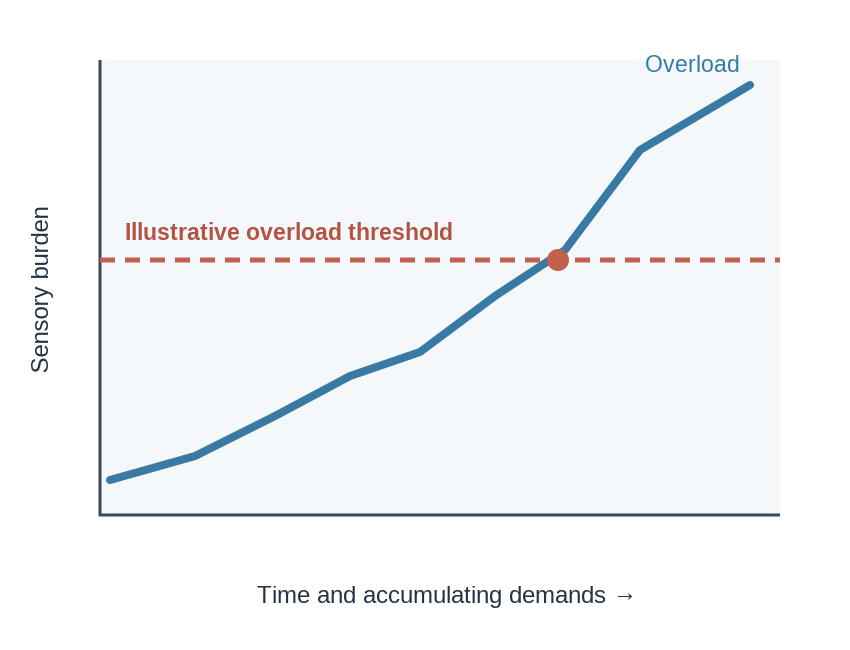
A person may appear to be coping successfully until their tolerance is exceeded. However, the process is not always gradual; a sudden, intense stimulus can also cause immediate overload.
3. Neurological and Physiological Responses
Sensory overload involves more than the conscious recognition that an environment is unpleasant. Sensory information is processed through interconnected neural systems involved in perception, attention, emotion, memory and physiological regulation.
Research into autism has investigated differences in sensory responsiveness, neural adaptation and the allocation of attention. These findings suggest several possible mechanisms contributing to overload, although results vary across studies and individuals.
3.1 Sensory filtering and attention
The nervous system ordinarily reduces attention to many predictable or irrelevant stimuli. For example, someone may initially notice the humming of a refrigerator but gradually stop paying attention to it. This process involves several mechanisms, including habituation, attention and sensory adaptation.
Some autistic individuals report that particular sensations remain intrusive despite prolonged exposure. Instead of becoming less noticeable, they may continue to compete for attention. This can increase the effort required to concentrate on conversations, written information or practical tasks.
It would nevertheless be inaccurate to suggest that all autistic brains are unable to filter sensory information. Differences are highly individual, and some autistic people demonstrate effective filtering in certain circumstances but not others.
3.2 The autonomic nervous system
When sensory stimulation becomes threatening or intolerable, the body's stress-response systems may become activated. The autonomic nervous system regulates involuntary functions, including heart rate, breathing, sweating and aspects of digestion.
During acute distress, sympathetic nervous system activity may contribute to increased alertness and physical readiness to respond. Possible symptoms include:
- A racing heartbeat or awareness of heartbeats.
- Rapid or shallow breathing.
- Sweating, trembling or muscle tension.
- Nausea or abdominal discomfort.
- Dizziness or a sensation of being physically overwhelmed.
- A strong desire to escape the environment.
These responses can occur during sensory distress, although they are not unique to autism or sensory overload.
3.3 Sensory overload and anxiety
Sensory overload and anxiety can reinforce one another. An individual who has previously experienced severe sensory distress in a particular environment may begin anticipating similar difficulties before returning. This anticipation may increase physiological arousal, making subsequent sensory stimulation more difficult to tolerate.
For example, an autistic person who has experienced overload in a crowded restaurant may become anxious when arranging another restaurant visit. The anxiety may arise not from social interaction alone, but from remembering the intensity of the noise, lighting, movement and inability to escape easily.
It is therefore important that professionals do not automatically interpret every instance of sensory avoidance as an anxiety disorder. Sometimes anxiety is a consequence of repeated exposure to genuinely distressing sensory environments. Addressing the environmental cause may be more appropriate than expecting the individual to tolerate the same conditions without adjustment.
4. Recognising Sensory Overload
Sensory overload does not always begin with an obvious emotional reaction. In many cases, the earliest signs are subtle changes in attention, communication, movement or physical comfort. Recognising these changes provides an opportunity to reduce stimulation before distress becomes more severe. Table 1 summarises possible signs.
| Stage | Possible experiences or observations |
|---|---|
| Early discomfort | Increasing distraction, irritation, sensitivity to sound or light |
| Rising distress | Difficulty concentrating, muscle tension, repeated movements, reduced conversation |
| Significant overload | Confusion, inability to make decisions, strong urge to escape, difficulty speaking |
| Acute distress | Crying, shouting, freezing, withdrawal, or other individual responses |
| Recovery | Exhaustion, reduced tolerance for further demands, need for quiet and rest |
These are possible patterns, not a diagnostic scale. Some individuals experience sudden overload without clearly recognisable warning signs.
4.1 Changes in communication
One particularly important sign is a change in the person's ability to communicate. Someone who normally speaks fluently may suddenly struggle to find words, understand questions or respond to instructions. They may become unusually quiet, provide very short answers or stop speaking temporarily.
This should not automatically be interpreted as deliberate non-cooperation. The individual may be experiencing such intense sensory and cognitive demands that processing additional verbal information becomes extremely difficult.
4.2 Changes in behaviour
Other signs may include pacing, rocking, covering the ears, closing the eyes, repetitive movements, withdrawing from others or seeking a familiar object. These behaviours may be attempts to regulate sensory experiences. Stopping harmless repetitive movements simply because they appear unusual can remove an important coping mechanism.
The National Autistic Society advises allowing non-harmful self-regulatory behaviour and reducing unnecessary sensory input when someone is overwhelmed. 3
5. Everyday Environments and Sensory Challenges
Sensory overload is not confined to exceptionally loud or chaotic environments. Many everyday settings combine multiple forms of stimulation with social expectations and limited opportunities to withdraw.
5.1 Supermarkets and shopping centres
Supermarkets can be particularly demanding because several sensory and cognitive challenges occur simultaneously. These may include bright overhead lighting, refrigeration units, music, public announcements, moving trolleys, crowded aisles, strong smells and unexpected encounters with other shoppers.
The individual must also locate products, compare prices, navigate around people, make decisions and sometimes interact with staff. Even when each activity is manageable individually, their combined effects may create substantial overload.
For some autistic people, completing the shopping is followed by pronounced exhaustion, headaches, irritability or the need to withdraw from further activity.
5.2 Schools and educational environments
Educational settings can expose autistic children and young people to prolonged sensory demands. Classrooms may contain conversations, scraping chairs, electronic equipment, fluorescent lighting, movement and frequent transitions between activities.
Corridors, dining halls, playgrounds and assemblies can be particularly difficult because of crowding, unpredictability and high noise levels. Some pupils may maintain outward composure throughout the school day while experiencing substantial internal distress.
When they reach home, where they feel safer, the accumulated strain may become apparent through withdrawal, emotional distress or a reduced capacity to manage ordinary requests. This relationship is explored more fully in the separate essay on autistic meltdowns. The important consideration here is that the sensory demands of the school day may contribute to difficulties that only become visible later.
5.3 Workplaces
Open-plan offices, shared workspaces, factories, shops and other employment environments may create persistent sensory demands. Examples include overlapping conversations, telephone calls, machinery, strong fragrances, unpredictable interruptions and uncomfortable lighting.
The pressure to maintain productivity while suppressing visible signs of distress can increase the overall burden. An autistic employee may appear to be managing effectively while using considerable energy simply to remain in the workplace.
Reasonable adjustments such as quieter workstations, predictable breaks, flexible working arrangements and control over lighting can make employment more sustainable.
5.4 Healthcare settings
Hospitals, GP surgeries, dental practices and waiting rooms may create additional difficulties. Bright lighting, unfamiliar smells, medical equipment, crowded waiting areas and uncertainty about appointment times can all contribute to sensory distress.
A person who becomes overwhelmed may struggle to explain symptoms or understand medical information. Healthcare professionals should therefore consider sensory adjustments alongside communication needs. NICE guidance for autistic adults specifically recommends considering lighting, noise, personal space and opportunities for breaks. 4
5.5 Family gatherings and social occasions
Family celebrations, weddings, parties and other gatherings may involve loud conversations, music, unfamiliar people, strong smells and expectations to participate socially. An autistic person may genuinely enjoy seeing relatives or friends while simultaneously finding the sensory environment exhausting.
Their decision to leave early, sit in another room or decline a particular event should not automatically be interpreted as rejection of the people involved. In many cases, these decisions represent attempts to maintain wellbeing and prevent more serious distress.
6. Physical and Psychological Consequences
The consequences of sensory overload may continue long after the individual has left the triggering environment.
6.1 Physical exhaustion and discomfort
Prolonged sensory distress can be associated with substantial fatigue. A person may feel physically drained despite having undertaken little obvious physical activity. This may reflect the combined effects of heightened alertness, sustained attention, muscle tension, emotional distress and the effort required to remain engaged with the environment.
Some autistic individuals also report headaches, nausea, muscle tension or other uncomfortable bodily sensations during or after sensory overload. These symptoms should be taken seriously rather than automatically attributed to autism. New, severe, persistent or unexplained symptoms require appropriate medical assessment.
6.2 Psychological and emotional consequences
Repeated sensory overload may contribute to frustration, anxiety, reduced confidence and apprehension about future activities. A person who repeatedly experiences severe distress in shops, restaurants or public transport may begin restricting their participation in these environments.
This can reduce opportunities for employment, education, social contact and independent living. Such withdrawal may reflect an understandable response to inaccessible environments rather than a lack of interest in participating.
6.3 Shutdowns, meltdowns and autistic burnout
Sensory overload can contribute to both autistic shutdowns and meltdowns, although neither response is inevitable. A meltdown may involve an outward expression of intense distress, while a shutdown may involve withdrawal, reduced movement, diminished communication or difficulty responding. Neither should automatically be regarded as deliberate behaviour or a failure of self-control.
Sensory overload may also contribute to autistic burnout, particularly when repeated exposure occurs alongside masking, social expectations and inadequate opportunities for recovery. However, sensory overload and autistic burnout are not identical. Sensory overload may be relatively short-lived, whereas autistic burnout is commonly described as a prolonged state of exhaustion and reduced functioning associated with sustained demands.
These related experiences are examined in greater detail in the website's separate essays on autistic meltdowns, masking and fatigue.
7. Preventing and Managing Sensory Overload
Prevention is generally preferable to responding after severe distress has developed. Effective prevention requires understanding the individual's sensory experiences, recognising patterns and making appropriate adjustments.
7.1 Identifying triggers and planning activities
An individual sensory profile can help identify environments, sensations and circumstances associated with overload. This may include recording the location, activity, sensory conditions, duration of exposure, early warning signs and subsequent recovery requirements.
Planning can also reduce uncertainty and unnecessary sensory demands. For example, an autistic person visiting a supermarket may benefit from choosing a quieter time, preparing a shopping list, using familiar routes through the shop and limiting the duration of the visit.
Someone attending a social event may prefer to establish beforehand where they can sit, whether a quiet room is available and how they can leave if necessary. These arrangements can provide greater control and reduce anxiety about becoming overwhelmed.
7.2 Environmental adjustments
Small changes can sometimes make a substantial difference. Table 2 presents examples of possible adjustments.
| Sensory demand | Possible adjustment |
|---|---|
| Excessive noise | Quieter rooms, noise-reducing headphones or reduced background music |
| Bright or flickering lighting | Adjustable lighting, natural light or suitable window coverings |
| Crowding | Less busy visiting times and additional personal space |
| Strong smells | Fragrance-free arrangements and improved ventilation |
| Unpredictable activity | Advance information, clear schedules and warnings of changes |
| Prolonged exposure | Shorter sessions, regular breaks and access to quiet spaces |
| Uncomfortable seating or clothing | Individual choice of materials, seating and clothing |
Adjustments should be based on personal preferences. A strategy that benefits one autistic individual may be uncomfortable or ineffective for another.
7.3 Responding when sensory overload occurs
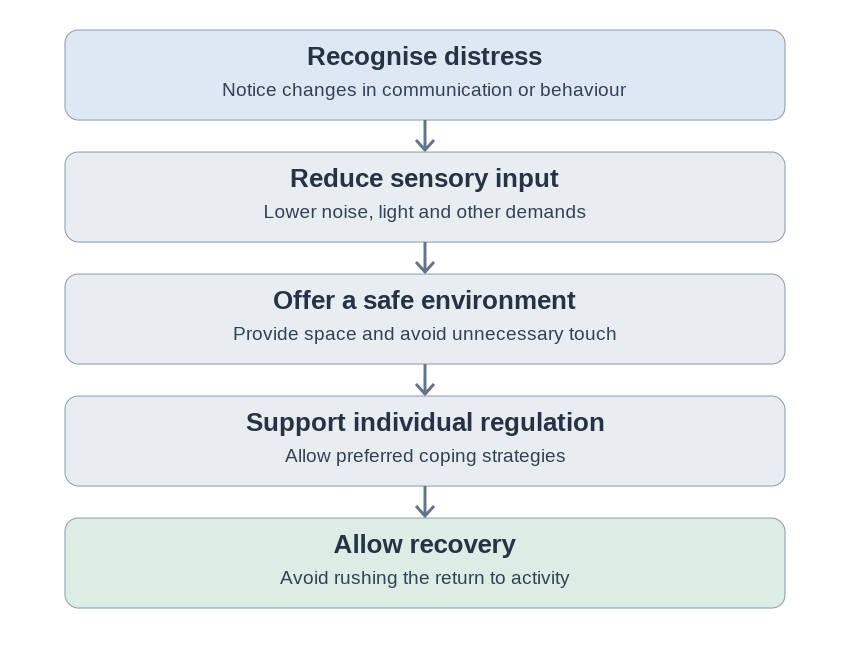
When someone is experiencing significant sensory overload, the immediate priority is to reduce distress and support their safety. Attempting to reason extensively with the person, demand explanations or insist that they continue an activity may increase the amount of information they are required to process.
Where possible, sensory triggers should be reduced, communication kept clear and brief, and access to a quiet environment provided. Some autistic people become particularly sensitive to touch when distressed. Unwanted physical contact, even when intended as reassurance, may intensify the experience.
The person's known preferences and consent should guide any intervention. Figure 3 illustrates a supportive response.
7.4 Recovery after sensory overload
Once the immediate sensory demands have been reduced, recovery should not be rushed. The individual may need time without conversation, social interaction or further responsibilities.
Returning immediately to the same environment can sometimes lead to renewed distress, particularly when the underlying sensory conditions have not changed. Recovery requirements vary. Some people may benefit from quiet rest, while others prefer familiar activities, movement or other personally effective strategies.
8. Supporting Autistic People Throughout Life
Sensory support should be appropriate to the individual's age, circumstances, communication preferences and level of independence.
8.1 Children and young people
Children may have difficulty identifying or explaining sensory distress. Parents, carers and educational staff can help by observing patterns, offering accessible communication methods and ensuring that the child has somewhere safe to withdraw.
Schools should consider whether classroom arrangements, playground activities, assemblies or transitions between lessons are contributing to distress. Support should focus on reducing unnecessary sensory demands rather than requiring the child to suppress their reactions.
8.2 Adults
Autistic adults may have spent many years developing ways to conceal their sensory discomfort. Some may not recognise the extent of their distress until they experience significant exhaustion or a reduction in their ability to manage everyday activities.
Adults should be supported to identify their own needs, request reasonable adjustments and make decisions about participation without unnecessary pressure. This may include adjustments to employment, healthcare appointments, travel and social activities.
8.3 Older autistic people
Sensory needs do not necessarily disappear with age. Changes in physical health, hearing, vision, mobility, medication or energy levels may alter how an older autistic person experiences their environment.
Care settings should therefore avoid assuming that sensory preferences established earlier in life will always remain unchanged. An individualised approach remains essential.
9. Understanding, Acceptance and Individual Support
One of the most damaging aspects of sensory overload can be the reaction of other people. An autistic person who leaves a gathering early, covers their ears, declines an invitation or requests reduced lighting may be perceived as difficult, antisocial or overly sensitive.
Such interpretations can create additional distress and discourage individuals from communicating their needs. Understanding sensory overload requires recognising that people do not all experience the same environment in the same way.
A sound that is barely noticeable to one individual may be intrusive or painful to another. Similarly, an environment that is enjoyable for some people may be physically and emotionally exhausting for others.
9.1 Creating more inclusive environments
Shops, transport providers, healthcare organisations, schools and employers all have opportunities to improve sensory accessibility. Measures such as quieter shopping periods, adjustable lighting, accessible waiting areas, predictable appointment arrangements and reduced background noise may benefit many people beyond the autistic community.
However, designated quiet periods should not be regarded as a complete solution. Autistic people also need access to ordinary services at times that are practical for them. Meaningful inclusion requires considering sensory accessibility as part of everyday design and service delivery.
9.2 Developing an individual sensory overload plan
A written plan may help autistic individuals, families, carers, teachers and employers recognise and respond to overload more effectively. Such a plan should be developed collaboratively, with the autistic person's preferences taking priority wherever possible.
- Known triggers: Environments, activities or sensations associated with distress.
- Early warning signs: Changes in behaviour, communication or physical comfort.
- Preventative measures: Adjustments that reduce the likelihood of overload.
- Immediate responses: Agreed actions when significant distress develops.
- Communication preferences: How the person wishes to receive information or request assistance.
- Recovery arrangements: Preferred environments, activities and periods of rest.
- Review: Opportunities to update the plan as circumstances and needs change.
A plan should remain flexible. It should support autonomy rather than become a set of rules imposed upon the individual. Where sensory difficulties substantially affect daily functioning, an occupational therapist experienced in autism and sensory processing may be able to provide an individual assessment and practical recommendations.
10. The Author's Experience
The Importance of Predictability and Personal Control
For many autistic people, predictability and a sense of personal control are fundamental to maintaining emotional wellbeing and managing everyday activities. This need for control extends beyond established routines to include external environments, unexpected events and interactions with other people.
The author places considerable importance on predictability, particularly when entering environments that may present significant sensory challenges. Familiar surroundings allow activities to be planned in advance, reducing uncertainty and helping to minimise exposure to potentially overwhelming situations.
Conversely, unexpected changes can disrupt carefully established routines, creating frustration, anxiety and a sense of losing control. The resulting distress is not necessarily caused by the change itself but by the additional demands imposed upon an individual who may already be managing considerable sensory stimulation.
Supermarkets and Unexpected Changes
The author generally chooses to shop at the same supermarket because of familiarity with its layout, lighting, background noise and the space available to move around other shoppers and their trolleys. This familiarity enables shopping visits to be planned and completed as efficiently as possible, thereby limiting unnecessary exposure to sensory demands.
Difficulties arise when supermarkets unexpectedly relocate products. An item that has traditionally been found in a particular aisle, such as rice pudding, may suddenly appear elsewhere in the store. Although such changes may seem relatively insignificant to other shoppers, they can substantially disrupt an established routine.
The author must then search for the relocated product, potentially encountering additional noise, movement, crowded aisles and unexpected interactions. This increases the time spent in an environment where the original intention was to obtain the required items, complete payment and leave as quickly as possible.
The resulting frustration is not simply associated with the relocation of a product. It reflects the loss of predictability and control over an activity that has been deliberately organised to minimise sensory exposure.
As uncertainty increases, so too can stress and anxiety, potentially reducing the author's ability to tolerate further sensory stimulation.
The Limitations of Quiet Shopping Hours
Several major UK supermarkets offer designated quiet shopping periods intended to provide a calmer and more accessible environment for autistic, neurodivergent and disabled customers. However, the author's experiences suggest that these arrangements do not necessarily provide the anticipated reduction in sensory demands.
During normal shopping hours, the author generally finds the behaviour of other shoppers relatively predictable. Neurotypical shoppers tend to follow familiar social conventions, such as maintaining personal space, allowing others to pass and moving their trolleys in a reasonably predictable manner. Although the supermarket may still present sensory challenges, these established patterns of behaviour reduce the need for the author to concentrate continually on the movements and actions of other people.
This predictability is particularly important because it allows greater attention to be directed towards completing the shopping rather than constantly monitoring the surrounding environment.
In contrast, the author has found designated quiet shopping periods considerably more challenging. Although background music and public announcements may be reduced or switched off, the behaviour and movements of other shoppers can appear far less predictable.
During these sessions, the author has encountered shoppers approaching directly with their trolleys, sometimes resulting in unwanted physical contact. Loud conversations, sudden vocalisations and unexpected movements have also contributed to increased sensory discomfort.
Particular difficulties arise around checkout areas, where abandoned shopping trolleys, dropped products and other obstacles can restrict movement and create additional challenges. With increasing age, negotiating these obstacles has become more physically demanding.
Consequently, rather than experiencing the intended calm and reduced sensory stimulation, the author finds that considerably more attention must be devoted to monitoring the surrounding environment, anticipating the movements of others and avoiding unexpected physical encounters.
The author describes these experiences as resembling a “free-for-all, where it feels as though the best person wins”, comparing the effort required to navigate the store to negotiating a military assault course.
This comparison reflects the author's perception that the informal conventions and predictable patterns of behaviour normally encountered during ordinary shopping hours are less apparent during some quiet shopping sessions. The resulting uncertainty can increase stress and anxiety, undermining the very purpose of providing a quieter shopping environment.
These observations are not intended to suggest that all neurodivergent or disabled shoppers behave in this manner, nor that neurotypical shoppers are invariably considerate or predictable. Rather, they highlight the author's personal experience of how differences in movement, communication and awareness of personal space can influence the accessibility of a shared environment.
The experience also illustrates an important distinction between reducing background noise and creating a genuinely accessible shopping environment. For the author, sensory comfort depends not only upon lighting and sound levels but also upon predictable movement, respect for personal space, unobstructed walkways and the ability to navigate the store without continually anticipating unexpected encounters.
Ultimately, the author's experiences demonstrate that designated quiet shopping periods, although introduced with positive intentions, may not benefit every autistic individual. Effective sensory accessibility requires consideration of the diverse and sometimes conflicting needs of customers, rather than assuming that reducing music and public announcements will automatically create a calmer environment for everyone.
Parties and Social Gatherings
Parties and social gatherings represent another significant source of sensory discomfort for the author.
Such occasions frequently involve overlapping conversations, loud laughter, background music, strong smells and considerable movement. The combined effects of these stimuli can make participation increasingly difficult, even when the social occasion itself is welcomed.
The author values maintaining relationships with relatives and friends but generally finds smaller gatherings in quieter, more familiar surroundings considerably more manageable.
These environments provide greater predictability and allow more control over the duration of social contact and the level of sensory stimulation.
Nevertheless, the author recognises that individual preferences cannot always be accommodated, particularly when social occasions involve larger groups with differing expectations.
During earlier years, the author was frequently among the first people to leave parties and similar gatherings. This was not necessarily the result of disinterest in social interaction but rather the increasing discomfort associated with prolonged exposure to noise, movement and other sensory demands.
The experience demonstrates an important distinction between the desire to maintain social relationships and the ability to tolerate the sensory environment in which those relationships are maintained.
A preference for quieter social occasions should therefore not automatically be interpreted as antisocial behaviour or an unwillingness to participate.
Hospital Visits and the Importance of Staff Awareness
Hospital environments have also presented considerable difficulties for the author, particularly when attending Accident and Emergency (A&E) departments.
On one occasion, the author attended an A&E department where a designated quiet room was known to be available. Recognising that the main waiting area could become overwhelming, a request was made at reception to use the facility.
The request was initially refused because the room had reportedly been closed and locked after 6 pm.
This response caused considerable concern, particularly as the restriction appeared inconsistent with the purpose of providing an accessible environment for autistic patients.
From the author's perspective, the arrangement effectively suggested that sensory accommodations were only available during designated hours, despite medical emergencies and sensory distress occurring at any time of the day or night.
Consequently, the author remained in the main A&E waiting area, where conversations, movement, artificial lighting, background music and the general activity of a busy emergency department created substantial sensory demands.
After approximately thirty minutes, stress and anxiety had increased considerably. Recognising the development of significant sensory overload, the author approached reception again and explained that continued exposure to the waiting-room environment could result in a meltdown.
On this occasion, a different receptionist responded more positively and provided the access code required to enter the quiet room.
Although access was eventually obtained, the delay had already resulted in considerable agitation and unnecessary distress.
This incident highlights the importance of ensuring that accessibility arrangements are not only available in principle but can also be accessed consistently when required.
The contrasting responses from the two receptionists also demonstrate how differences in staff awareness, understanding and interpretation of procedures can significantly influence the experiences of autistic patients.
The author considers appropriate training for reception staff and other healthcare professionals essential. Such training should include an understanding of sensory overload, recognition of early warning signs and awareness of how relatively straightforward environmental adjustments can prevent distress from escalating.
It should also emphasise the importance of responding respectfully to requests for assistance and recognising that an autistic person's sensory needs do not necessarily correspond with administrative opening hours.
Particular attention should be given to emergency departments, where patients may already be experiencing illness, pain, uncertainty and heightened anxiety.
Reflections on the Author's Experiences
The author's experiences across supermarkets, social gatherings and healthcare environments demonstrate several recurring factors associated with sensory overload.
Although individual sounds, lights, smells and physical sensations can contribute to discomfort, the greatest difficulties frequently arise when sensory demands are combined with unpredictability, unexpected changes and a loss of personal control.
Familiarity, careful planning and opportunities to withdraw can significantly improve the ability to manage everyday activities. Conversely, environmental changes and inconsistent accessibility arrangements can increase stress and anxiety, potentially leading to more severe sensory distress.
These experiences also demonstrate that the effectiveness of accessibility measures cannot be assessed solely by their existence.
Quiet shopping periods, designated hospital rooms and other accommodations must be evaluated according to whether they genuinely meet the needs of the individuals for whom they are intended.
The diversity of autistic sensory experiences means that arrangements beneficial to one person may be ineffective or even uncomfortable for another.
Ultimately, the author's experiences reinforce the importance of recognising sensory overload as an interaction between individual sensory characteristics and environmental conditions.
Effective support therefore requires more than expecting autistic people to adapt continually to potentially overwhelming situations. It requires organisations, service providers and wider society to recognise sensory differences, provide appropriate adjustments and ensure that accessibility arrangements are implemented consistently and respectfully.
11. Conclusion
Sensory overload is a significant and sometimes disabling experience for autistic people. It can affect concentration, communication, emotional regulation, physical comfort and the ability to participate in everyday activities.
Its effects may develop gradually through the accumulation of sensory demands or arise rapidly in response to particularly intense stimulation.
Although individual experiences vary considerably, a common principle emerges: environments and expectations should be adapted to accommodate sensory needs wherever reasonably possible.
Understanding sensory overload also requires recognising that outward appearances can be misleading. An autistic person may complete an activity successfully while experiencing considerable internal distress and requiring substantial recovery afterwards.
Early recognition, appropriate environmental adjustments, respectful communication and sufficient recovery time can reduce unnecessary suffering.
Ultimately, the objective should not be to make autistic people endure environments that repeatedly overwhelm them. It should be to create a society in which sensory differences are recognised, respected and accommodated.
12. References and Further Reading
- National Autistic Society – Autism and Sensory Processing. Guidance on sensory differences, overload and individual support strategies.
- Green and colleagues – Neurobiology of Sensory Overresponsivity in Youth With Autism Spectrum Disorders. Research into neurological responses associated with sensory overresponsivity.
- National Autistic Society – Managing Sensory Differences and Overload. Guidance on recognising sensory distress, reducing triggers and supporting recovery.
- NICE Clinical Guideline CG142 – Autism Spectrum Disorder in Adults: Diagnosis and Management. Clinical recommendations covering sensory environments and reasonable adjustments.
Publication Disclaimer
This essay provides general educational information and incorporates the author's lived experience. Individual experiences vary. It is not a substitute for individual medical advice, diagnosis or treatment. All three diagrams are original conceptual illustrations and do not represent clinically validated measurement scales.