Supporting Autistic People and Their Families: Understanding, Communication and Stronger Relationships
Introduction
Autism affects how an individual experiences, understands and interacts with the world. These differences can influence communication, sensory experiences, emotional responses, relationships and everyday activities. However, autism does not exist in isolation. Autistic people are members of families, partners in relationships, parents, children, siblings, friends and members of wider communities.
Consequently, understanding autism requires consideration not only of the autistic individual but also of the people with whom they share their lives.
Relationships involving autistic people can be rewarding, supportive and fulfilling. Nevertheless, misunderstandings may arise when individuals experience the same situations differently or have contrasting expectations about communication, social interaction, emotional expression and personal responsibilities.
These difficulties should not automatically be attributed to autism. Many arise because the needs and experiences of those involved are not fully understood, because appropriate adjustments are absent, or because the pressures of everyday life exceed the resources available to a family.
Successful relationships depend upon mutual understanding, respect, communication and a willingness to recognise that different people may require different forms of support.
This article examines the experiences of autistic people and their families, partners, carers and friends. It considers the difficulties that may arise, explains their possible causes and explores practical approaches that can help individuals develop healthier, more understanding and supportive relationships.
1. Understanding Each Other’s Needs
One of the most important foundations of a successful relationship is recognising that individuals do not necessarily experience the world in the same way.
For an autistic person, ordinary activities such as shopping, attending social gatherings, travelling on public transport or participating in family celebrations may involve considerable sensory and emotional demands.
Bright lighting, unexpected noises, crowded environments, unfamiliar people and changes to established routines can create discomfort, anxiety or exhaustion. Situations that appear relatively straightforward to one person may require considerable effort from another.
Family members who do not experience these difficulties may find it difficult to understand why apparently ordinary activities produce such strong reactions.
For example, an autistic adult may decline an invitation to a family celebration because the anticipated noise, social interaction and unpredictability would be overwhelming. A relative might interpret this decision as disinterest, rejection or unwillingness to participate.
In reality, the autistic person may value the relationship deeply but recognise that attending would have a substantial effect on their wellbeing.
Similarly, an autistic person may struggle to understand why a partner wishes to attend frequent social gatherings or finds spontaneous changes enjoyable rather than stressful.
Neither perspective is necessarily wrong.
The difficulty arises when one individual’s experiences are treated as more reasonable or legitimate than those of another.
Mutual understanding requires individuals to acknowledge that their own experiences are not universal. Listening without immediately judging, questioning or dismissing another person’s feelings can help reduce misunderstandings.
It is equally important to recognise that autism varies considerably between individuals. Not every autistic person experiences the same sensory difficulties, communication preferences or support needs.
Understanding an autistic person begins with understanding that individual, rather than relying solely upon general descriptions of autism.
2. Communication Within Families
Communication difficulties are frequently described as a characteristic of autism. However, misunderstandings within relationships often arise because autistic and non-autistic people communicate differently, rather than because one individual lacks the ability to communicate effectively.
Some autistic people prefer direct, precise and unambiguous language. They may interpret statements literally or find indirect requests, sarcasm and implied meanings difficult to understand.
Others may communicate fluently but struggle to explain their feelings when anxious, overwhelmed or exhausted.
For example, a partner might say, "It would be nice if someone helped with the washing up."
The intended meaning may be a request for assistance. However, an autistic individual might interpret the statement as a general observation rather than an instruction.
A clearer approach would be to say, "Could you help me wash the dishes after dinner?"
This removes uncertainty and reduces the possibility of frustration.
Communication differences can also involve facial expressions, tone of voice, gestures and eye contact.
An autistic person may appear emotionally detached when they are concentrating on understanding what is being said. They may avoid eye contact because it is uncomfortable or distracting, rather than because they are uninterested.
Likewise, a non-autistic partner may interpret silence as anger or disapproval when the autistic individual is simply processing information.
Improving Communication
Clear and respectful communication can be encouraged by:
- Using direct language and avoiding unnecessary ambiguity.
- Allowing additional time for questions and responses.
- Checking whether a message has been understood without making assumptions.
- Avoiding important discussions during periods of emotional overload.
- Using written communication when speaking becomes difficult.
- Recognising that emotional expression may differ between individuals.
Communication should never become the sole responsibility of the autistic person. All parties need to make reasonable adjustments and remain willing to understand one another.
3. Marriage and Partnerships
Intimate relationships can bring companionship, emotional security and a sense of belonging. However, they also involve shared responsibilities, emotional expectations, compromise and frequent communication.
These demands may become particularly complicated when partners experience the world differently.
An autistic individual may require predictable routines, periods of solitude or reduced sensory stimulation. Their partner may prefer spontaneity, frequent social interaction or greater emotional discussion.
Without mutual understanding, these differences can gradually produce frustration and resentment.
Masking and Its Consequences
Autistic masking, sometimes described as camouflaging, involves consciously or unconsciously modifying behaviour to meet social expectations.
An autistic person may suppress natural movements, monitor facial expressions, rehearse conversations, maintain uncomfortable eye contact or conceal sensory distress.
Although masking can help an individual navigate social situations, it may require substantial mental and emotional effort.
The effects can extend into family life.
An autistic person may successfully maintain a sociable and confident appearance throughout the day, only to return home feeling mentally exhausted, irritable or unable to communicate.
A partner may then experience the individual’s withdrawal or reduced tolerance without having witnessed the effort required to cope with the earlier activities.
This can lead to misunderstandings, particularly if the partner believes that the autistic individual is deliberately behaving differently towards them.
The difficulty is not necessarily a lack of affection or commitment. It may reflect the cumulative effects of masking, sensory demands and emotional exhaustion.
Sharing Responsibilities
Another potential source of conflict involves household responsibilities, finances, childcare and social commitments.
Autism should not automatically excuse an individual from reasonable responsibilities, nor should a partner be expected to carry an unequal burden indefinitely.
Instead, couples may benefit from discussing which activities each person finds manageable, which create particular difficulties and how responsibilities can be distributed fairly.
Fairness does not always mean dividing every task equally. It may involve recognising differences in abilities, available energy, health and personal circumstances.
A successful partnership requires both individuals to feel that their needs are acknowledged and that their contributions are valued.
4. Supporting Autistic Children and Young People
Childhood and adolescence can be particularly demanding periods for autistic individuals and their families.
Children must navigate educational expectations, developing friendships, unfamiliar environments, sensory demands and increasing pressure to behave in socially acceptable ways.
Some autistic children experience considerable difficulty communicating distress or identifying the factors responsible for their discomfort.
Others may appear to cope successfully at school while experiencing significant emotional difficulties when they return home.
Why Difficulties May Become Apparent After School
During the school day, an autistic child may be required to follow instructions, tolerate classroom noise, cope with changing activities, interact with peers and suppress behaviours that attract unwanted attention.
The child may also feel pressure to conceal anxiety, confusion or sensory discomfort.
Maintaining this appearance of coping can require substantial effort.
When the child returns home, the need to maintain control may diminish because home feels safer and more predictable.
The accumulated strain may then become apparent through crying, irritability, withdrawal, refusal to communicate or an autistic meltdown.
This is sometimes described as after-school restraint collapse.
The term describes a pattern of accumulated stress becoming apparent after a period of sustained self-control. It is not a separate medical diagnosis, and not every autistic child experiences it.
Importantly, the child’s behaviour should not automatically be interpreted as deliberate disobedience or poor parenting.
It may indicate that the demands of the school day have exceeded the child’s capacity to cope.
Creating a Supportive Home Environment
Parents and carers may help by providing a predictable period of recovery after school.
Some children benefit from quiet surroundings, reduced conversation, familiar activities or access to preferred interests. Others may need movement, physical activity or sensory stimulation.
The appropriate response depends upon the individual child.
Where difficulties are frequent, parents should communicate with the school to identify possible sources of distress and consider reasonable adjustments.
Supporting the child should involve reducing unnecessary demands rather than expecting the child to tolerate an unsuitable environment indefinitely.
5. Autistic Adults and Independence
Discussions about autism frequently concentrate on children and young people. However, autism is lifelong, and the needs of autistic adults deserve equal recognition.
Some autistic adults live independently, maintain employment, raise families and require relatively little practical assistance.
Others may need substantial support with everyday activities, communication, financial management or independent living.
Many experience a combination of independence in some areas and difficulty in others.
It is therefore inappropriate to assume that an autistic adult’s abilities in one situation accurately reflect their abilities in every situation.
For example, an individual may be highly competent in a professional role but struggle with shopping, managing appointments or coping with unexpected changes.
Respecting Autonomy
Families and carers may naturally wish to protect an autistic person from distress or potential difficulties.
However, excessive protection can unintentionally undermine confidence, independence and personal choice.
Where an autistic adult has the capacity to make a particular decision, their wishes and preferences should be respected, even when relatives would make a different choice.
Support should aim to increase opportunities for independence rather than create unnecessary dependence.
This may involve providing information in an accessible format, allowing additional decision-making time, assisting with planning or offering practical help when requested.
The objective should be to support the individual’s autonomy while recognising that independence does not necessarily mean managing every aspect of life without assistance.
6. Managing Meltdowns and Emotional Overload
An autistic meltdown is an involuntary response to overwhelming sensory, emotional, cognitive or situational demands.
It may occur when an individual’s capacity to process and manage accumulated stress has been exceeded.
Meltdowns can involve crying, shouting, agitation, loss of speech, physical movements or other visible signs of distress.
Some individuals experience a shutdown instead, becoming withdrawn, unusually quiet or temporarily unable to communicate effectively.
A meltdown is not the same as a deliberate attempt to obtain something, manipulate another person or avoid responsibility.
However, this does not mean that harmful behaviour should be ignored. Safety, appropriate boundaries and the wellbeing of everyone involved remain important.
Recognising Warning Signs
Possible indications of increasing overload include:
- Greater sensitivity to noise, lighting or physical contact.
- Reduced ability to concentrate or communicate.
- Increased repetitive movements or restlessness.
- Irritability, anxiety or visible tension.
- Withdrawal from conversation or social interaction.
- Difficulty coping with additional requests or unexpected changes.
Recognising these signs may allow supportive action before distress becomes overwhelming.
Responding During a Meltdown
The immediate priority should be safety and reducing unnecessary demands.
Where appropriate, family members can lower noise levels, reduce conversation, provide access to a quieter environment and avoid unnecessary physical contact.
Attempting to reason extensively with someone during severe emotional overload may be ineffective because their capacity to process information may be temporarily reduced.
It is generally preferable to wait until the individual has recovered before discussing what happened.
Understanding the Causes
Following recovery, the autistic person and those supporting them may benefit from identifying possible contributing factors.
These could include sensory overload, unexpected changes, social exhaustion, hunger, pain, lack of sleep or prolonged anxiety.
The purpose of this discussion should be understanding and prevention, not assigning blame.
Repeated meltdowns may indicate that existing demands or environmental conditions need to change.
7. The Needs of Partners, Parents and Carers
Supporting an autistic family member can be rewarding and meaningful. Nevertheless, some partners, parents and carers experience considerable practical, emotional and financial responsibilities.
These responsibilities may involve attending appointments, advocating for appropriate services, managing household activities, providing reassurance or helping an individual navigate difficult situations.
When such demands become prolonged, particularly without adequate assistance, carers may experience exhaustion, anxiety, isolation or declining physical health.
Some may reduce their employment, social activities or personal interests because of caring responsibilities.
Others may feel guilty about wanting time for themselves.
These experiences deserve recognition without suggesting that the autistic individual is responsible for another person’s unhappiness.
Recognising the Need for Support
Carers and family members may benefit from opportunities to discuss their experiences with people who understand their circumstances.
Peer support groups, counselling, practical assistance and short breaks from caring can provide valuable opportunities for recovery.
Partners may also benefit from discussing their own emotional needs openly and respectfully.
A relationship cannot remain healthy indefinitely if one person’s wellbeing is consistently overlooked.
Equally, autistic people may themselves be carers, parents or partners who support relatives with disabilities, long-term illnesses or other needs.
The assumption that autistic people are always recipients of care, rather than providers of care, overlooks an important aspect of their lives.
The wellbeing of every individual within a family deserves consideration, regardless of whether they are autistic or non-autistic.
8. Building Stronger Relationships
Healthy relationships are not defined by the complete absence of disagreement.
All families and partnerships experience differences of opinion, competing responsibilities and periods of emotional strain.
The important consideration is how these difficulties are understood and managed.
Developing Mutual Respect
Mutual respect involves recognising the legitimacy of another person’s experiences, even when those experiences differ from one’s own.
For example, an autistic partner’s need for quiet time should be respected, but so should the other partner’s need for companionship and emotional connection.
Rather than treating these needs as incompatible, couples may benefit from identifying arrangements that accommodate both.
This might involve agreeing upon a period of quiet recovery after work followed by shared activities later in the evening.
Avoiding Assumptions
Relationships can deteriorate when individuals repeatedly assume they understand another person’s motives.
A person who withdraws from conversation may be overwhelmed rather than angry.
A partner who requests more time together may be expressing loneliness rather than criticising the autistic person’s need for solitude.
Asking questions and listening to the answers can prevent misunderstandings from developing into unnecessary conflict.
Appreciating Strengths
Autistic individuals may bring qualities to relationships such as honesty, loyalty, commitment, creativity, careful observation and a strong sense of fairness.
However, these qualities are not universal characteristics of autism, and each individual has their own personality, strengths and limitations.
Successful relationships benefit when individuals are valued for who they are rather than measured against expectations about how autistic or non-autistic people should behave.
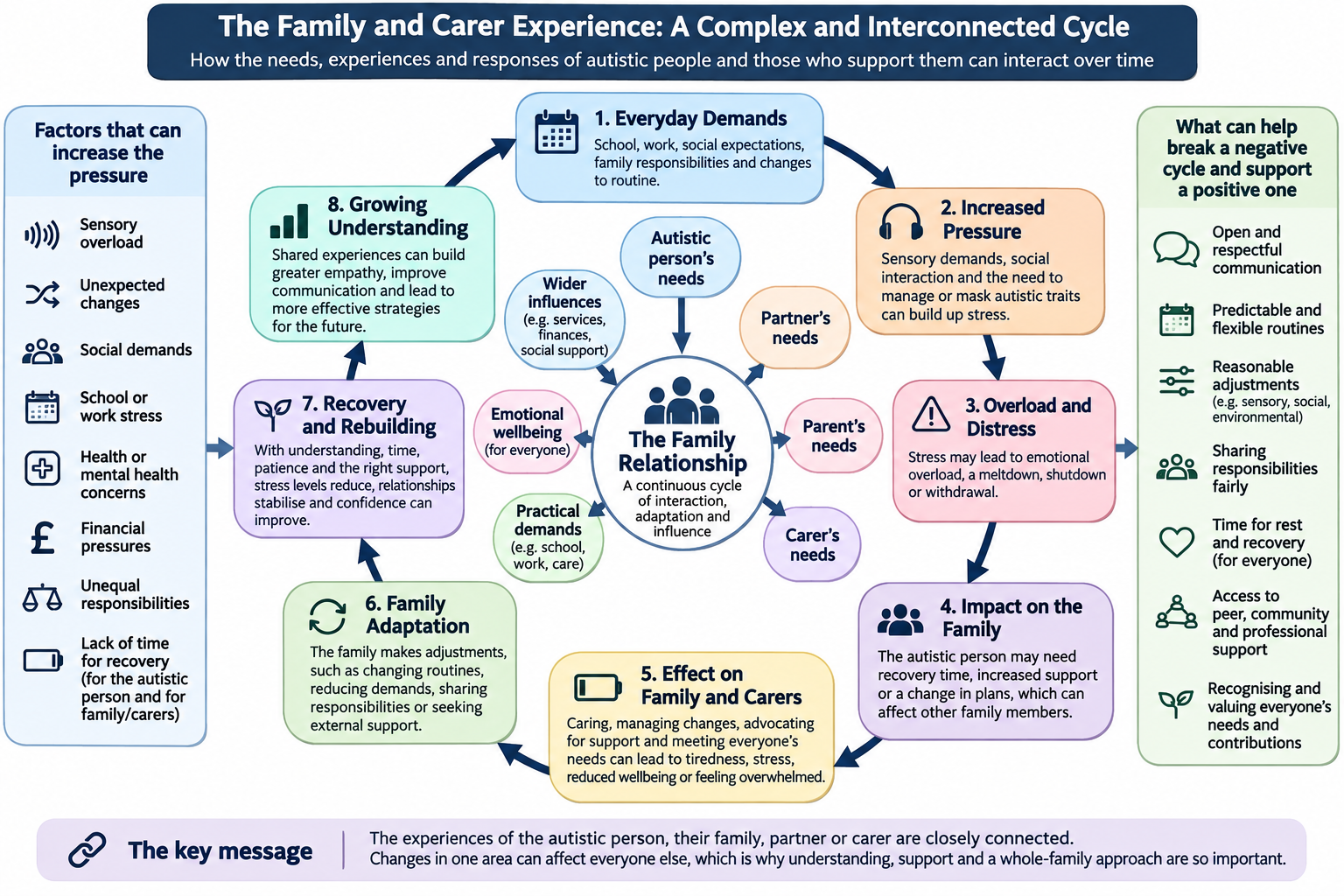
9. When Relationships Become Difficult
Some relationships experience prolonged difficulties despite the efforts of those involved.
Communication may deteriorate, responsibilities may become increasingly unequal, or individuals may feel that their emotional needs are consistently overlooked.
Where these problems remain unresolved, frustration can develop into resentment, withdrawal or repeated conflict.
It is important not to assume that autism is the underlying cause of every relationship difficulty.
Financial pressures, incompatible expectations, mental health difficulties, past experiences, unequal responsibilities and inadequate external support may all contribute.
Recognising Unhealthy Patterns
Certain patterns require particular attention.
These include persistent criticism, controlling behaviour, intimidation, threats, humiliation, coercion or the deliberate dismissal of another person’s needs.
Autism does not justify abusive behaviour, and autistic people can also experience abuse or exploitation.
Everyone has the right to personal safety, dignity and respectful treatment.
Seeking Professional Assistance
Relationship counselling or family therapy may be helpful where difficulties persist and everyone involved is willing to participate.
It is important to seek professionals who understand autism and are prepared to adapt their communication and therapeutic approaches appropriately.
Counselling should not be based upon the assumption that the autistic person must simply learn to behave like a non-autistic individual.
Instead, support should consider the needs, experiences and responsibilities of everyone involved.
Where abuse or coercive control is present, individual specialist support and safety planning may be more appropriate than joint counselling.
10. Practical Strategies for Everyday Life
Although every family is different, relatively straightforward adjustments can sometimes reduce stress and improve relationships.
Establishing Predictable Routines
Predictable routines can reduce uncertainty and help some autistic people prepare for everyday activities.
Shared calendars, written schedules and advance notice of changes may be useful.
However, routines should remain sufficiently flexible to accommodate the reasonable needs of other family members.
Allowing Recovery Time
After demanding social, educational or professional activities, an autistic individual may require time to recover.
This might involve sitting quietly, engaging in a preferred activity, avoiding conversation or resting.
Recognising this need can prevent family members from misinterpreting withdrawal as rejection.
Managing Sensory Environments
Small environmental changes may make a substantial difference.
Examples include softer lighting, reducing background noise, avoiding strong fragrances or providing a quiet room.
Family members should discuss these adjustments together, as one person’s preferred environment may not be comfortable for another.
Planning Difficult Conversations
Important discussions are often more productive when everyone is calm and has sufficient time to consider the issues involved.
Written notes or agreed discussion topics may help individuals who find spontaneous emotional conversations difficult.
Sharing Household Responsibilities
Clear agreements about domestic tasks, childcare and financial responsibilities can reduce uncertainty and resentment.
Responsibilities should be realistic and reviewed when circumstances change.
Maintaining Individual Interests
Healthy relationships benefit when individuals retain opportunities for friendships, hobbies and personal development.
Partners and family members should not feel obliged to participate in every activity together.
Recognising When Additional Support Is Needed
If difficulties persist despite reasonable adjustments, families should consider seeking professional advice or community support.
Early assistance may prevent manageable problems from becoming more serious.
Ultimately, successful support should not be measured by how closely an autistic person conforms to conventional expectations.
It should be measured by whether individuals feel respected, understood, safe and able to participate in family life without unnecessary distress.
11. Advocacy — Helping Autistic People Have Their Voices Heard
Advocacy plays an important role in ensuring that autistic people are listened to, understand their rights and can participate in decisions affecting their lives. Some individuals may find it difficult to communicate their needs or challenge decisions made by healthcare professionals, educational establishments, employers or public authorities. An independent advocate can provide assistance by helping them express their wishes, understand available options and ensure their views are properly considered.
Advocacy can also benefit families, partners and carers who experience difficulties obtaining appropriate services or support. However, the wishes and independence of the autistic individual should always remain central to any decisions being made.
There are various forms of advocacy, including self-advocacy, independent advocacy, family advocacy and collective advocacy. These will be explored in greater detail in a separate article on this website.
Information about advocacy organisations and other sources of assistance can be found in the following section.
12. Where to Find Support
Living with or supporting an autistic family member can bring considerable rewards, but it may also involve emotional, psychological and practical challenges. Parents, spouses, partners, siblings and carers can experience stress, anxiety, exhaustion or isolation, particularly when they feel that their own needs are not fully understood or acknowledged.
Although many organisations provide valuable assistance directly to autistic individuals, there is an equally important need for services that support the people closest to them. Families and partners may require guidance on communication, managing disagreements, understanding sensory differences, coping with emotional overload and maintaining healthy relationships.
Partners may also benefit from opportunities to discuss their experiences confidentially with professionals or others in similar circumstances. This is particularly important when the effects of masking, autistic burnout or emotional exhaustion influence everyday family life.
Throughout the United Kingdom, numerous charities, independent organisations and small volunteer-led groups provide support for families and carers. Some offer counselling, information and practical assistance, while others organise informal meetings, online discussions and peer support networks.
These services can help family members recognise that their own wellbeing matters and that seeking support does not represent a failure in their relationship with an autistic person.
12.1. Support for Families, Partners and Carers
Family members may require assistance for several reasons. Parents might be struggling to obtain appropriate educational support for their child. A spouse may be experiencing difficulties communicating with their autistic partner. An unpaid carer may feel overwhelmed by practical responsibilities or uncertain about what financial assistance is available.
It is important to recognise that these situations are not identical. Consequently, the type of support required will depend upon the individual’s circumstances.
Some organisations provide specialist information about autism, while others concentrate on carers’ rights, emotional wellbeing, family relationships or practical assistance.
The following organisations offer useful starting points across the four nations of the United Kingdom.
Scotland
Carers Scotland is part of Carers UK and provides information, advice and support for unpaid carers throughout Scotland.
It offers guidance on carers’ rights, financial matters, employment and access to services. It also raises awareness of the difficulties experienced by people providing unpaid care to relatives, partners or friends.
For someone supporting an autistic family member, Carers Scotland may be a useful source of information about available assistance and the recognition of caring responsibilities.
Shared Care Scotland promotes access to short breaks for unpaid carers and the people they support.
Short breaks can provide opportunities for carers to rest, pursue personal interests and maintain their own physical and emotional wellbeing.
The organisation also provides information about short-break opportunities and relevant support services.
Care Information Scotland provides information about care and support services, including advice relevant to unpaid carers.
It can help individuals understand the support available through local services and how to seek further assistance.
Local Carers’ Centres
Throughout Scotland, local carers’ centres provide information, practical advice, emotional support and opportunities to meet other carers.
Some organise peer support meetings, wellbeing activities and training sessions. Others provide assistance with carers’ assessments, financial information and accessing local services.
A local carers’ centre may be particularly useful for families seeking ongoing support within their own community.
England
Carers UK provides information, advice and support to people who care for relatives, partners or friends.
Its resources cover carers’ rights, financial support, employment, wellbeing and the practical difficulties associated with caring responsibilities.
The organisation also provides opportunities for carers to connect with others who understand their experiences.
Contact — For Families with Disabled Children
Contact is a national charity supporting families with disabled children, including autistic children.
It provides advice about education, benefits, health services, family finances and other matters affecting parents and carers.
Contact also helps families connect with others experiencing similar circumstances.
Carers Trust works with a network of local carer organisations providing practical and emotional support.
Depending upon the local service, assistance may include information, peer support, wellbeing activities and opportunities for short breaks.
Its network can be particularly helpful for identifying support within a family’s own area.
Wales
Carers Wales provides information and support for unpaid carers throughout Wales.
Its resources cover carers’ rights, financial assistance, employment, health and wellbeing, and access to services.
The organisation also campaigns for greater recognition of the contribution made by unpaid carers.
Credu supports unpaid carers, including young carers and adult carers, in parts of Wales.
Its work focuses on recognising caring responsibilities, providing opportunities for support and helping individuals maintain their wellbeing.
Availability of particular activities and services depends upon the area concerned.
Carers Trust works with local organisations supporting unpaid carers, including services in Wales.
Its network can help individuals identify organisations offering practical assistance, information and opportunities to meet other carers.
Northern Ireland
Carers NI is part of Carers UK and provides information, guidance and support for unpaid carers throughout Northern Ireland.
Its resources include advice about financial assistance, carers’ rights, employment and maintaining personal wellbeing.
Autism NI provides information, advice and support for autistic individuals and their families.
Its family support activities and local group network can help parents and carers share experiences, obtain information and develop connections with others.
Family Support NI provides an online directory of services available to children, young people and families throughout Northern Ireland.
It can help parents and carers locate community organisations, family support services and specialist assistance in their local area.
12.2. Support Specifically for Spouses and Partners
The needs of spouses and long-term partners deserve particular attention.
Much of the support available to families affected by autism concentrates on parents of autistic children or people undertaking substantial caring responsibilities.
However, being married to or in a relationship with an autistic person does not necessarily mean that the other partner is a carer.
Many autistic adults are independent, employed and fully capable of managing their own lives. Nevertheless, differences in communication, emotional expression, sensory experiences and social expectations may create difficulties within intimate relationships.
For example, a non-autistic partner may feel lonely because their autistic spouse requires considerable time alone following demanding social activities.
Conversely, the autistic partner may feel misunderstood because their need for recovery time is interpreted as emotional rejection.
Neither individual necessarily intends to cause distress.
In such circumstances, conventional carers’ services may not be appropriate. The couple may instead benefit from relationship counselling, communication guidance or support from professionals who understand neurodivergent relationships.
Relate provides relationship counselling and information for individuals, couples and families in England and Wales, with service availability varying by location.
Couples considering counselling should ask whether the practitioner has experience working with autistic and neurodivergent individuals.
Relationships Scotland provides relationship counselling and family support services through its local network.
These services may help couples explore communication difficulties, emotional expectations, disagreements and other concerns affecting their relationships.
It is advisable to enquire whether an individual counsellor has relevant autism experience.
British Association for Counselling and Psychotherapy (BACP)
BACP provides a therapist directory that can help individuals identify counsellors offering relationship or family counselling.
When searching, it may be useful to look for professionals who describe experience working with autistic adults, neurodivergent couples or mixed-neurotype relationships.
Counselling Directory allows individuals to search for counselling professionals by location and area of experience.
It may be useful for identifying practitioners who offer autism-informed counselling, relationship support or online appointments.
Choosing Appropriate Relationship Support
Not every relationship counsellor has specialist knowledge of autism.
Before arranging an appointment, individuals may wish to ask whether the counsellor understands autistic communication differences, masking, sensory overload and the effects of emotional exhaustion.
It is equally important that the counsellor does not automatically attribute every relationship difficulty to autism.
Effective counselling should recognise the experiences, needs and responsibilities of both partners.
Where one partner is experiencing intimidation, abuse or coercive control, specialist individual assistance may be more appropriate than couples counselling.
12.3. Support for Autistic People
Supporting autistic individuals remains an essential part of maintaining healthy family relationships.
Autistic adults and young people may benefit from opportunities to meet others who share similar experiences, discuss everyday difficulties, obtain practical advice or participate in activities without feeling pressured to conceal their autistic characteristics.
Throughout the United Kingdom, there are many small, independent, self-supporting and volunteer-led groups providing assistance to autistic people.
Some have been established by autistic adults seeking friendship, understanding and mutual support. Others have developed through parents, partners or carers coming together to share experiences and provide community assistance.
These organisations frequently operate with limited financial resources and depend upon volunteers, charitable donations, community fundraising or small grants.
Despite their modest size, they can make an important contribution by reducing isolation, encouraging independence and providing opportunities for social interaction.
The following examples illustrate the variety of support available across the four nations.
Scotland
Autistic Mutual Aid Society Edinburgh (AMASE)
AMASE is an autistic-led organisation based in Edinburgh. It provides opportunities for autistic adults to connect through community events, peer support, advocacy and education.
The organisation promotes mutual assistance and encourages autistic people to participate in improving their own lives and those of others.
Scottish Women’s Autism Network (SWAN)
SWAN provides autistic-led peer support for autistic women and non-binary people in Scotland.
Its activities include local social gatherings and online discussion opportunities.
Many of its meet-ups are facilitated by autistic volunteers and provide environments in which individuals can share experiences, listen to others or simply enjoy being part of an understanding community.
Autism Rights Group Highland (ARGH)
ARGH is a group run by and for autistic adults in the Highlands.
It promotes autistic people’s rights, challenges discrimination and advocates for improved understanding and services.
The organisation demonstrates how smaller, autistic-led groups can contribute to individual wellbeing and wider social change.
Number 6 One Stop Shop — Edinburgh, Lothians and Scottish Borders
Number 6 One Stop Shop is a specialist support service operated by the charity Autism Initiatives.
Based at 24 Hill Street in Edinburgh, it provides free advice, practical assistance and social opportunities for eligible autistic people aged 16 and over who have a formal autism diagnosis, do not have a learning disability and live in Edinburgh, the Lothians or Scottish Borders.
The service offers individual appointments covering employment, education, housing, benefits, mental health and relationships.
It also organises social and interest groups, providing opportunities for autistic people to meet others, develop friendships and reduce social isolation.
Email: number6@aiscotland.org.uk
England
Bristol Autism Support is an independent charity providing peer support, information and practical guidance for parents and carers of autistic children.
Originally established through informal meetings between parents, it has developed into a community organisation offering support groups, information sessions, social opportunities and guidance about other services.
Leeds Autism AIM provides information, advocacy and peer support for autistic adults in the Leeds area, particularly those receiving little or no funded support.
Its activities include autistic-led groups, practical advice, employment-related assistance and opportunities to discuss everyday challenges with people who understand autistic experiences.
Newark and Sherwood Autism Support Group
This parent-led group supports families and carers of autistic children and young people, including those without a formal diagnosis.
It provides opportunities to share experiences involving education, sleep, sensory differences and other aspects of family life.
The group also helps families identify relevant local services.
Wales
CANDO — Neurodiverse West Wales
CANDO is a small, volunteer-led peer support organisation serving neurodivergent adults in Carmarthen and Aberystwyth.
Its informal gatherings allow participants to share experiences, develop friendships and feel less isolated.
The organisation also provides information and signposting to other services.
Autism Wellbeing is a Carmarthenshire-based social enterprise offering autism-related resources, psychological support services and online peer support opportunities.
Its activities include support for autistic adults and families.
Some resources and peer support opportunities are free, while certain professional services are chargeable.
National Autistic Society — Welsh Peer Support Groups
Although the National Autistic Society is a large charity, this particular project encourages autistic adults in Wales to establish and run their own local peer support groups.
It provides guidance and training to help volunteers create welcoming social opportunities within their communities.
This demonstrates how a national organisation can support the development of smaller, locally organised groups.
Northern Ireland
Autism Families Community Support Group
This community charity supports families affected by autism and learning disabilities in the Newry, Mourne and Down area and surrounding communities.
Its activities include family clubs, social events, recreational opportunities, sensory activities and an online parent and carer support group.
Such activities provide families with opportunities to meet others, share experiences and participate in community life.
ABC Autism Support Group provides peer support for parents, carers and others affected by autism in the Armagh, Banbridge and Craigavon area.
The group encourages members to share experiences, seek advice and discuss difficulties within an understanding and non-judgemental environment.
Autism NI — Community Support Groups
Autism NI supports a network of local groups across Northern Ireland, many of which depend upon volunteer parents and carers.
These groups provide opportunities for families to exchange practical advice, discuss concerns, develop friendships and access information about local assistance.
Although coordinated by a larger charity, the individual groups retain an important community and volunteer-led character.
12.4. Finding Support in Your Own Area
The organisations listed above represent only a selection of the support available throughout the United Kingdom.
Many smaller groups do not maintain extensive websites and may advertise their activities through community centres, local libraries, social media, voluntary organisations or local authority information services.
Individuals seeking assistance may find it useful to contact their local carers’ centre, council, community organisation or an established autism charity and ask about peer support opportunities nearby.
It is important to establish what type of support a particular organisation provides.
Some groups concentrate on autistic adults, while others are intended for parents, spouses, partners, siblings or unpaid carers.
Some welcome people who are self-identified as autistic or awaiting assessment, while others require a formal diagnosis.
Before attending, it may be helpful to ask about accessibility, sensory environments, online participation and whether individuals are expected to contribute verbally during meetings.
Families and partners should also recognise that peer support and professional assistance serve different purposes.
Peer support can provide friendship, understanding and opportunities to exchange experiences. Professional assistance may be necessary where individuals experience persistent psychological distress, significant relationship difficulties or complex health and social care needs.
Peer support should complement, rather than replace, appropriate professional medical, psychological or social care assistance when this is required.
12.5. The Importance of Community Support
Small, independent groups frequently provide something that formal services cannot always offer: regular contact with people who share similar experiences and understand the everyday realities of autism.
For autistic adults, these groups can provide opportunities to develop friendships without the pressure to mask or conform to unfamiliar social expectations.
For parents and carers, they may offer reassurance, practical advice and the opportunity to discuss difficulties without fear of judgement.
For spouses and partners, support groups and relationship services may provide opportunities to explore their own emotional needs, improve communication and develop a greater understanding of their relationship.
Their value should not be underestimated simply because they operate on a small scale or have limited funding.
In many communities, the commitment of a handful of volunteers can make a substantial difference to the wellbeing of autistic individuals and their families.
Ultimately, supporting the autistic person and supporting their family should not be regarded as competing priorities.
A healthy and sustainable family relationship depends upon recognising and respecting the wellbeing of everyone involved.
Organisations, activities, geographical coverage and eligibility requirements may change. Readers should contact the relevant organisation directly to confirm current services and meeting arrangements.
Conclusion
Supporting autistic people and their families requires more than an awareness of autism’s diagnostic characteristics.
It requires an understanding of how sensory differences, communication preferences, emotional demands, social expectations and everyday responsibilities influence relationships.
Autistic individuals should not be expected to suppress their needs continually in order to meet the expectations of others. Equally, partners, parents, carers and family members should not be expected to disregard their own emotional, physical or practical needs.
Successful relationships depend upon mutual respect, shared responsibility, appropriate adjustments and a willingness to recognise different perspectives.
Many difficulties can be reduced through clearer communication, predictable arrangements, greater understanding of sensory and emotional overload, and access to appropriate support.
However, there is no single approach that will suit every autistic individual or family. Circumstances vary, relationships change and the level of assistance required may alter over time.
The objective should not be to create families in which disagreements never occur, but rather to develop relationships in which difficulties can be discussed safely, differences are respected and everyone has opportunities to maintain their wellbeing and independence.
Autism need not be a barrier to meaningful relationships. With understanding, communication and appropriate support, autistic people and those closest to them can develop relationships based upon respect, trust and mutual appreciation.