The Camera Obscura
History of Photography – Chapter 2
1. Introduction
Long before the invention of photography, people discovered that light could project an image of the outside world onto a flat surface. This discovery led to the camera obscura, an optical device that provided the scientific foundation for the photographic camera.1,2
The term camera obscura comes from Latin, meaning ‘dark chamber’. Although it produced remarkably detailed images, it could not permanently record them. Nevertheless, it became an important instrument for artists, scientists and astronomers investigating light.1,2
2. How the camera obscura works
When light enters a darkened room or enclosed box through a small opening, an inverted image of the outside world is projected onto the opposite surface.2
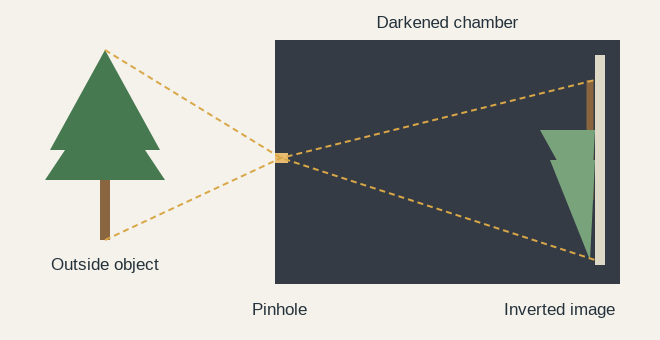
The image appears upside down because light travels in straight lines. Light reflected from the upper part of an object passes through the opening and reaches the lower part of the projection surface, whilst light from the lower part reaches the upper surface.
Early camera obscuras used a simple pinhole, but later versions incorporated glass lenses to produce brighter and sharper images. Mirrors were also introduced to make the projected image easier to view and trace.2
3. Early discoveries
The principles behind the camera obscura were understood centuries before photography was invented. The Chinese philosopher Mozi, who lived during the fifth century BC, is associated with early observations of inverted images formed through small openings.1
The Arab mathematician and scientist Ibn al-Haytham (c.965–1040), sometimes known as Alhazen, investigated light, vision and optical projection, helping establish principles of modern optics. During the Renaissance, Leonardo da Vinci (1452–1519) described the operation of the camera obscura in his notebooks, recognising similarities between its workings and those of the human eye.1
4. The development of the camera obscura
During the 16th and 17th centuries, improvements in glass lenses transformed the camera obscura into a more practical instrument. The Italian scholar Giambattista della Porta helped popularise its use. In the following century, Johannes Kepler used optical projection in scientific investigations.1,2
Initially, these devices occupied entire rooms. Smaller, portable versions eventually enabled artists and scientists to work outdoors without a permanently darkened room.2
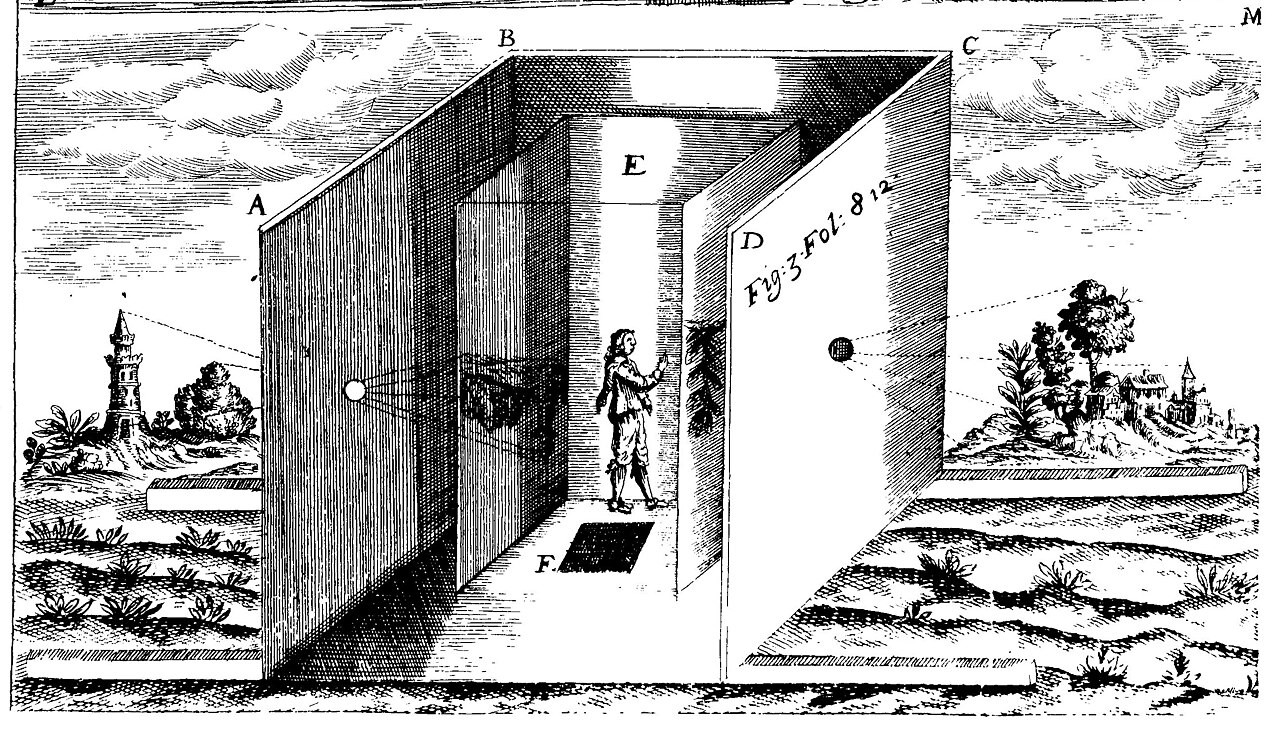
Public Domain – Athanasius Kircher’s portable camera obscura (1646)
5. The camera obscura and art
Before photography, artists relied on observational and drawing skills to reproduce landscapes, buildings and people accurately. The camera obscura enabled artists to trace projected images onto paper or canvas, helping them reproduce architectural features, landscape scenery, perspective and proportions, light and shadows, and fine details and textures.
The Italian artist Canaletto (1697–1768) is associated with optical drawing aids. It has also been suggested that Johannes Vermeer (1632–1675) used a camera obscura, although this has never been conclusively proven. Considerable artistic skill was still required to produce the finished painting.2
6. Different types of camera obscura
By the 18th and early 19th centuries, several designs had developed.
6.1 Room-sized camera obscura
A permanent darkened room in which an image of the surrounding landscape was projected onto a wall or viewing surface.
6.2 Tent camera obscura
A portable structure allowing artists to work outdoors whilst remaining in a darkened environment.
6.3 Portable box camera obscura
A smaller instrument incorporating a lens and, in some designs, a mirror and viewing surface onto which an image could be projected and traced.
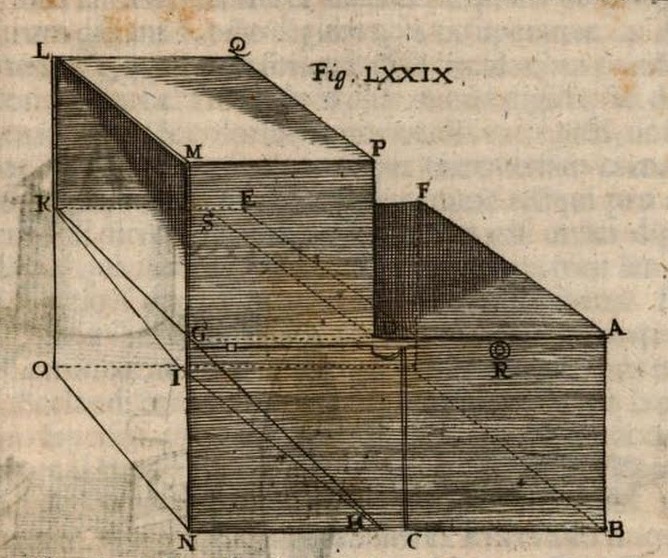
Public Domain – Johann Sturm’s portable camera obscura (1676)
The portable box camera obscura was particularly significant because its design closely resembled that of the earliest photographic cameras.2
7. Scotland – Edinburgh’s Camera Obscura
One of Scotland’s finest surviving examples of this technology can be found on Castlehill, near Edinburgh Castle. In 1835, Maria Theresa Short established a public observatory on Calton Hill. In 1853, she relocated her attraction to Castlehill, where it became known as Short’s Observatory.3,4
Following Maria Short’s death, the building was acquired by Scottish sociologist, biologist and town planner Sir Patrick Geddes (1854–1932), who renamed it the Outlook Tower. Geddes recognised its educational potential and used it to encourage people to explore and understand their surroundings.3
Today, visitors can still observe live moving images of Edinburgh projected onto a circular viewing table. A rotating mirror allows different areas of the city to be viewed without electronic cameras.5
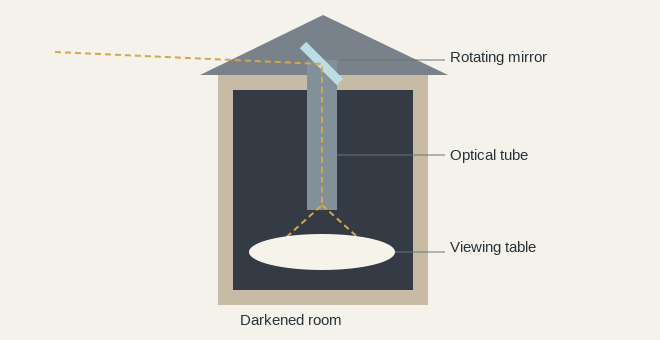
Edinburgh’s Camera Obscura provides an important link between Scotland’s scientific heritage and the optical technology that eventually led to modern photography.
8. The limitations of the camera obscura
Despite its ability to produce detailed images, it could not permanently capture them.
| Advantages | Limitations |
|---|---|
| Produced realistic images | Could not permanently record images |
| Assisted artists with perspective | Required sufficient external light |
| Reproduced fine details | Required manual tracing to preserve images |
| Displayed moving images | Images disappeared when light was removed |
| Required no electricity | Early versions were bulky |
Scientists began investigating whether a chemical substance could permanently record the projected image without an artist. This would become the next major development in the history of photography.
9. From the camera obscura to the smartphone
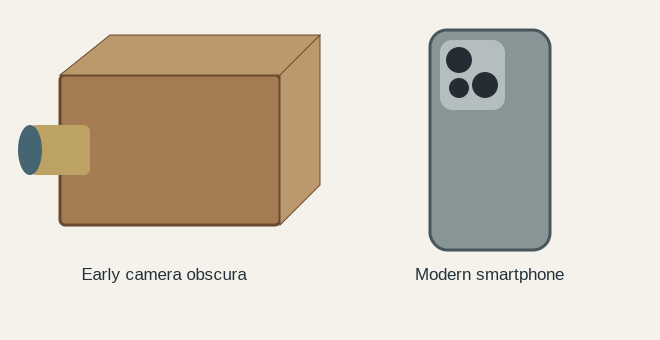
Although separated by centuries of technological development, both allow light to enter through an opening and use optical technology to produce an image. Instead of projecting an image onto a viewing surface for an artist to trace, a smartphone uses an electronic image sensor to capture and store the image digitally.
Every time we take a smartphone photograph, we use scientific principles first recognised more than two thousand years ago.
10. Conclusion
The camera obscura represents one of the most important developments in the history of photography. It provided a means of reproducing the world with remarkable visual accuracy, long before a photographic image could be permanently recorded. Its development brought together science, mathematics, optics and art, providing foundations upon which early photographic pioneers would build.
The challenge now facing scientists was how to make these temporary images permanent.
11. References and further reading
- History of Science Museum, University of Oxford – Camera Obscura
- National Science and Media Museum – Introduction to the Camera Obscura
- Camera Obscura Edinburgh – Our History
- Camera Obscura Edinburgh – Maria Theresa Short
- Camera Obscura Edinburgh – What Is a Camera Obscura?
12. Image sources and copyright
Figures 1, 4 and 5: original educational diagrams created for this publication. Figures 2 and 3, the historical illustrations reproduced above, are identified as free of known copyright restrictions under the Public Domain Mark 1.0.